The relationship between ceremonial magic and Christianity is complicated, particularly when you’ve spent years exploring both from the inside.
Something rather unexpected has happened lately.
I’m losing interest in ceremonial magic.
I realised just how true this was when I opened Facebook after a mostly sleepless night and the first thing in my feed was a meme:
Nobody:
Ceremonial Magicians: I’m going to make this way harder than it needs to be.
I laughed.
Because after spending more time praying the Rosary lately, that is increasingly how ceremonial magic feels to me.
Not worthless and certainly not something I regret studying.
Just… incredibly complicated.
The irony is that ceremonial magic is partly responsible for bringing me back to the much simpler faith I’m rediscovering now.
And today, on the Feast of Our Lady of Sorrows, that feels especially significant.
I Needed a Practice
For a long time, my spirituality was rich in ideas.
Decades of study have taken me through Tarot, astrology, magic, mysticism, witchcraft, Qabalah and various esoteric traditions. Devotional practices have come and gone along the way.
Something changed when I began taking ceremonial magic seriously, though.
It made me realise that I needed a practice.
There is an enormous difference between having spiritual beliefs and having a disciplined daily spiritual practice.
A practice asks something of you. You get up and do it whether or not you feel particularly spiritual that morning. Words and gestures are repeated. Attention is trained. The whole person is deliberately oriented towards something beyond the ordinary concerns of the day.
Eventually, the practice begins to shape the practitioner.
Ceremonial magic taught me that.
My exploration of Iamblichus and theurgy had already begun shifting my attention away from magical results and towards the question of what spiritual practice is ultimately meant to accomplish.
Exploring theurgy made me realise that reading another book about spirituality wasn’t necessarily going to take me where I wanted to go.
At some point, you have to stop reading about the path and actually walk it.
But that discovery led to another question.
Practice in Service of What?
Once the need for practice became clear, another question followed naturally.
What was that practice actually for?
That changed everything.
When I drilled down into what spiritual practice meant for me, it only made sense within a Christian context.
Spiritual power for its own sake doesn’t particularly interest me. Neither does accumulating increasingly sophisticated magical techniques.
What I wanted was transformation.
Sanctification.
An intimate relationship with God.
I wanted whatever gifts and abilities I possess to become useful in relieving suffering and serving something infinitely greater than myself.
Once I admitted that, Christianity stopped looking like merely the religion I’d left behind.
It started looking like home.
And home, as it turns out, already had practices.
Then I Started Praying the Rosary
This is where I could hear the family of Saints giggling.
After studying elaborate systems of ceremonial ritual, there I was with a string of beads, saying prayers Christians have been repeating for centuries.
And something clicked.
Much of what I’d discovered I needed from ritual was already there.
Repetition. Sacred speech. Physical gesture. Contemplative imagery. Scripture. Rhythm. Discipline. Intention. Intercession.
There is a clear beginning and ending. The mysteries give the imagination somewhere to go, allowing us to enter sacred events contemplatively rather than merely thinking about them.
Yet one difference matters to me more than all the others.
There is relationship.
Rather than manipulating an elaborate symbolic architecture in the hope of achieving a particular spiritual state, I’m praying.
More specifically, I’m contemplating the life of Christ in the company of his Mother.
That has changed something in me.
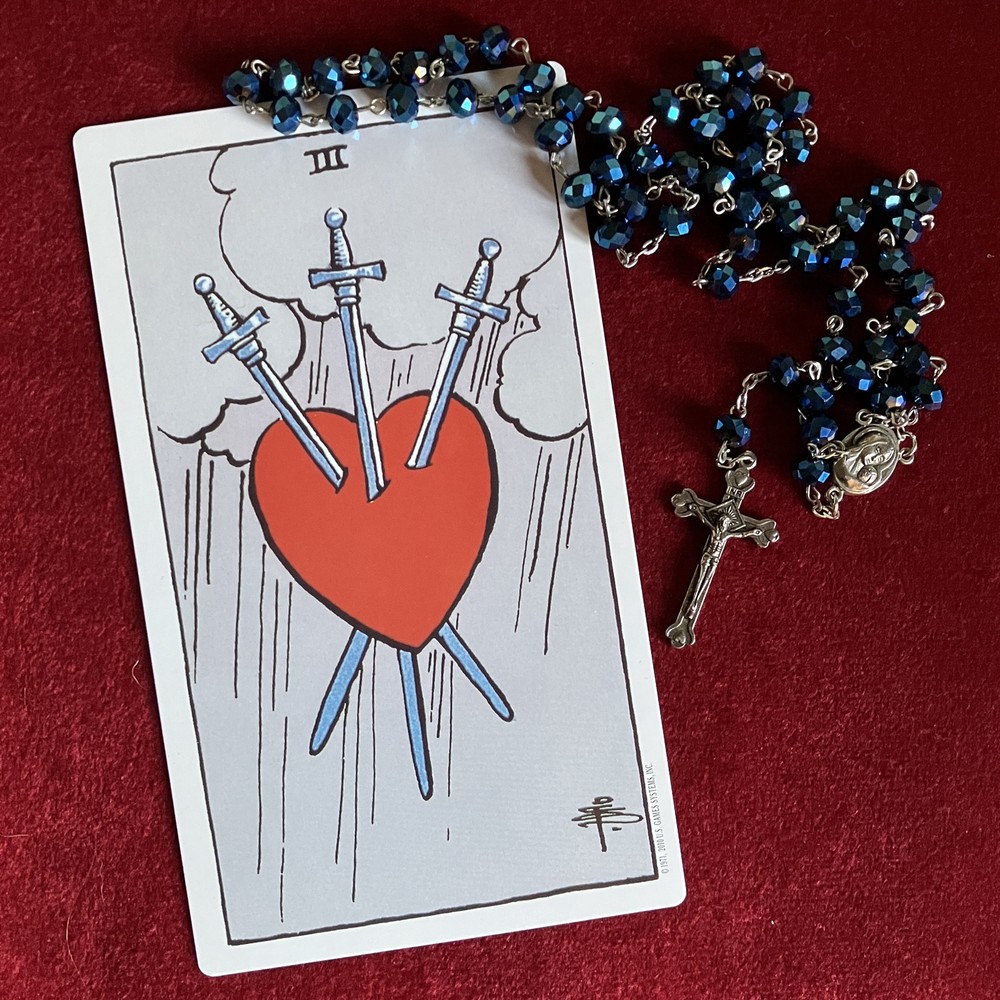
Our Lady of Sorrows and the Wounded Heart
Today is 15 September, the Feast of Our Lady of Sorrows.
I’ve also recently begun praying the Chaplet of the Seven Sorrows, and perhaps that is part of why all of this is coming into focus now.
Our Lady of Sorrows presents a very different model of spiritual power.
Mary doesn’t conquer suffering.
She remains.
Simeon’s prophecy tells her that a sword will pierce her own soul. She flees with her child into Egypt, loses him in Jerusalem, encounters him carrying the Cross and ultimately stands at Calvary watching her Son die.
Then she holds his body.
There is nothing passive about this kind of presence.
Anyone who has accompanied someone through suffering knows how much courage it can require simply to remain when there is nothing left to fix.
And perhaps this is where my understanding of spiritual practice has changed most radically.
The question is becoming less about what spiritual power I can acquire and more about becoming someone who doesn’t look away from suffering.
How can the spiritual tools I’ve spent my life studying help rather than merely fascinate?
How can my work alleviate suffering, restore hope, offer companionship or help another person recognise the presence of Divine grace in the middle of a difficult life?
Our Lady of Sorrows gives me an answer that requires surprisingly little equipment.
Stay.
Love.
Pray.
Simplicity on the Other Side of Complexity
I don’t think I could have arrived here by simply telling myself years ago that I ought to pray the Rosary.
Perhaps I needed the complexity first.
Ceremonial magic taught me through experience why ritual matters. Sacred space, intentionality, symbolism, disciplined attention and repetition stopped being abstract concepts. Most importantly, I learned the difference between occasionally doing something spiritual and maintaining a practice.
Having learned all of that, I’ve discovered something rather wonderful.
I might not need most of the machinery.
Give me the Rosary, Scripture, and a candle to light for somebody who is suffering.
Give me Tarot when I need to become quiet enough to listen.
That may actually be enough.
There is something wonderfully reassuring about a spiritual practice that doesn’t constantly require upgrading. Nobody is about to release Rosary 2.0 with seventeen additional correspondences and an advanced grade system.
Tomorrow, the task will simply be to pray again.
Then do it the following day.
The practice remains simple while, God willing, the person practising it changes.
What Happens to Magic?
None of this means everything I’ve spent years studying now belongs in the bin.
Far from it.
Mysticism, esotericism and the Western Mystery Tradition still fascinate me. Tarot certainly isn’t going anywhere. Neither is my interest in the philosophical questions underneath magic.
What has changed is my understanding of what I want these things to accomplish.
Recently, I arrived at two very simple definitions:
The purpose of theurgy is sanctification.
The purpose of magic is to dispense Divine grace into the world.
Those definitions have consequences.
If lighting a candle for someone, praying a Psalm and offering the Rosary for their intention accomplishes what I’m actually trying to do, another layer of ceremonial complexity needs a reason for being there.
Sometimes there may be one.
Sometimes there may not.
Increasingly, I’m comfortable with that.
Ceremonial Magic Did Its Job
This is why I don’t want to tell this story as I tried ceremonial magic and eventually realised Christianity was better.
That isn’t what happened.
In fact, I’ve written before about how studying the Western Mystery Tradition unexpectedly brought me back towards Christ. What I hadn’t yet realised was where that homecoming would lead next.
Ceremonial magic confronted me with a question:
What would happen if I stopped treating spirituality primarily as something to study and made it something I practised every day?
Following that question brought me somewhere I wasn’t expecting.
Back to Christ and Mama.
Back to prayer.
And, strangely enough, back to practices much older and simpler than those that prompted the journey.
There is a tendency when our spiritual direction changes to reinterpret the previous stage as a mistake. We want a clean conversion narrative with an obvious Before and After.
I’m increasingly suspicious of those narratives.
Sometimes a path does exactly what it needed to do before you leave it.
Perhaps ceremonial magic was never going to be my spiritual home.
But it taught me that I needed one.
Today, Our Lady of Sorrows adds something else to that lesson. Spiritual practice isn’t primarily about how much esoteric knowledge I can accumulate or how elaborate a ritual I can perform.
At the foot of the Cross, all of that suddenly looks rather small.
Mary simply stands there.
She loves and suffers with.
She remains faithful.
Perhaps that’s why the Rosary is making so much sense to me now. Its simplicity isn’t an absence of depth. The depth comes from returning to the same mysteries until they begin changing the person who returns to them.
Ceremonial magic taught me to practise.
The Rosary is teaching me why.
And sometimes the long way round really does bring us home.