Tag: Tarot

  • What I’d Do Differently If I Started Learning Tarot Today

    What I’d Do Differently If I Started Learning Tarot Today

    I started learning Tarot long before I had properly deconstructed my religious beliefs. More precisely, I started more in-depth Tarot studies not long after I left organised religion.

    Looking back, I think that matters far more than I realised at the time.

    I had begun questioning organised Christianity and eventually left the Church around my first Saturn return. But leaving a religious institution isn’t the same thing as dismantling everything it taught you about God, yourself and the nature of reality.

    Some of those beliefs remained buried remarkably deep.

    Change to:

    So when I began studying Tarot, occultism and alternative spirituality in earnest, I wasn’t starting with a blank slate. I was trying to build a new spiritual worldview while parts of the old one were still running quietly in the background.

    If I started learning Tarot today, there are many things I’d do differently.

    The biggest?

    I’d give myself a tradition to learn from before trying to reinvent the wheel.

    I Wouldn’t Start by Trying to Invent My Own Spirituality

    After leaving organised religion, the freedom of the New Age was enormously appealing.

    There were no creeds to sign. No threat of hell for asking the wrong questions. No authority insisting that it possessed the only acceptable version of Truth.

    After my experiences with Evangelical Christianity, that freedom was something I needed.

    The problem was that I went from one extreme to the other.

    Instead of having a rigid framework in which everything had already been decided for me, I suddenly had virtually no framework at all.

    Tarot. Astrology. Angels. Energy healing. Eastern philosophy. Paganism. Mysticism. Channelling. Crystals. Psychology. Manifestation. Whatever resonated could be added to the spiritual soup.

    Some of it was useful. Some of it wasn’t.

    More importantly, there wasn’t always a reliable way of telling the difference.

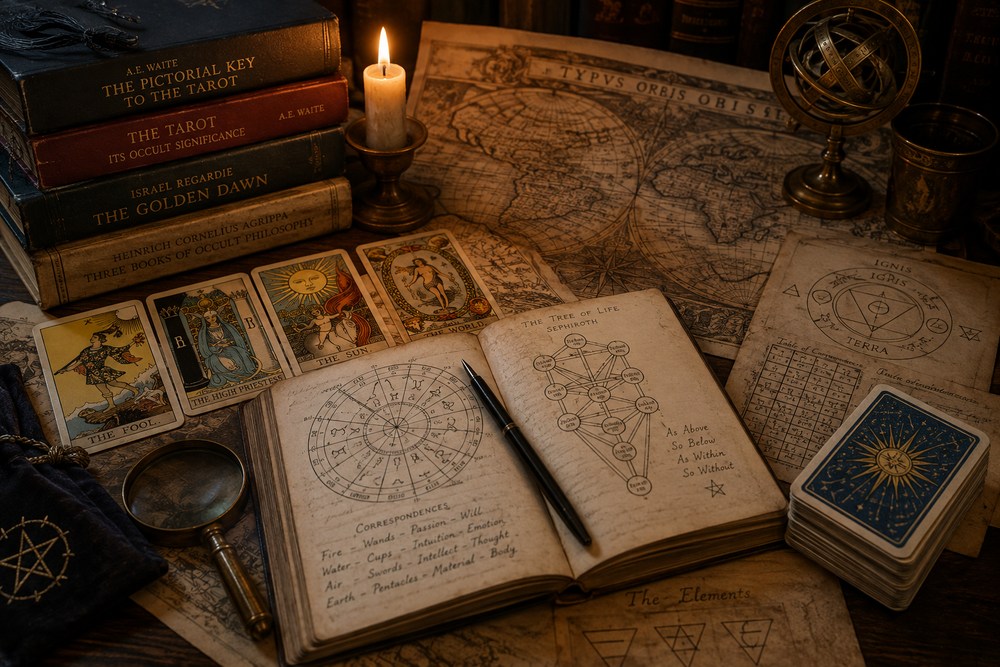
    I spent years trying to assemble my own spiritual cosmology from disconnected pieces. In retrospect, I was trying to reinvent a wheel that people such as A. E. Waite, Israel Regardie and generations of Western esotericists had already spent considerable time constructing.

    I simply didn’t realise that the wheel was available to me.

    I Wish I’d Discovered the Western Mystery Tradition Earlier

    By the Western Mystery Tradition, I mean the broad stream of Western esotericism incorporating subjects such as Hermeticism, Neoplatonism, Kabbalah, astrology, alchemy, ceremonial magic and Christian mysticism.

    These traditions don’t all teach precisely the same thing, nor should they be collapsed into one homogeneous system.

    What they provide is context.

    That is what I was missing.

    If you’re learning the Rider-Waite-Smith Tarot, for instance, you’re not dealing with 78 pictures that appeared spontaneously in 1909 and are simply waiting for your intuition to decide what they mean.

    The deck emerged from a particular esoteric environment.

    A. E. Waite and Pamela Colman Smith were both members of the Hermetic Order of the Golden Dawn. Behind the deck lies a vast network of Western symbolism involving astrology, Kabbalah, elemental correspondences, Christian mysticism and ceremonial magic.

    You don’t have to believe everything taught within those traditions.

    You don’t even have to practise magic.

    But knowing the symbolic language changes how you read the cards.

    I Would Learn Tarot’s Grammar Before Trying to Write Poetry

    This is probably the advice I most wish somebody had given me.

    Learn the grammar before trying to write poetry.

    Intuition matters enormously in Tarot. I certainly wouldn’t want to remove it from Tarot reading.

    But intuition becomes much more useful when it has something substantial to work with.

    If you understand why a particular symbol appears on a card, what its planetary correspondence means, how its element behaves, where it sits numerically within its suit and how earlier Tarot traditions treated that card, your intuition isn’t restricted.

    It has more material available to it.

    The difference is rather like learning a language.

    Eventually, you stop consciously thinking about grammar every time you speak. You simply speak.

    But that fluency didn’t arise because grammar was unnecessary. It arose because the underlying structure became internalised.

    It’s not that I didn’t study the grammar at all. I studied it in parts rather than as a whole. For instance, I quickly memorised numerological meanings and astrological correspondences, but without understanding the larger framework they belonged to.

    Tradition gives intuition something to push against, converse with and occasionally disagree with.

    I Would Study Tarot History Much Earlier

    I’d also go further back than the Golden Dawn.

    If I were beginning again today, I’d want to understand historical Tarot and the Tarot de Marseille before assuming that the Rider-Waite-Smith system simply represented what Tarot had always been.

    When you understand what came before Waite and Smith, you can begin to see what they inherited, what they altered and what those alterations reveal about the esoteric ideas behind their deck.

    You also become less likely to treat modern Tarot conventions as ancient wisdom simply because they’ve been repeated often enough.

    This is one area where access to scholarship has improved enormously since I started learning Tarot.

    I’d make use of it.

    I Was Learning an Esoteric Christian Tarot While Running Away From Christianity

    This is perhaps the greatest irony of my Tarot journey.

    I spent years trying to understand a deck created under the direction of an esoteric Christian mystic while assuming that Christianity and the occult were mutually exclusive.

    I had good reasons for making that assumption.

    The Christianity I had encountered as a teenager taught me that occult practices were dangerous and that human beings were fundamentally sinful creatures in desperate need of salvation.

    Tarot belonged firmly on the forbidden side of the fence.

    So when I eventually escaped that worldview, I naturally ran in the opposite direction.

    What I didn’t know was that Western Christianity has its own long, complicated and frequently suppressed mystical and esoteric history.

    There were other ways of understanding Christ.

    There were other ways of thinking about Scripture, creation, the soul and our relationship with the Divine.

    Had I known that when I first encountered Tarot, I wonder how different my spiritual journey might have been.

    Ironically, decades later, studying the Western Mystery Tradition helped bring me back to Christ.

    Not through fear of hell.

    Through love of Truth.

    But I Understand Why I Shied Away From the Golden Dawn

    There’s another side to this story.

    It would be easy for me to look backwards and wonder why I didn’t simply throw myself into the Western Mystery Tradition decades ago.

    The truth is that some of the people publicly representing occult traditions didn’t exactly make them look appealing.

    I had already experienced religious authority, spiritual ego and people claiming privileged access to Truth. I wasn’t particularly keen to sign up for another version of the same thing wearing a robe.

    Then there was the Golden Dawn itself.

    Here was an organisation responsible for an extraordinary synthesis of Western esoteric teachings that managed to fracture remarkably quickly amid personality clashes, competing claims to authority and some spectacular occult egos.

    I looked at that and backed away.

    In hindsight, however, I was confusing the tradition with some of its representatives.

    That’s something I would do very differently today.

    A Tradition Is Bigger Than Its Representatives

    One of the most important lessons I’ve learned is this:

    The value of a tradition is not determined by the character of everyone who has represented it.

    I’ve had to learn this lesson more than once.

    People behaving badly in the name of Christianity don’t necessarily tell me anything about Christ.

    Occultists behaving badly don’t necessarily invalidate the systems they studied.

    Human beings have an astonishing ability to bring ego, politics, status-seeking and interpersonal drama into almost anything.

    Spirituality is certainly no exception.

    If I were starting again, I still wouldn’t rush to join an occult order.

    What I’d change is my assumption that studying a tradition means submitting to the people who claim authority within it.

    It doesn’t.

    I can read Agrippa without treating Agrippa as infallible.

    I can learn from Waite without agreeing with Waite about everything.

    There is nothing stopping me from learning Golden Dawn correspondences without recreating the Golden Dawn.

    I can learn from Israel Regardie without turning him into a guru.

    The tradition gives me a body of material to engage with.

    What I do with it remains my responsibility.

    I Needed Freedom Before I Could Tell the Difference Between Structure and Control

    This is why I don’t regret my years exploring the New Age.

    I needed them.

    After experiencing authoritarian religion, I needed to discover that nobody could dictate what I was allowed to think about God.

    I needed to question and experiment.

    I needed to encounter ideas that would previously have frightened me.

    Most of all, I needed freedom.

    What I didn’t yet understand was that structure and control are not the same thing.

    A tradition can provide structure without demanding obedience.

    Historical sources can provide context without becoming Scripture.

    A teacher can point towards something without becoming an authority over my spiritual life.

    The Western Mystery Tradition could have given me a map without telling me where I was required to go.

    I Would Deconstruct Before Trying to Reconstruct

    There’s another thing I’d change if I could.

    I’d pay much more attention to the beliefs I was carrying with me into Tarot.

    Leaving a religion doesn’t automatically remove its theology from your nervous system or imagination.

    I discovered that rather dramatically.

    Years after leaving organised Christianity, unresolved religious trauma contributed to two periods when I returned to Evangelical Christianity out of fear. During the first, in 2020, I became convinced that my occult practices had been wrong and threw my entire collection of esoteric books and decks into a recycling skip.

    Yes.

    I still wince.

    Eventually, I realised that I had tried to reconstruct my spirituality without completely understanding what I was reconstructing it from.

    If I were beginning my Tarot journey today, I’d ask myself difficult questions much earlier.

    What do I actually believe?

    Which beliefs have I examined?

    Which ones am I merely reacting against?

    What am I afraid might happen if Christianity turns out to contain some truth?

    What am I afraid might happen if it doesn’t?

    Am I exploring something because I genuinely believe it, or because it is the opposite of something I was taught?

    Those questions would have saved me a great deal of flailing.

    I Wouldn’t Ask Tarot to Give Me Ultimate Truth

    This one makes me smile because Tarot is extraordinarily good at helping us explore uncertainty.

    And yet we sometimes use it in an attempt to eliminate uncertainty altogether.

    Which religion is true?

    Which spiritual path should I follow?

    Was that synchronicity a sign?

    Which deity is contacting me?

    What does the Universe want me to do?

    Tarot is such a flexible symbolic system that it can easily become incorporated into whatever worldview we’re currently constructing.

    If I started learning Tarot today, I’d be much more cautious about asking the cards to tell me what reality ultimately is. I’d use them to explore questions, notice patterns and examine possibilities, allowing space for Mystery rather than expecting the cards to provide certainty.

    But I wouldn’t expect 78 pieces of cardboard to resolve two thousand years of theological debate before breakfast.

    What I’d Actually Recommend to a Tarot Beginner Today

    If somebody asked me now about learning Tarot, I wouldn’t tell them to suppress their intuition and memorise a mountain of occult correspondences before they’re allowed to touch the cards.

    Where’s the fun in that?

    I’d encourage them to read cards from the beginning.

    But I’d study alongside the practice.

    Learn some Tarot history.

    If you’re using the Rider-Waite-Smith Tarot, learn something about Waite and Pamela Colman Smith.

    Explore the Tarot de Marseille and see what changed when the RWS appeared.

    Learn the basic elemental structure of the suits.

    Learn some astrology.

    Explore the Kabbalistic Tree of Life.

    Read about Hermeticism and the Western esoteric tradition.

    Find out where these ideas came from rather than relying entirely on modern Tarot books repeating interpretations of interpretations of interpretations.

    Then question all of it.

    Keep what proves useful.

    Challenge what doesn’t.

    And allow your personal relationship with Tarot to develop from informed engagement rather than either blind obedience or complete rootlessness.

    How This Is Changing Angelorum

    These realisations aren’t purely retrospective. They’re also changing the direction I’m taking with Angelorum.

    After nearly two decades of writing about Tarot and spirituality online, I’m increasingly interested in going back to the foundations. Rather than treating Tarot as a free-floating divination system onto which almost any spiritual idea can be grafted, I want to explore it more deeply within the Western Mystery Tradition that shaped the deck I have worked with for most of my life.

    That means paying closer attention to Tarot history, Hermeticism, astrology, Kabbalah, Neoplatonism, Renaissance magic, angelology and the esoteric Christian currents that once seemed incompatible with Tarot to me. It also means revisiting some of my older work with better sources and a much clearer understanding of the framework behind the correspondences I learned piecemeal all those years ago.

    I’m not interested in replacing one form of dogma with another. Nor am I abandoning intuition, personal experience or the freedom to question what I’ve inherited. If anything, having firmer roots gives me greater freedom to explore because I finally know what I’m agreeing with, adapting or departing from.

    Roots Without Dogma

    If I could go back and hand my younger self one thing, it wouldn’t be a better Tarot deck. As far as I’m concerned, Pixie Smith achieved perfection, as did whoever originated the Marseille Tarot.

    No. I would hand myself a map.

    For years, I thought the choice was between accepting somebody else’s spiritual truth or inventing my own from scratch.

    I no longer believe those are the only options.

    Tradition can give us roots without requiring unquestioning obedience.

    Scholarship can give us context without killing Mystery.

    Structure can support intuition without controlling it.

    And Tarot can become more interesting, not less, when we understand the centuries of philosophy, religion, magic, art and human questioning that sit behind the cards.

    Perhaps I needed to take the long way around to understand that.

    But if I started learning Tarot today?

    I’d still wander. I’d just take a map.

    purple lisa signature

  • The Alex Reads Tarot Controversy Took Me Back to 2017

    The Alex Reads Tarot Controversy Took Me Back to 2017

    I wasn’t planning to write about the Alex (formerly) Reads Tarot controversy again.

    Like many people, I’d been watching it from a distance. I had no desire to add another opinion to an already overflowing internet.

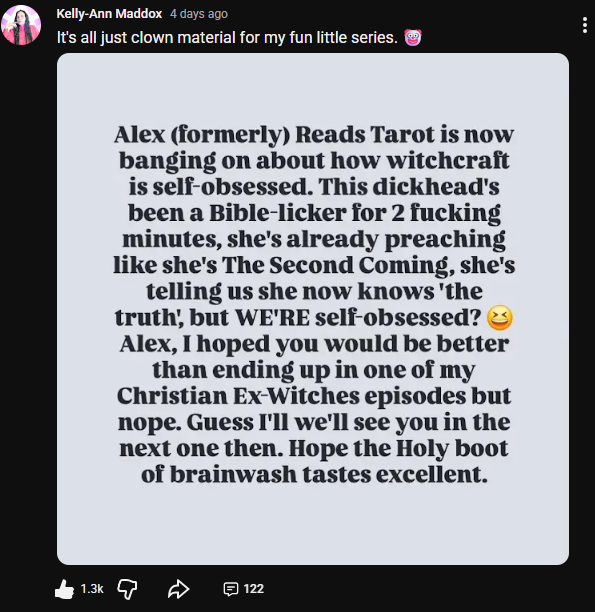
    Then I came across this post by Kelly-Ann Maddox.

    Screenshot of a social media post by Kelly-Ann Maddox discussing Alex (formerly) Reads Tarot's recent conversion to Christianity. The post strongly criticises Alex's comments about witchcraft and uses profane language to express disappointment and anger. The post received around 1,300 likes and more than 120 comments.

    As I read her words, I wasn’t thinking about Alex.

    I was thinking about Doreen Virtue.

    More specifically, I was thinking about the woman I was when Doreen announced her conversion to Evangelical Christianity in 2017.

    The memories came flooding back before I’d even finished reading. I suddenly realised I hadn’t made peace with that chapter of my own life as much as I’d believed.

    When Doreen Virtue first announced her conversion to Evangelical Christianity, I respected her right to change her beliefs. After all, I knew from my own life that spiritual journeys can take unexpected turns. What I struggled with was what came afterwards.

    Renouncing tarot soon became denouncing it. Oracle cards, angels, crystals and many of the spiritual practices she had once taught were no longer presented as simply no longer being for her. They were increasingly described as spiritually dangerous or demonic. As former students questioned her dramatic change of direction, many felt they weren’t just being disagreed with—they were being told they had been deceived, were under demonic influence, or were serving the enemy.

    That changed everything.

    Like many people who had benefited from Doreen’s work, I felt betrayed. Not because she’d become an Evangelical Christian, but because it seemed as though she had rewritten the story of everyone who had walked alongside her.

    I reacted badly.

    I wrote articles criticising Doreen. They became some of the most successful posts I’d ever published. At the time, I thought I was defending my community. Looking back, I can see that I was also feeding an outrage cycle that ultimately did none of us any good—least of all me.

    At the time, those articles felt justified. They were widely shared, they sparked discussion and, if I’m honest, I enjoyed the validation. It felt good to know other people agreed with me. Every comment, every share and every spike in traffic convinced me I was on the right side of the argument.

    But there was another side to that success that I couldn’t see at the time.

    The more I wrote about what Doreen was doing wrong, the less attention I paid to my own spiritual life. My energy became entangled with someone else’s journey. Instead of asking where the Divine was leading me, I became preoccupied with where Doreen had gone wrong.

    Looking back with nearly a decade of hindsight, I no longer believe that was healthy. In fact, I think it played no small part in my own religious trauma resurfacing. I was convinced I was resisting spiritual abuse. In reality, that level of entanglement has a habit of rebounding on us.

    Which brings me back to Kelly-Ann’s post.

    Reading it, I didn’t feel the urge to argue with her. Nor did I feel the urge to defend Alex.

    What I felt instead was grief.

    Because I recognised something painfully familiar: the heartbreak that ripples through a community when someone whose work has mattered to us changes direction so dramatically that it feels like they’ve rejected not only a practice, but the people who shared it with them.

    I don’t think my biggest mistake was criticising Doreen Virtue. I still believe some of what she said after her conversion caused genuine harm, especially to people already carrying religious trauma. My mistake was believing that answering outrage with more outrage could somehow make things better.

    Over the past few weeks, I’ve been immersed in Henry Cornelius Agrippa’s Three Books of Occult Philosophy. One idea keeps confronting me. Agrippa has very little patience for dialectics. He regards dialectics as one of the great traps of the fallen intellect. We become so busy proving ourselves right that we forget to seek the One who is Truth.

    That has left me with an uncomfortable question.

    What if the need to be right is itself part of the problem?

    Looking back at 2017, I can see how easily I was drawn into it. I wasn’t seeking understanding. I was building a case. Every new statement from Doreen became another exhibit. Every article strengthened my position. Every surge in traffic convinced me I was fighting the good fight.

    But where was the Good in any of it?

    What troubles me is how readily we reach for the courtroom instead of the Upper Room.

    We gather evidence. We assemble arguments. We decide who is orthodox, who is deceived, who belongs and who doesn’t. Then we congratulate ourselves for standing on the right side.

    Yet when I read the Gospels, I see something altogether different. Yeshua challenged people—sometimes with astonishing directness—but His aim was never to win an argument. His purpose was always restoration. Even His strongest rebukes were invitations to repentance, not performances for a crowd.

    I can’t help wondering how differently these conversations might unfold if more of us asked a different question.

    Not, “How do I prove I’m right?”

    But, “How do I respond in a way that brings restoration to this situation?”

    That’s the question I wish I’d been asking in 2017.

    It’s also the question I hope I’ll still be asking when the next controversy comes along.

    purple lisa signature

  • When the Gates Are Barred: How to Move Forward in Life

    When the Gates Are Barred: How to Move Forward in Life

    Two days ago, the orthopaedic surgeon confirmed that my left hip needs replacing as soon as possible. He also told me my right hip will almost certainly need replacing in time.

    Recently, I began lifting weights to strengthen my upper body ahead of surgery. Unfortunately, I soon realised that my right shoulder is arthritic too. Some days it’s manageable. Other days, the pain shoots down my arm and reminds me that it has limits of its own.

    This morning, I lit a pink candle for sisterhood and prayed.

    Not for healing.

    Not for certainty.

    Just for a way forward.

    The Monastery I Still Miss

    A few years ago, I wrote about a past life memory that has accompanied me since I was a teenager.

    Whether it was an actual past life, a symbolic vision, or something else entirely, honestly, it doesn’t matter to me. The imprint is real, and it has shaped my life in ways I have never been able to ignore.

    The memory is of being a Carmelite prioress during the French Revolution. Over the years, fragments of that life have surfaced in dreams, meditation and an inexplicable sense of homesickness whenever I hear the Salve Regina sung in Latin.

    When I wrote about it in 2023, I believed I was primarily healing the fear of persecution.

    Looking back now, I wonder if I was only scratching the surface.

    Perhaps what I’ve really been grieving all these years is the loss of a way of life.

    Not because monastic life was perfect, but because it offered something I have struggled to find ever since: shared purpose, daily rhythm, prayer, meaningful work and a community devoted to something greater than themselves.

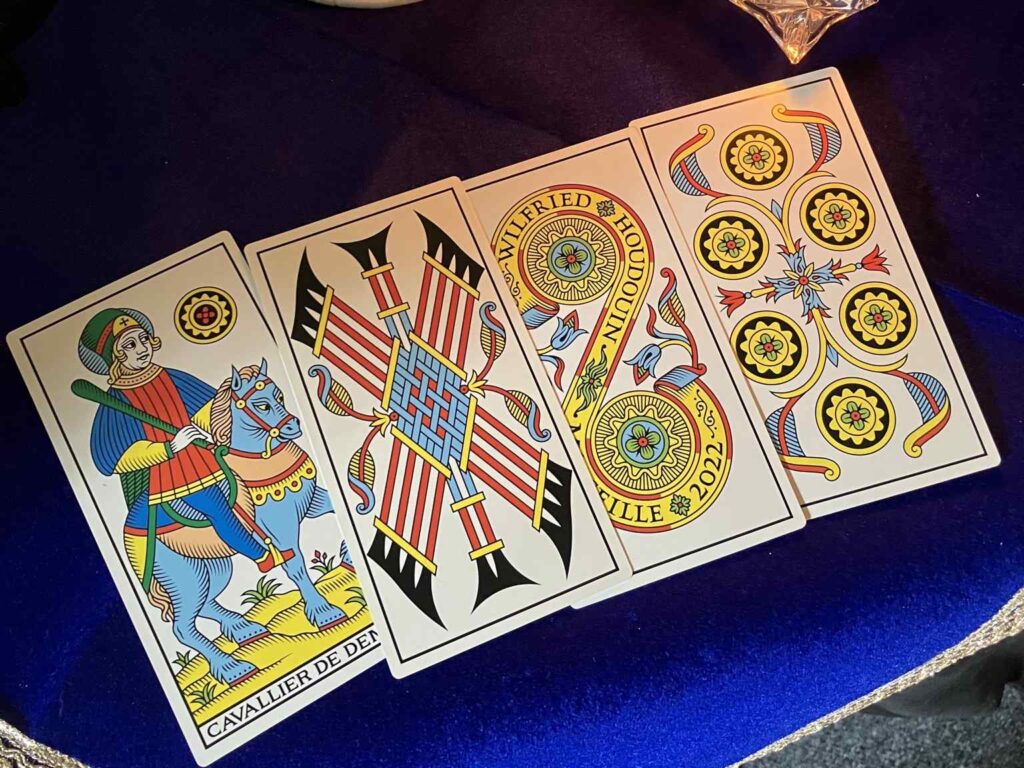
    four tarot cards from the millennium edition marseille tarot on a blue velvet cloth

    Four Cards

    After praying, I drew four Tarot cards.

    Not with any particular spread.

    Just a conversation with God.

    Knight of Coins

    I asked what I had learned in that lifetime.

    I’ve always associated this knight with the Fixed Earth sign Taurus. What I saw wasn’t simply diligence or perseverance. I saw vocation.

    Knowing who you are.

    Knowing what your day is for.

    Belonging.

    Ten of Wands

    This card broke me.

    In the Tarot de Marseille, the crossed wands create something that resembles a barred gate.

    I couldn’t stop looking at it.

    The message felt simple.

    You can’t go back.

    The gates are barred.

    Things have moved on.

    The form your vocation once took is no longer available.

    That realisation carried a grief I hadn’t expected.

    Two of Coins

    Then the conversation changed.

    The Two of Coins isn’t enclosed.

    It moves.

    Exchanges.

    Circulates.

    Perhaps the invitation isn’t to recreate the cloister but to carry its spirit into ordinary life.

    To step beyond the walls.

    To engage with the world instead of retreating from it.

    That feels far more daunting than disappearing behind monastery walls ever did.

    Six of Coins

    The final card answered the prayer I had begun with.

    Sisterhood.

    Not followers.

    Sisterhood.

    Women carrying one another’s burdens and praying together.

    My Body is Asking a Question

    I don’t know exactly what the connection is between emotional pain and osteoarthritis. Bodies are complicated, and I have no desire to oversimplify either medicine or spirituality.

    But I couldn’t help noticing the symbolism.

    My hips, the joints that carry us forward, have reached the point where one needs replacing, and the other will likely follow. Then, just as I began building upper body strength in preparation for surgery, my right shoulder reminded me that it too has limits.

    Whether that’s coincidence or something more, I honestly don’t know.

    What I do know is that my body is forcing me to ask questions I’ve spent years avoiding.

    Questions about how I move through life and what I’m carrying.

    Questions about why I’ve always believed I had to carry it alone.

    My Mother

    As I sat with these thoughts, I found myself thinking about my mother.

    She left my abusive father when I was very young.

    She carried wounds from her own childhood that were never given the chance to heal properly.

    I remember her saying more than once that she wished she could join a convent.

    A couple of years before dementia took hold, she told me she was eternally twelve.

    Not long afterwards, her life began unravelling in ways none of us could stop. She eventually became homeless before the police found her and reunited her with my sister in Sweden. By the time I visited her in the care home two weeks before she died, she no longer knew who I was.

    Looking back, I don’t think she ever found a place where she truly belonged.

    Perhaps that’s why her longing for the convent has stayed with me all these years.

    And maybe I’ve been looking for the same thing.

    God-Substitutes

    Looking back over my own life, I can also see another pattern.

    I’ve been wondering whether some of the relationships I invested so much hope in were really attempts to recreate a sense of sanctuary. I don’t mean that the feelings weren’t genuine. They were. But looking back, I can see that I was sometimes asking another human being to become a God-substitute: to provide the sense of safety, certainty, belonging and homecoming that I couldn’t find within myself.

    That’s far too heavy a burden for anyone to carry. No relationship can bear the weight of becoming someone else’s monastery.

    That’s why those relationships could never carry what I was asking of them. Not because the people themselves were lacking, but because I was asking them to fill a space that only God could fill.

    A Different Way Forward

    One of the hardest things I’ve had to admit this morning is that I can’t keep doing everything on my own.

    Perhaps that’s the deepest lesson hidden in these four cards.

    The story doesn’t end with the barred gate.

    It moves from the burden of the Ten of Wands to the exchange of the Two of Coins and finally to the generosity of the Six of Coins.

    From carrying everything alone…

    to a fair exchange.

    When I lit that pink candle this morning, I asked God to show me a way forward.

    I expected another solitary path.

    Instead, I was shown people.

    Whether I’m ready for that is another question.

    I’ve spent so much of my life believing I had to carry everything alone that accepting help feels strangely unfamiliar.

    Perhaps that’s where the real work begins.

    I wish I could tell you that drawing those four cards resolved everything.

    It didn’t.

    Old fears don’t disappear in a single morning. Neither do old patterns.

    But something shifted.

    Instead of trying to force the gates open, I found myself wondering what might happen if I simply turned around.

    purple lisa signature

  • 7/7 Portal Musings: Psalm 77, The Chariot & Synchronicity

    7/7 Portal Musings: Psalm 77, The Chariot & Synchronicity

    Portal schmortal. I must admit, I sometimes wonder if these numerology portals are just New Age nonsense. That said, I have paid attention to some of them when intuition nudged me to, especially the triple portals where the day, month and year all carry the same number.

    I decided to dig around in memory for when the 7th of July was a triple portal. That would have been in 2023. My memory isn’t great, so I looked through my blog posts over on angelorum from July 2023. It was a busy month of blogging, apparently, and about half the posts no longer resonate.

    While I found nothing on the day itself, I did find a 777 portal tarot spread from the 5th of July. If you resonate strongly with number portals, you might wish to take this spread for a spin today.

    7/7 Psalm Magic

    I also decided to look up Psalm 77. According to Anna Riva, in Powers of the Psalms, this is a psalm to use against despondency and lack of faith.

    That kind of synchronicity speaks to me far more than the idea of a numerology portal. In July 2023, I was still in the throes of religious trauma recovery, trying to write my way through it. Hence, the copious amount of blog posts that month. This was and still is my neurodivergent way of coping with any form of trauma.

    Looking back, I can see that the real issue wasn’t a lack of faith in God so much as a lack of faith in myself. I hadn’t yet learned to trust my own discernment.

    The Chariot

    Perhaps that’s why The Chariot came to mind this morning. As the seventh Major Arcanum, and traditionally linked with Cancer, it speaks of harnessing opposing forces and moving forward with intention. The Chariot doesn’t succeed through brute force but through inner alignment. When our will and our deeper purpose pull in the same direction, life begins to move again.

    For so long, childhood abuse, abandonment and trauma left my will feeling broken. Without knowing and trusting our own will, we easily fall prey to doubts and despondency.

    A Reading About Despondency

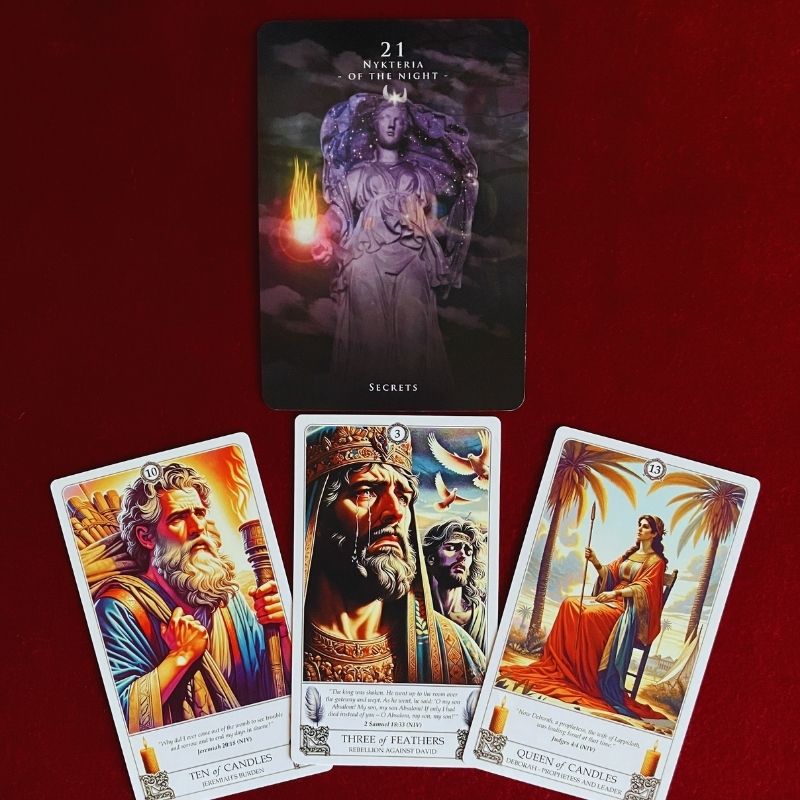
    Yesterday, I spoke to someone near and dear to me. They were feeling very despondent, so this morning I lit a candle and read the Psalm over their situation. I also pulled some cards for them. I love how clearly the Oracle of the Hekatean Path and the Biblical Tarot spoke to the situation.

    Tarot and oracle reading for 7/7 featuring Nykteria of the Night from the Oracle of the Hekatean Path above the Ten of Candles, Three of Feathers and Queen of Candles from the Biblical Tarot on a deep red cloth.

    The 10 of Wands (here called Candles) testify to the state of feeling at the end of one’s tether and simply not knowing if one has the strength to carry on. The 3 of Swords (here called Feathers) shows that there is a real need to shed some tears. Tears can remove blockages and relieve tension so that we can breathe again.

    The final card, the Queen of Wands/Candles, is how I see this person. They are much more resourceful than they think they are, and so very beautiful, artistic and charismatic. Yesterday, I found myself reminding them how very loved they are, and it boggled my mind that someone so stunningly beautiful would ever need such a reminder. Yet that’s what despondency does. It blinds us to our own light.

    But it also showed me that they will bounce back very soon, and that filled me with hope. It also reminded me of all the times I bounced back from the pit of despair.

    Whether or not 7/7 is really a “portal” almost feels beside the point now. This morning became a doorway for me, not because of numerology, but because it invited me to look back and notice how much has changed. Three years ago, Psalm 77 would have described my own heart. Today, it became a prayer for someone else. That’s the kind of synchronicity I trust. Not one that tells me what to believe, but one that quietly reveals how far I’ve come.

    purple lisa signature

  • I’m So Full of Shit (And So Are You): The Stories We Tell Ourselves

    I’m So Full of Shit (And So Are You): The Stories We Tell Ourselves

    Yesterday’s post, 29 June 2026: Crossroads Devotion, ended with a prayer.

    Not because I was trying to sound holy. Not because I wanted anyone to think I’d somehow transcended ordinary human frailty overnight. I wrote it because, in that moment, it genuinely reflected where my heart was.

    Then I read it again this morning.

    Oh, good grief…

    If I didn’t know myself better, I’d think I’d achieved enlightenment sometime between my first coffee and hitting the Publish button.

    It was all love, grace, and compassion on the Middle Path. Beautiful sentiments, all of them. Sincere sentiments too.

    The only problem was that I’d accidentally presented one facet of myself as though it were the whole person.

    Fast forward twenty-four hours and I’m sitting here rolling my eyes at my own sanctimony, quietly remembering that I’m also capable of being impatient, sarcastic, judgmental and occasionally spectacularly full of myself.

    That’s not a contradiction.

    That’s just being human.

    Wholehearted, Not Holy

    The older I get, the more suspicious I become of my own attempts to sound spiritually evolved.

    I think that’s one of the reasons the Christo-Hekatean path has felt so liberating. It isn’t because I’ve stopped caring about ethics. Quite the opposite. It’s because I’m increasingly allergic to hypocrisy, especially my own.

    For years, spirituality often felt like a performance review. Was I loving enough? Forgiving enough? Detached enough? Had I responded with sufficient grace? Was my ego showing?

    No wonder shame was never very far away.

    These days, I’m much more interested in wholeness than holiness. I don’t want to spend the second half of my life editing myself into someone who sounds enlightened. I’d rather become more honest about who I already am.

    That means making room for contradictions.

    I can genuinely want peace and still lose my temper.

    I can believe in compassion and still think someone is being an absolute prick.

    Neither cancels the other out.

    A Rabbit Hole Worth Falling Into

    This morning, I stumbled across a video about Dr John DeMartini’s method. I’d never come across his work before, but within a few minutes, I had the same feeling I remember having when I first discovered Byron Katie over twenty years ago.

    It wasn’t that either of them handed me answers.

    They handed me better questions.

    As I listened, I found myself becoming increasingly aware of the stories quietly running in the background of my own mind. We all have them. They help us make sense of the world, until one day we stop recognising them as stories and start treating them as objective reality.

    That made me wonder what narratives I’ve been carrying around for years without ever examining them properly.

    Relationship narratives immediately sprang to mind.

    Not any one relationship in particular. Just the collection of stories I’ve accumulated over a lifetime about love, romance, marriage, commitment, intimacy and what all those things are supposed to mean.

    I’ve no doubt some of those stories are complete bollocks.

    An Unexpected Answer

    One question refused to leave me alone: What do I actually want from love?

    It sounds ridiculously simple, but I realised I’d never asked it without all the background noise of expectation. I wasn’t interested in the answer offered by religion, romantic films or society’s collective script. I wanted to know what remained once all those voices had quietened down.

    The answer surprised me by arriving so quickly: freedom. Not freedom from love, but freedom within love. Freedom to remain curious, to keep growing, and to pursue truth without feeling as though I have to squeeze myself into a role that no longer fits.

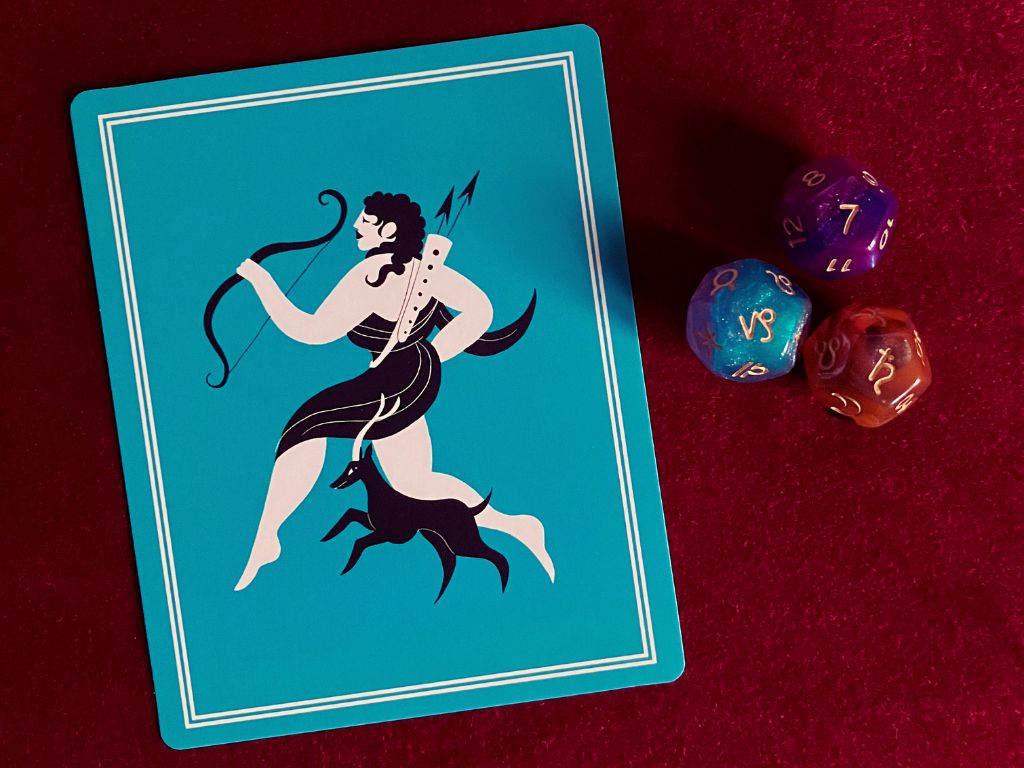
    That thought was still rattling around my head when I reached for my astrology dice.

    Saturn in Capricorn in the Seventh House.

    (Sometimes symbolism has all the subtlety of a 2×4 upside the head.)

    There it was: duty, convention, inherited expectations and obligations.

    Then I picked a card from Stephen Fry’s Mythos Oracle.

    Artemis. I smiled.

    I’ve always thought of myself as a hopeless romantic.

    Perhaps I’ve been wrong.

    Perhaps what I’ve really been hunting all these years is truth. All my writing is about romancing the Truth. Yes, capital T.

    Turning the Cards Around

    The biggest gift I took away from DeMartini’s work was the possibility of a more honest divination practice.

    For years, I’ve encouraged Tarot clients to ask thoughtful questions when they come for readings. Sometimes I forget that advice applies to me as well.

    It’s remarkably easy to use Tarot and other divination tools as mirrors that reflect whatever narrative we’re already invested in believing. I’ve done it many times. I’m fairly sure everyone who engages in divinatory practices has done it.

    From now on, I’d like to focus more on questions like these:

    • What story am I telling myself that this card quietly refuses to support?
    • Which assumption have I promoted to the status of fact without ever really questioning it?
    • What part of the picture am I conveniently leaving out?
    • If the opposite were also true, what might I be failing to see?
    • What expectation is shaping the way I’m interpreting this card?
    • Am I asking this oracle to reveal the truth, or simply to confirm what I already believe?
    • If I let go of my preferred narrative for a moment, what else becomes possible?
    • What would change if I stopped trying to be right and became genuinely curious instead?

    I’m under no illusion that this will stop me projecting onto the cards at times when I read for myself. That’s probably impossible.

    What it might do is help me notice when I’m doing it.

    And that feels like a worthwhile practice.

    After all, the cards have never lied to me.

    More often than not, I’ve simply been a little too attached to my own BS.

    purple lisa signature

  • Alex Reads Tarot No More: A Lesson in Spiritual Grace

    Alex Reads Tarot No More: A Lesson in Spiritual Grace

    Yesterday, I learned that a popular TikTok Tarot reader with 1 M+ followers quit the world of Tarot. She used to go by ‘Alex Reads Tarot’ and was so successful that pop singer/songwriter Hayley Williams name-dropped her in one of her songs. Before yesterday, I had heard of neither.

    Alex is young enough to be my daughter, and my heart goes out to her. I watched her farewell video after stumbling across someone’s cynical take on why she quit and how that somehow, supposedly makes her a ‘grifter.’

    Watching Alex’s Farewell Video

    I didn’t see a grifter in the 10-minute TikTok video. I saw a tense, responsible young woman trying to make the best of a difficult situation. Before me was someone who felt obligated to let the world know about the internal storm of consciousness that was taking place inside her, and that led to the difficult decision to leave the successful place in the Tarot community she had worked so hard to earn.

    There were no signs of detachment from reality, and I wouldn’t want to attempt to diagnose her with religious trauma. Needless to say, for me, it brought plenty of memories of my two major religious trauma relapses.

    Watching Alex’s video also forced me to confront an uncomfortable memory about myself.

    Why I Judged Doreen Virtue

    In 2017, when Doreen Virtue announced that she had become a fundamentalist Christian and denounced Tarot, I judged her harshly. Like many others in the spiritual community, I assumed I knew what had happened. I believed she had succumbed to fear, traded freedom for dogma, and perhaps found a lucrative new audience.

    When I Walked Away from Tarot

    Then, three years later, around the time of my Chiron return, I found myself walking through a remarkably similar door.

    Not because I had suddenly become irrational. Not because I wanted to deceive anyone. And certainly not because I stopped seeking the truth.

    I was carrying unresolved religious trauma that I didn’t yet understand. When it resurfaced, it demanded to be faced. Looking back, I can see that stepping away from Tarot for a season was part of that process. At the time, however, it felt like the only faithful thing I could do.

    That experience permanently changed the way I think about other people’s spiritual journeys.

    The Spiritual Community Needs More Grace

    Today, I have no idea whether Alex’s decision will last six months, six years or a lifetime. Nor do I need to know. What I do know is that none of us has access to another person’s inner world.

    We see an announcement.

    Nor do we see the years of wrestling that came before it.

    We see a ten-minute video.

    We don’t see the sleepless nights, the private prayers, the fears, the hopes, the conversations that were never filmed, or the questions that refused to leave.

    Yet social media encourages us to fill in all those blanks. Within hours, people were confidently declaring that Alex was either genuinely saved or cynically grifting.

    Perhaps she is neither.

    Perhaps she is simply a human being responding honestly to where her conscience has led her today.

    Life Has a Way of Humbling Our Certainties

    If my own journey has taught me anything, it is that spiritual life rarely unfolds in a straight line.

    Only when I stopped judging myself for the path I had taken did something unexpected happen. The rigid either-or thinking that had trapped me for so long began to dissolve. I discovered that the deepest truths in my own life weren’t asking me to choose between one world and another. They were inviting me into a both-and spacious enough to hold Christ, Tarot, contemplation, discernment and mystery without forcing any of them into a false opposition.

    That doesn’t mean everyone will arrive at the same place I have.

    Nor should they.

    But perhaps, as a spiritual community, we could become a little slower to pronounce verdicts on one another’s journeys. The grace we withhold from others today may be the very grace we find ourselves desperately needing tomorrow.

    Life has a remarkable way of humbling our certainties.

    Mine certainly did.

    Click here for more thoughts on the ongoing Alex Reads Tarot controversy

    purple lisa signature