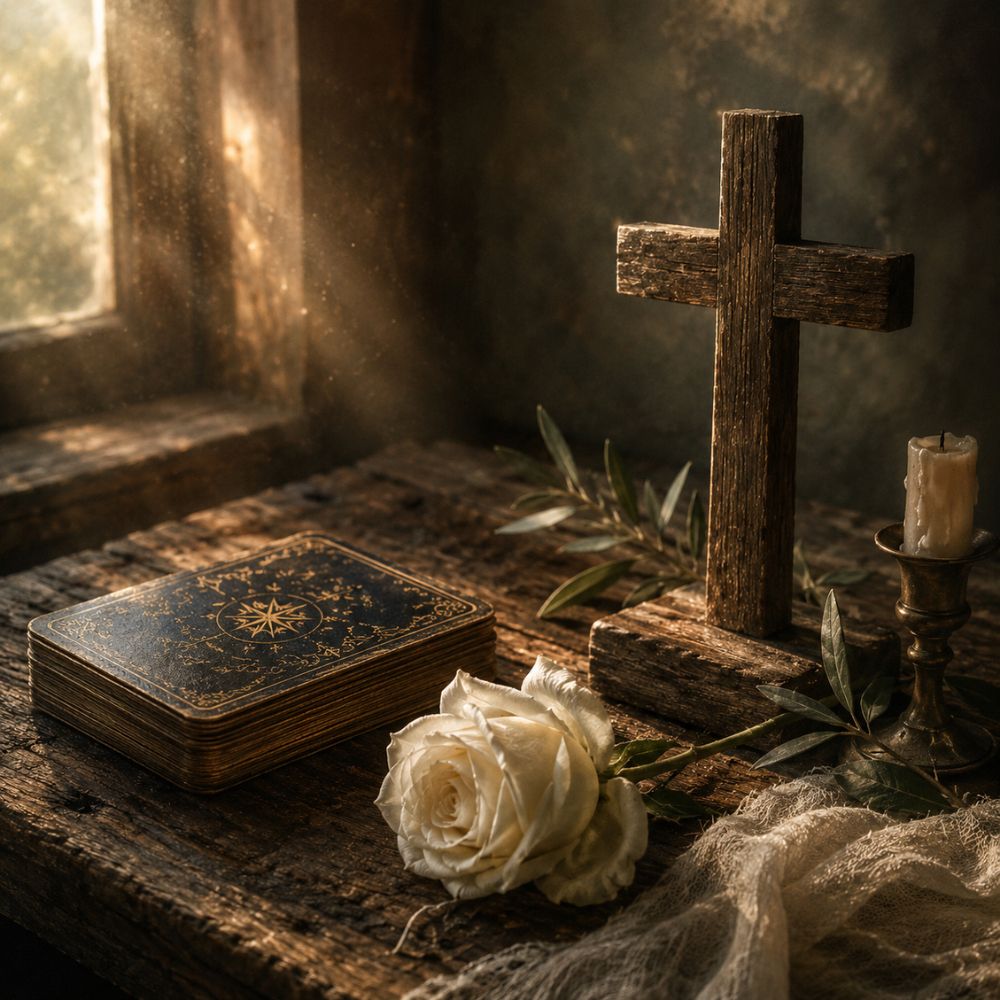
Portal schmortal. I must admit, I sometimes wonder if these numerology portals are just New Age nonsense. That said, I have paid attention to some of them when intuition nudged me to, especially the triple portals where the day, month and year all carry the same number.
I decided to dig around in memory for when the 7th of July was a triple portal. That would have been in 2023. My memory isn’t great, so I looked through my blog posts over on angelorum from July 2023. It was a busy month of blogging, apparently, and about half the posts no longer resonate.
While I found nothing on the day itself, I did find a 777 portal tarot spread from the 5th of July. If you resonate strongly with number portals, you might wish to take this spread for a spin today.
7/7 Psalm Magic
I also decided to look up Psalm 77. According to Anna Riva, in Powers of the Psalms, this is a psalm to use against despondency and lack of faith.
That kind of synchronicity speaks to me far more than the idea of a numerology portal. In July 2023, I was still in the throes of religious trauma recovery, trying to write my way through it. Hence, the copious amount of blog posts that month. This was and still is my neurodivergent way of coping with any form of trauma.
Looking back, I can see that the real issue wasn’t a lack of faith in God so much as a lack of faith in myself. I hadn’t yet learned to trust my own discernment.
The Chariot
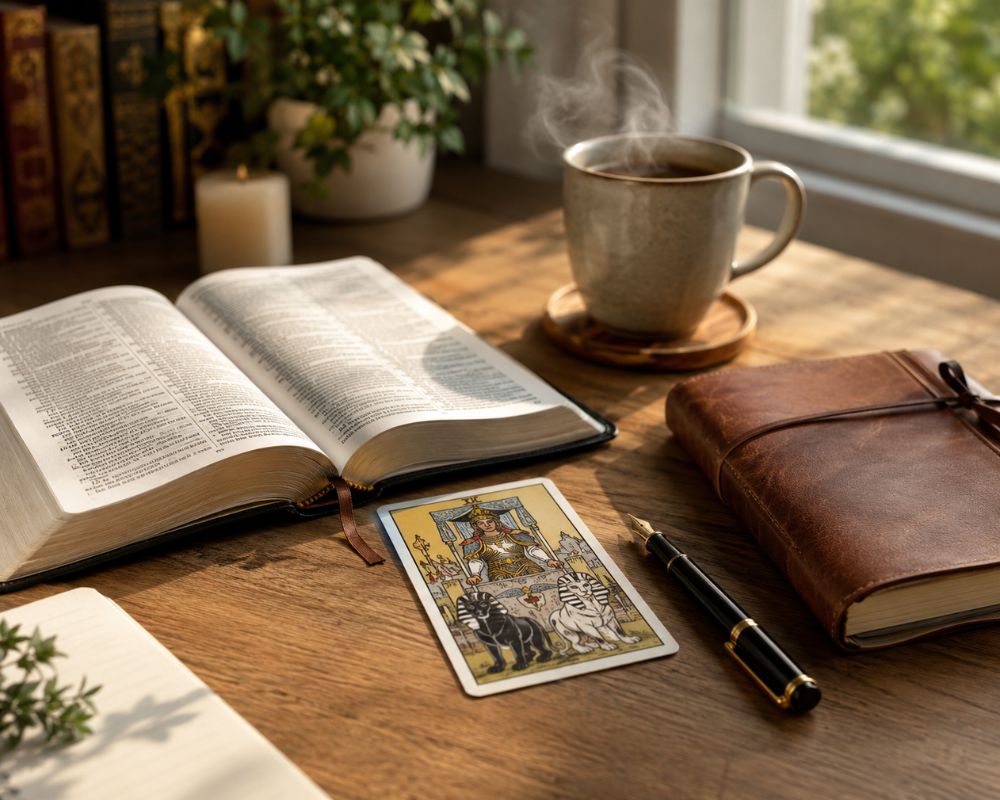
Perhaps that’s why The Chariot came to mind this morning. As the seventh Major Arcanum, and traditionally linked with Cancer, it speaks of harnessing opposing forces and moving forward with intention. The Chariot doesn’t succeed through brute force but through inner alignment. When our will and our deeper purpose pull in the same direction, life begins to move again.
For so long, childhood abuse, abandonment and trauma left my will feeling broken. Without knowing and trusting our own will, we easily fall prey to doubts and despondency.
A Reading About Despondency
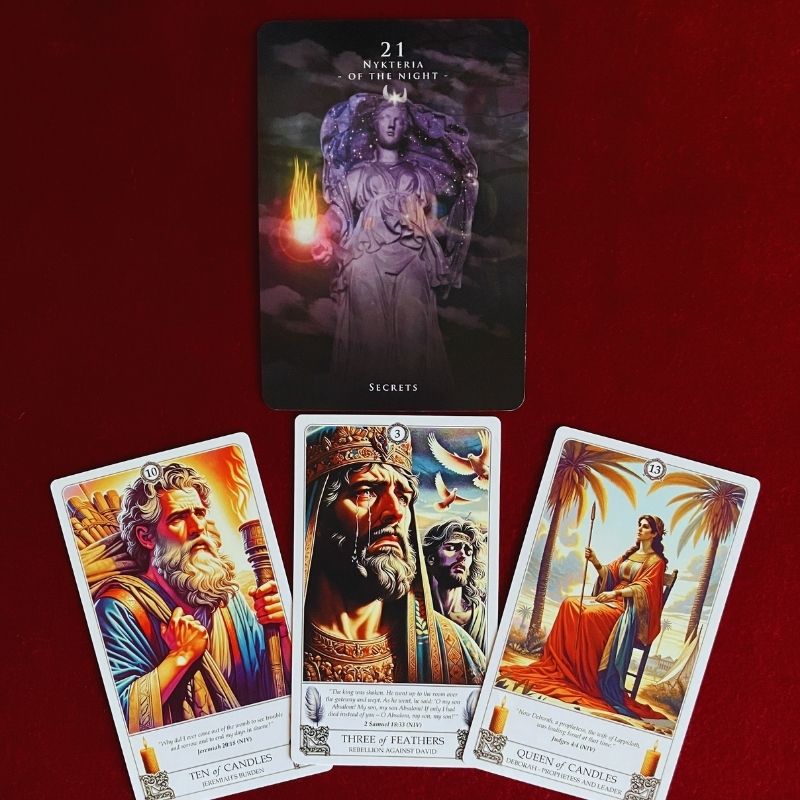
Yesterday, I spoke to someone near and dear to me. They were feeling very despondent, so this morning I lit a candle and read the Psalm over their situation. I also pulled some cards for them. I love how clearly the Oracle of the Hekatean Path and the Biblical Tarot spoke to the situation.
The 10 of Wands (here called Candles) testify to the state of feeling at the end of one’s tether and simply not knowing if one has the strength to carry on. The 3 of Swords (here called Feathers) shows that there is a real need to shed some tears. Tears can remove blockages and relieve tension so that we can breathe again.
The final card, the Queen of Wands/Candles, is how I see this person. They are much more resourceful than they think they are, and so very beautiful, artistic and charismatic. Yesterday, I found myself reminding them how very loved they are, and it boggled my mind that someone so stunningly beautiful would ever need such a reminder. Yet that’s what despondency does. It blinds us to our own light.
But it also showed me that they will bounce back very soon, and that filled me with hope. It also reminded me of all the times I bounced back from the pit of despair.
Whether or not 7/7 is really a “portal” almost feels beside the point now. This morning became a doorway for me, not because of numerology, but because it invited me to look back and notice how much has changed. Three years ago, Psalm 77 would have described my own heart. Today, it became a prayer for someone else. That’s the kind of synchronicity I trust. Not one that tells me what to believe, but one that quietly reveals how far I’ve come.
Not because I was trying to sound holy. Not because I wanted anyone to think I’d somehow transcended ordinary human frailty overnight. I wrote it because, in that moment, it genuinely reflected where my heart was.
Then I read it again this morning.
Oh, good grief…
If I didn’t know myself better, I’d think I’d achieved enlightenment sometime between my first coffee and hitting the Publish button.
It was all love, grace, and compassion on the Middle Path. Beautiful sentiments, all of them. Sincere sentiments too.
The only problem was that I’d accidentally presented one facet of myself as though it were the whole person.
Fast forward twenty-four hours and I’m sitting here rolling my eyes at my own sanctimony, quietly remembering that I’m also capable of being impatient, sarcastic, judgmental and occasionally spectacularly full of myself.
That’s not a contradiction.
That’s just being human.
Wholehearted, Not Holy
The older I get, the more suspicious I become of my own attempts to sound spiritually evolved.
I think that’s one of the reasons the Christo-Hekatean path has felt so liberating. It isn’t because I’ve stopped caring about ethics. Quite the opposite. It’s because I’m increasingly allergic to hypocrisy, especially my own.
For years, spirituality often felt like a performance review. Was I loving enough? Forgiving enough? Detached enough? Had I responded with sufficient grace? Was my ego showing?
No wonder shame was never very far away.
These days, I’m much more interested in wholeness than holiness. I don’t want to spend the second half of my life editing myself into someone who sounds enlightened. I’d rather become more honest about who I already am.
That means making room for contradictions.
I can genuinely want peace and still lose my temper.
I can believe in compassion and still think someone is being an absolute prick.
Neither cancels the other out.
A Rabbit Hole Worth Falling Into
This morning, I stumbled across a video about Dr John DeMartini’s method. I’d never come across his work before, but within a few minutes, I had the same feeling I remember having when I first discovered Byron Katie over twenty years ago.
It wasn’t that either of them handed me answers.
They handed me better questions.
As I listened, I found myself becoming increasingly aware of the stories quietly running in the background of my own mind. We all have them. They help us make sense of the world, until one day we stop recognising them as stories and start treating them as objective reality.
That made me wonder what narratives I’ve been carrying around for years without ever examining them properly.
Relationship narratives immediately sprang to mind.
Not any one relationship in particular. Just the collection of stories I’ve accumulated over a lifetime about love, romance, marriage, commitment, intimacy and what all those things are supposed to mean.
I’ve no doubt some of those stories are complete bollocks.
An Unexpected Answer
One question refused to leave me alone: What do I actually want from love?
It sounds ridiculously simple, but I realised I’d never asked it without all the background noise of expectation. I wasn’t interested in the answer offered by religion, romantic films or society’s collective script. I wanted to know what remained once all those voices had quietened down.
The answer surprised me by arriving so quickly: freedom. Not freedom from love, but freedom within love. Freedom to remain curious, to keep growing, and to pursue truth without feeling as though I have to squeeze myself into a role that no longer fits.
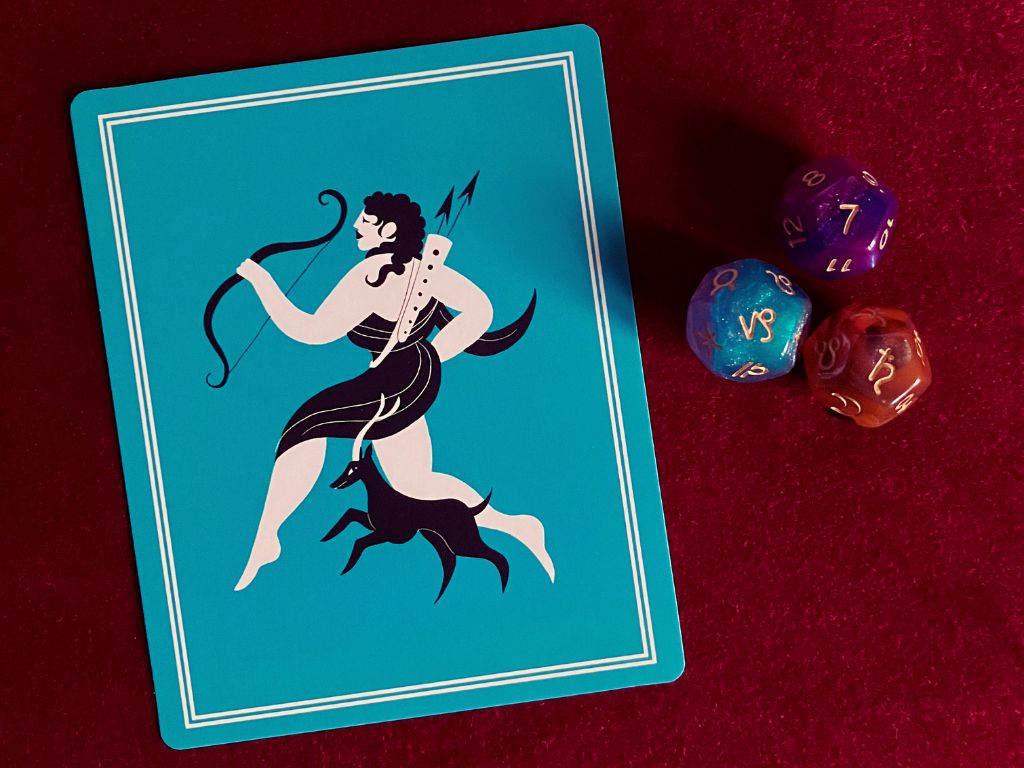
That thought was still rattling around my head when I reached for my astrology dice.
Saturn in Capricorn in the Seventh House.
(Sometimes symbolism has all the subtlety of a 2×4 upside the head.)
There it was: duty, convention, inherited expectations and obligations.
Then I picked a card from Stephen Fry’s Mythos Oracle.
Artemis. I smiled.
I’ve always thought of myself as a hopeless romantic.
Perhaps I’ve been wrong.
Perhaps what I’ve really been hunting all these years is truth. All my writing is about romancing the Truth. Yes, capital T.
Turning the Cards Around
The biggest gift I took away from DeMartini’s work was the possibility of a more honest divination practice.
It’s remarkably easy to use Tarot and other divination tools as mirrors that reflect whatever narrative we’re already invested in believing. I’ve done it many times. I’m fairly sure everyone who engages in divinatory practices has done it.
From now on, I’d like to focus more on questions like these:
What story am I telling myself that this card quietly refuses to support?
Which assumption have I promoted to the status of fact without ever really questioning it?
What part of the picture am I conveniently leaving out?
If the opposite were also true, what might I be failing to see?
What expectation is shaping the way I’m interpreting this card?
Am I asking this oracle to reveal the truth, or simply to confirm what I already believe?
If I let go of my preferred narrative for a moment, what else becomes possible?
What would change if I stopped trying to be right and became genuinely curious instead?
I’m under no illusion that this will stop me projecting onto the cards at times when I read for myself. That’s probably impossible.
What it might do is help me notice when I’m doing it.
And that feels like a worthwhile practice.
After all, the cards have never lied to me.
More often than not, I’ve simply been a little too attached to my own BS.
Yesterday, I learned that a popular TikTok Tarot reader with 1 M+ followers quit the world of Tarot. She used to go by ‘Alex Reads Tarot’ and was so successful that pop singer/songwriter Hayley Williams name-dropped her in one of her songs. Before yesterday, I had heard of neither.
Alex is young enough to be my daughter, and my heart goes out to her. I watched her farewell video after stumbling across someone’s cynical take on why she quit and how that somehow, supposedly makes her a ‘grifter.’
Watching Alex’s Farewell Video
I didn’t see a grifter in the 10-minute TikTok video. I saw a tense, responsible young woman trying to make the best of a difficult situation. Before me was someone who felt obligated to let the world know about the internal storm of consciousness that was taking place inside her, and that led to the difficult decision to leave the successful place in the Tarot community she had worked so hard to earn.
There were no signs of detachment from reality, and I wouldn’t want to attempt to diagnose her with religious trauma. Needless to say, for me, it brought plenty of memories of my two major religious trauma relapses.
Watching Alex’s video also forced me to confront an uncomfortable memory about myself.
Why I Judged Doreen Virtue
In 2017, when Doreen Virtue announced that she had become a fundamentalist Christian and denounced Tarot, I judged her harshly. Like many others in the spiritual community, I assumed I knew what had happened. I believed she had succumbed to fear, traded freedom for dogma, and perhaps found a lucrative new audience.
Not because I had suddenly become irrational. Not because I wanted to deceive anyone. And certainly not because I stopped seeking the truth.
I was carrying unresolved religious trauma that I didn’t yet understand. When it resurfaced, it demanded to be faced. Looking back, I can see that stepping away from Tarot for a season was part of that process. At the time, however, it felt like the only faithful thing I could do.
That experience permanently changed the way I think about other people’s spiritual journeys.
The Spiritual Community Needs More Grace
Today, I have no idea whether Alex’s decision will last six months, six years or a lifetime. Nor do I need to know. What I do know is that none of us has access to another person’s inner world.
We see an announcement.
Nor do we see the years of wrestling that came before it.
We see a ten-minute video.
We don’t see the sleepless nights, the private prayers, the fears, the hopes, the conversations that were never filmed, or the questions that refused to leave.
Yet social media encourages us to fill in all those blanks. Within hours, people were confidently declaring that Alex was either genuinely saved or cynically grifting.
Perhaps she is neither.
Perhaps she is simply a human being responding honestly to where her conscience has led her today.
Life Has a Way of Humbling Our Certainties
If my own journey has taught me anything, it is that spiritual life rarely unfolds in a straight line.
Only when I stopped judging myself for the path I had taken did something unexpected happen. The rigid either-or thinking that had trapped me for so long began to dissolve. I discovered that the deepest truths in my own life weren’t asking me to choose between one world and another. They were inviting me into a both-and spacious enough to hold Christ, Tarot, contemplation, discernment and mystery without forcing any of them into a false opposition.
That doesn’t mean everyone will arrive at the same place I have.
Nor should they.
But perhaps, as a spiritual community, we could become a little slower to pronounce verdicts on one another’s journeys. The grace we withhold from others today may be the very grace we find ourselves desperately needing tomorrow.
Life has a remarkable way of humbling our certainties.
This year marks twenty years since I published my first blog post.
When I started blogging in 2006, Facebook was still finding its feet, Twitter didn’t exist yet, and nobody was talking about algorithms, content strategies, personal brands, or AI.
We simply wrote about our interests. Some of us spent an inordinate amount of time writing about our special interests because nobody else wanted to listen to us harp on about them. Looking back, perhaps that should have been my first clue.
Then we wandered around the blogosphere reading what everyone else had written and leaving comments.
The internet felt smaller then. More human.
Twenty years later, I find myself launching yet another website and reflecting on what blogging has given me over the past two decades.
These are some of the lessons that stand out.
1. Blogging changed my life
This sounds dramatic, but it’s true.
If I hadn’t started blogging, I would never have built the business that followed. I wouldn’t have met many of the people who became friends. I wouldn’t have discovered so much about myself.
A simple habit of writing online altered the course of my life.
2. Authenticity is not a marketing strategy
These days, authenticity is often discussed as though it were another branding technique.
People can tell the difference.
I have written thousands of posts. The posts that resonated most deeply were rarely the ones I carefully optimised. They were the ones where I was simply telling the truth or asking a question that others were curious about, too.
3. You never run out of ideas if you stay curious
All these years, people have repeatedly asked how I keep finding things to write about.
The answer is that ideas are everywhere.
Questions become posts.
Books become posts.
Conversations become posts.
Tarot readings and spread ideas become posts.
Life becomes blog posts.
Curiosity is an inexhaustible source of material.
Not worrying about whether other people will find it interesting helps, of course. It’s the writerly equivalent of dancing as if nobody is watching.
That is honestly how I’ve been writing my whole life.
Autistic much?
4. A blog can become a spiritual practice
Long before I recognised it as such, blogging became part of my spiritual path.
Writing helps me clarify what I think, what I believe, and what I am willing to question.
Many of my most important spiritual insights arrived while trying to explain something to someone else.
Then there is the light trance that sometimes settles in while I’m typing. Time disappears. The words seem to arrive more quickly than conscious thought. It feels less like constructing an argument and more like receiving one.
I’m curious whether other writers experience this too.
Whether we call it flow state, inspiration, or channelling, some of my most meaningful writing has emerged from that space.
5. The internet remembers everything
This can be comforting and horrifying in equal measure.
I’ve published things I’m proud of and things that make me cringe.
Both remain part of the record.
I’ve learned to make peace with that.
When I happen across the cringey bits, I think, “Phew. At least I didn’t turn that into a book.”
6. Starting over is not failure
I’ve started over more than once.
New websites.
New directions.
New beliefs.
New identities.
Every reinvention taught me something.
The willingness to begin again may be one of the most valuable skills I’ve learned.
7. Every successful blog is built one post at a time
It’s easy to look at an established site and imagine it appeared fully formed.
It didn’t.
Every successful blog begins with a blank page and a single post.
Then another.
And another.
Sometimes, the Tower strikes. Twice, I’ve had websites simply vanish overnight, without explanation (WordPress.com both times). Gone forever.
Yet the foundations remained. The projects that were meant to last kept growing gradually.
8. Community matters more than follower counts
One thoughtful comment is worth more than a hundred anonymous likes.
The relationships formed through blogging have often been more meaningful than any traffic statistic.
These days, thoughtful comments are like gold dust, but they are still what keep me going.
9. The comments section used to be the social network
I miss this.
Before social media took over, bloggers visited one another’s sites, left comments, and built genuine communities.
The internet felt less like a marketplace and more like a village.
Part of me would love to see that return.
10. Burnout can disguise itself as ambition
This is one I learned the hard way.
At one point, one of my websites was attracting thousands of visitors per day and generating an excellent income.
From the outside, it looked like success.
From the inside, I was exhausted.
At the time, I didn’t know I might be AuDHD. Looking back, what I called dedication may have contained a substantial amount of burnout.
Achievement is not always evidence that something is sustainable.
11. Making money from blogging is still possible
People have been declaring blogging dead for at least fifteen years.
Meanwhile, bloggers continue to build businesses.
The landscape changes. The opportunities change. The methods change.
But valuable content remains valuable.
My prediction is that genuinely personal writing will become even more valuable in the age of AI. Facts and information are becoming increasingly accessible. What remains scarce is lived experience, individual perspective, and the courage to share both honestly.
12. SEO is a tool, not a purpose
SEO helps people find your work.
It should never become the reason for creating it.
Whenever I worried more about search engines than my readers, the writing suffered.
13. Your blog grows as you grow
Every website I’ve created is a snapshot of who I was at the time.
Looking back through old posts is like opening a time capsule.
The blogs changed because I changed.
14. Writing helped me heal
Blogging has accompanied me through spiritual transformation, religious trauma, grief, joy, reinvention, and countless periods of uncertainty.
Sometimes the writing itself became part of the healing.
15. Some of my biggest breakthroughs happened in public
Not because I intended them to.
Simply because I was documenting the journey as I went.
There is something powerful about allowing people to witness growth rather than presenting a polished version after the fact.
16. Plagiarism hurts
There is no point pretending otherwise.
Seeing your work copied without permission is frustrating.
Over time, I’ve learned not to dwell on it.
The original source of the work remains with the creator.
17. Social media is rented land
This may be the most important lesson of all.
Platforms come and go.
Algorithms change.
Accounts disappear.
A self-hosted blog is still one of the few places online that genuinely belongs to you.
18. To AI or not to AI?
As Dr Angela Puca writes in an excellent essay on Substack, the question is not if we use AI, but how.
Used carelessly, AI can regurgitate information and platitudes.
Used thoughtfully, it can help us brainstorm, organise ideas, edit drafts, and explore new perspectives.
The challenge is remaining human while using increasingly powerful tools. I shared my own thoughts on how to use AI without losing my voice in this article.
19. My blog became the foundation of a business
When I published my first post, I had no business plan.
Years later, blogging became the foundation of the work I do today.
Not because I set out to build a business, but because I kept showing up and writing.
20. Twenty years later, I still love blogging
That may be the lesson that surprises me most.
The platforms changed.
The technology changed.
The internet changed.
I changed.
Yet somehow the simple act of sitting down with an idea and turning it into words still feels like magic.
Twenty years ago, I started a blog because I was curious.
Twenty years later, despite all the changes in algorithms, social media platforms, SEO updates, AI tools, successes, failures, reinventions, and false starts, the reason hasn’t changed.