Late in the afternoon on the day before Nimmy died, she started shivering.
Mike noticed it first and came to tell me just as I was about to go upstairs to pray my Rosary. We were concerned, but not yet frightened, so we agreed that he would keep an eye on her while I prayed. Afterwards, we would decide whether we needed to phone the vet.
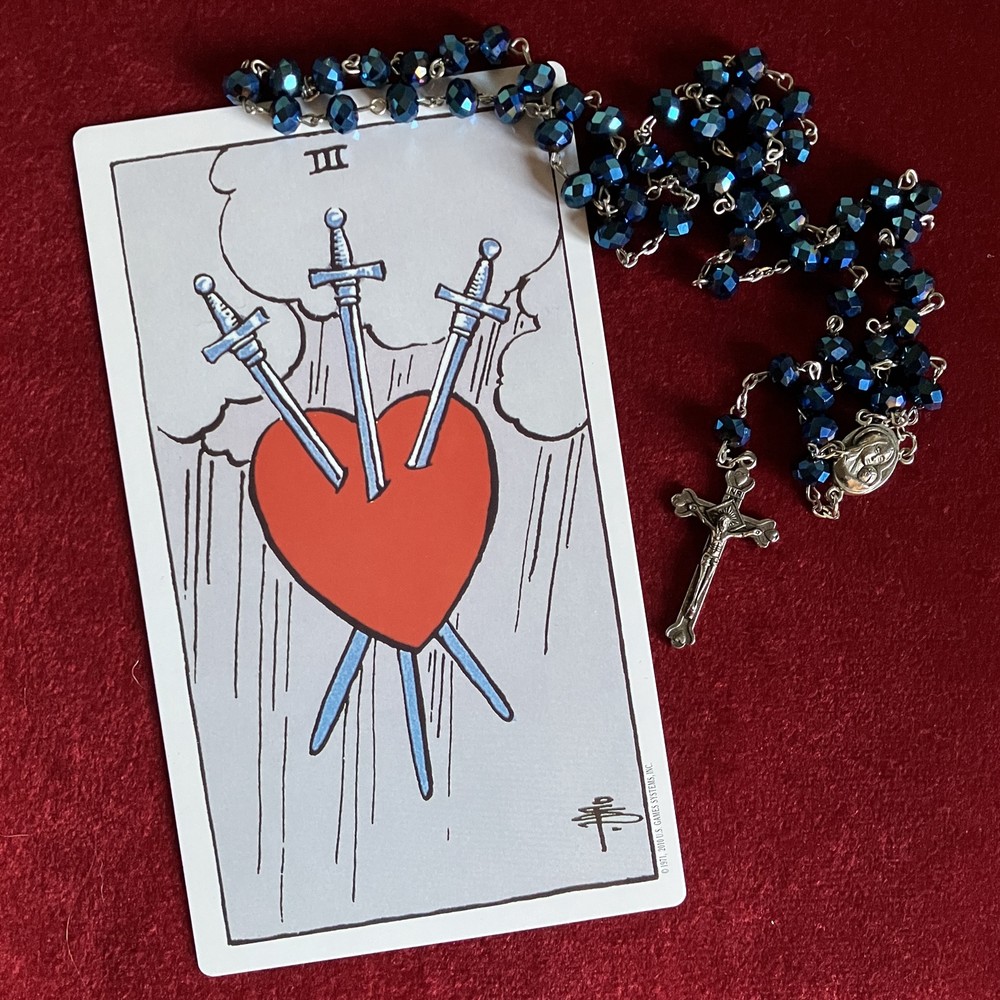
I dedicated the whole Rosary to Nimmy. While I was upstairs praying, Mike did what people do in 2026 when something odd happens at home and checked her symptoms with ChatGPT.
When I came back downstairs, she was still shivering. I lifted her gently onto my lap, stroked her and prayed over her while we counted her breaths per minute. Gradually, her breathing slowed and after perhaps ten or fifteen minutes, the shivering stopped.
Before long, Nimmy made it quite clear that she had had enough of being fussed over and wanted to get down. I placed her carefully on the floor, and she walked over to her water bowl without wobbling, had a drink and then went to her bed and curled up for a sleep.
She seemed perfectly fine.
A Small Miracle
By then it would have meant contacting the emergency vet. Small dogs sometimes shiver when they have an upset stomach, and because Nimmy appeared to have recovered completely, we decided simply to keep an eye on her.
What I remember most clearly is thanking Mother Mary. Not because I believed I had somehow performed a miraculous healing, but because I had been given the peace I needed while Nimmy was distressed. Instead of panicking, I had been able to hold her, pray over her and help her settle.
It felt like a small miracle.
I went to bed early that night. Mike, who usually stays up much later than I do, later assured me that Nimmy had been absolutely fine all evening. She went outside into the garden as normal, came back in and eventually settled down to sleep without showing any further signs of being poorly.
The following morning, I found her dead.
The shock was enormous because there had been no obvious decline the evening before. Only the previous afternoon, we had walked through her favourite field in the September sunshine. Suddenly, we were waking up to a house without Nimmy in it.
Perhaps That Was the Answer
I spent most of that day in tears, but underneath the grief there was gratitude too.
The prayer had not stopped Nimmy from dying. What it had done was bring peace into her final hours. She had calmed in my arms, the shivering had stopped and she had spent the rest of the evening at home without obvious distress.
I wasn’t there holding her when she crossed over, and that hurts. Yet I found myself thanking Mother Mary again because I knew that when Nimmy needed comfort, I had been given the chance to give it to her.
Perhaps it simply was her time.
Ten years ago, I would probably have tried to construct an entire metaphysical explanation for why prayer appeared to help but did not prevent her death. These days, I am much less interested in working out the mechanism.
I am learning to receive grace without demanding that I first understand how it works.
The Little Dog Who Couldn’t Be Stopped
Nimmy had been with us for ten years. For almost five of those years she was completely blind after meningitis took her sight, yet losing her vision never defeated her.
She learned the shape of the world all over again. Our home became something she could navigate through memory, smell and touch, and she continued going for walks, investigating whatever caught her nose and expressing very definite opinions about what the humans or dogs around her ought to be doing.
Blindness changed her life dramatically, but it never became the whole story of who she was.
Her determination amazed both Mike and me. Even now, remembering her lifts my heart because Nimmy was never primarily a story about illness or disability. She was a story about curiosity, stubbornness, joy and carrying on regardless, including remaining firmly in charge of the other two dogs who came into our lives while she was with us.
During ten extraordinary years of wandering and wondering on my spiritual path, she was my constant companion and taught me more than she ever knew.
I have written elsewhere about the strange way Nimmy bookended those ten years, so I won’t repeat that story here. You can read The Dog Who Walked Me Home on Substack.
What matters here is where those ten years began.
A Miracle on a Train
A couple of days ago, while clearing old posts from Angelorum, I came across something I had written in 2016.
The article was about miracles, but the personal story inside it went back much further.
In 1990, when I was twenty, I bought an Interrail ticket and set off alone around Europe with an enormous backpack and sensible shoes that turned out to be considerably less sensible than I had imagined.
Somewhere on the train between Copenhagen and Hamburg, I developed a blister covering almost the entire top of my big toe. The pain became excruciating and I could barely walk, which left me wondering whether my grand European adventure was going to end almost as soon as it had begun.
Sitting on that unbearably hot train, I suddenly remembered the words of Jesus in John 14:12:
“He that believeth on me, the works that I do shall he do also; and greater works than these shall he do.”
The thought came very simply: I can ask Jesus to heal this.
So I did.
An Immediate Answer to Prayer
Thirty-six years later, I no longer remember the exact wording of the prayer. What I do remember is holding my foot on my lap and asking Jesus to remove the blister.
For a short while, I seemed to enter a strange state in which I felt outside ordinary time and space. Then I looked down.
The blister was gone.
Not smaller or less inflamed. Not merely less painful. The skin covering my toe looked normal.
I had asked Jesus for healing and received an immediate answer to prayer.
At twenty, I did not have an elaborate philosophy for what had happened. Perhaps that was fortunate. I prayed, I was healed and I carried on with my journey.
The complexity came much later.
What I Did to the Miracle in 2016
Twenty-six years after that train journey, I wrote about the experience on Angelorum. I found the old article again this week while clearing out posts with no internal links and decided to delete it.
The miracle itself still matters enormously to me, but the framework I wrapped around it no longer reflects what I believe. Rather than preserve the post simply because it existed, I wanted to tell the story again here.
Reading the old version now is fascinating and, in places, slightly hilarious. By 2016, I had accumulated quite a lot of spiritual furniture. The healing itself was still exactly as simple as it had been in 1990: I asked Jesus to heal me and the blister disappeared.
By then, however, I felt compelled to explain what had happened through belief, manifestation, karma, vibration, ego, attachment to outcomes and, somehow, faeries.
Apparently, simply asking Jesus and being healed wasn’t complicated enough. 😂
At the time, I was trying very hard to reconcile my Christian faith with the occult and esoteric practices that had become such a large part of my life. There was also still a strong need to arrive at the correct explanation and then, ideally, persuade everybody else that I had found it.
I can laugh at that now, because I can see how hard the 2016 version of me was working to make everything fit. What had happened on that train required almost no theology at all. It required faith.
The explanation had become much more complicated than the experience.
Trying to Find My Way Back
Around the same time, I was making another attempt to find my way back into church.
That did not go particularly well.
There was no dramatic confrontation and nobody marched me towards the door shouting, Begone, Tarot woman! The disapproval was much quieter than that, but it was clear enough.
Eventually, so was the message that I wasn’t really welcome.
There is a wonderfully absurd little footnote to this story. Not long afterwards, Mike advertised a pianoforte in a local Facebook group. It was free to anybody willing to collect it, and the vicar’s wife came round to look at it.
I strongly suspect she had not expected me to be there.
They declined the free piano.
To this day, I cannot tell you what theological deficiency they discovered in the instrument. Perhaps it had been exposed to Tarot cards.
Then I Dreamed About a Puppy
After my not-particularly-successful attempt to return to church, I had a dream about a little black puppy.
Not long afterwards, I found her.
Nimmy was the runt of the litter, a ten-week-old Jack Russell–Shih Tzu cross with enormous eyes. I recognised her immediately.
She came into our lives only a couple of months after I wrote that old article about miracles and stayed beside us for the next ten years.
At that point, I was still trying to fit Christianity, Tarot, angels, New Age metaphysics and various esoteric teachings into one coherent worldview. Doreen Virtue was one of the people who made that synthesis seem possible to me.
Then came what I still cheerfully refer to as Doreengate.
Within about a year, the teacher who had helped me believe that spiritual mixture could work performed an extraordinary about-face and began condemning much of what she had previously taught.
I have written more about that strange chapter in this post.
At the time, it shattered some of the scaffolding I had been leaning on. Looking back, the scaffolding needed to fall.
Ten Years of Wandering and Wondering
Nimmy arrived near the beginning of the slow process of letting go of my need to have my faith validated, and died almost exactly ten years later.
An enormous amount happened spiritually in between. I studied, explored and experimented. Systems were built, dismantled and occasionally rebuilt with slightly different wallpaper. There were periods when I thought I had finally worked everything out, followed by the inevitable discovery that I hadn’t.
Nimmy remained magnificently unimpressed by all of it.
She needed food, walks, affection and somewhere comfortable to sleep. After she lost her sight, she needed help navigating a world she could no longer see.
There was something quietly instructive about that. Animals have an efficient way of stripping spirituality back to essentials because they do not care whether your theology is tidy.
When Nimmy needed me, she needed me to be present.
That may be one of the greatest things she taught me.
From Explaining Faith to Having Faith
This is perhaps the biggest difference between the woman who wrote that miracle article in 2016 and the woman writing this in 2026.
Back then, I wanted to understand the mechanism. If prayer worked, why did it work? What role did belief play? How did karma, manifestation, attachment, vibration and all the other concepts I had accumulated fit together?
Apparently, I was going to have a bloody good try at fitting Jesus, angels, Tarot, faeries and the entire metaphysical kitchen cupboard into one grand theory of everything.
These days, I am less interested in mastering the theory.
The evening before Nimmy died, I prayed the Rosary for her. Afterwards, I held her while she shivered, stroked her and prayed over her until her breathing slowed and she settled.
The next morning, she was gone.
Those facts do not need to be forced into a philosophy before they can mean something to me.
Faith Does Not Explain Everything
The blister disappeared. Nimmy died.
Both experiences belong to my life of prayer, but they had very different outcomes. One prayer was followed by spectacular physical healing, while the other brought comfort and peace in the final hours of a life that was ending.
If faith depended upon always receiving the outcome I wanted, Nimmy’s death would somehow have to cancel out the healing on that train.
Instead, I think faith means something different to me now.
It is no longer confidence that I have decoded the machinery behind reality. Faith is trust in God when I haven’t.
Perhaps that is why praying for Nimmy felt so different from the way I once thought about miracles. There was no attempt to manifest a result or find the correct combination of belief, detachment and spiritual technique.
I simply loved her, prayed for her and held her when she needed me. When she became peaceful again, I gave thanks.
The following morning, through tears, I gave thanks again.
I was grateful because she had been ours for ten years, because her indomitable little spirit had changed both of us and because even blindness had not stopped her loving life.
Perhaps grace does not always look like keeping what we love.
Sometimes it is being given enough peace to love them well while they are still here, and enough faith to entrust them to God when they go.