Tag: Personal Growth

  • The Alex Reads Tarot Controversy Took Me Back to 2017

    The Alex Reads Tarot Controversy Took Me Back to 2017

    I wasn’t planning to write about the Alex (formerly) Reads Tarot controversy again.

    Like many people, I’d been watching it from a distance. I had no desire to add another opinion to an already overflowing internet.

    Then I came across this post by Kelly-Ann Maddox.
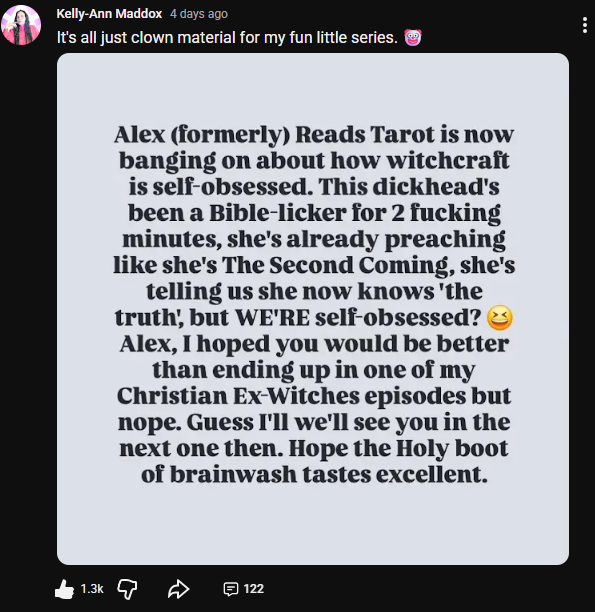
    Screenshot of a social media post by Kelly-Ann Maddox discussing Alex (formerly) Reads Tarot's recent conversion to Christianity. The post strongly criticises Alex's comments about witchcraft and uses profane language to express disappointment and anger. The post received around 1,300 likes and more than 120 comments.

    As I read her words, I wasn’t thinking about Alex.

    I was thinking about Doreen Virtue.

    More specifically, I was thinking about the woman I was when Doreen announced her conversion to Evangelical Christianity in 2017.

    The memories came flooding back before I’d even finished reading. I suddenly realised I hadn’t made peace with that chapter of my own life as much as I’d believed.

    When Doreen Virtue first announced her conversion to Evangelical Christianity, I respected her right to change her beliefs. After all, I knew from my own life that spiritual journeys can take unexpected turns. What I struggled with was what came afterwards.

    Renouncing tarot soon became denouncing it. Oracle cards, angels, crystals and many of the spiritual practices she had once taught were no longer presented as simply no longer being for her. They were increasingly described as spiritually dangerous or demonic. As former students questioned her dramatic change of direction, many felt they weren’t just being disagreed with—they were being told they had been deceived, were under demonic influence, or were serving the enemy.

    That changed everything.

    Like many people who had benefited from Doreen’s work, I felt betrayed. Not because she’d become an Evangelical Christian, but because it seemed as though she had rewritten the story of everyone who had walked alongside her.

    I reacted badly.

    I wrote articles criticising Doreen. They became some of the most successful posts I’d ever published. At the time, I thought I was defending my community. Looking back, I can see that I was also feeding an outrage cycle that ultimately did none of us any good—least of all me.

    At the time, those articles felt justified. They were widely shared, they sparked discussion and, if I’m honest, I enjoyed the validation. It felt good to know other people agreed with me. Every comment, every share and every spike in traffic convinced me I was on the right side of the argument.

    But there was another side to that success that I couldn’t see at the time.

    The more I wrote about what Doreen was doing wrong, the less attention I paid to my own spiritual life. My energy became entangled with someone else’s journey. Instead of asking where the Divine was leading me, I became preoccupied with where Doreen had gone wrong.

    Looking back with nearly a decade of hindsight, I no longer believe that was healthy. In fact, I think it played no small part in my own religious trauma resurfacing. I was convinced I was resisting spiritual abuse. In reality, that level of entanglement has a habit of rebounding on us.

    Which brings me back to Kelly-Ann’s post.

    Reading it, I didn’t feel the urge to argue with her. Nor did I feel the urge to defend Alex.

    What I felt instead was grief.

    Because I recognised something painfully familiar: the heartbreak that ripples through a community when someone whose work has mattered to us changes direction so dramatically that it feels like they’ve rejected not only a practice, but the people who shared it with them.

    I don’t think my biggest mistake was criticising Doreen Virtue. I still believe some of what she said after her conversion caused genuine harm, especially to people already carrying religious trauma. My mistake was believing that answering outrage with more outrage could somehow make things better.

    Over the past few weeks, I’ve been immersed in Henry Cornelius Agrippa’s Three Books of Occult Philosophy. One idea keeps confronting me. Agrippa has very little patience for dialectics. He regards dialectics as one of the great traps of the fallen intellect. We become so busy proving ourselves right that we forget to seek the One who is Truth.

    That has left me with an uncomfortable question.

    What if the need to be right is itself part of the problem?

    Looking back at 2017, I can see how easily I was drawn into it. I wasn’t seeking understanding. I was building a case. Every new statement from Doreen became another exhibit. Every article strengthened my position. Every surge in traffic convinced me I was fighting the good fight.

    But where was the Good in any of it?

    What troubles me is how readily we reach for the courtroom instead of the Upper Room.

    We gather evidence. We assemble arguments. We decide who is orthodox, who is deceived, who belongs and who doesn’t. Then we congratulate ourselves for standing on the right side.

    Yet when I read the Gospels, I see something altogether different. Yeshua challenged people—sometimes with astonishing directness—but His aim was never to win an argument. His purpose was always restoration. Even His strongest rebukes were invitations to repentance, not performances for a crowd.

    I can’t help wondering how differently these conversations might unfold if more of us asked a different question.

    Not, “How do I prove I’m right?”

    But, “How do I respond in a way that brings restoration to this situation?”

    That’s the question I wish I’d been asking in 2017.

    It’s also the question I hope I’ll still be asking when the next controversy comes along.

    purple lisa signature

  • I’m So Full of Shit (And So Are You): The Stories We Tell Ourselves

    I’m So Full of Shit (And So Are You): The Stories We Tell Ourselves

    Yesterday’s post, 29 June 2026: Crossroads Devotion, ended with a prayer.

    Not because I was trying to sound holy. Not because I wanted anyone to think I’d somehow transcended ordinary human frailty overnight. I wrote it because, in that moment, it genuinely reflected where my heart was.

    Then I read it again this morning.

    Oh, good grief…

    If I didn’t know myself better, I’d think I’d achieved enlightenment sometime between my first coffee and hitting the Publish button.

    It was all love, grace, and compassion on the Middle Path. Beautiful sentiments, all of them. Sincere sentiments too.

    The only problem was that I’d accidentally presented one facet of myself as though it were the whole person.

    Fast forward twenty-four hours and I’m sitting here rolling my eyes at my own sanctimony, quietly remembering that I’m also capable of being impatient, sarcastic, judgmental and occasionally spectacularly full of myself.

    That’s not a contradiction.

    That’s just being human.

    Wholehearted, Not Holy

    The older I get, the more suspicious I become of my own attempts to sound spiritually evolved.

    I think that’s one of the reasons the Christo-Hekatean path has felt so liberating. It isn’t because I’ve stopped caring about ethics. Quite the opposite. It’s because I’m increasingly allergic to hypocrisy, especially my own.

    For years, spirituality often felt like a performance review. Was I loving enough? Forgiving enough? Detached enough? Had I responded with sufficient grace? Was my ego showing?

    No wonder shame was never very far away.

    These days, I’m much more interested in wholeness than holiness. I don’t want to spend the second half of my life editing myself into someone who sounds enlightened. I’d rather become more honest about who I already am.

    That means making room for contradictions.

    I can genuinely want peace and still lose my temper.

    I can believe in compassion and still think someone is being an absolute prick.

    Neither cancels the other out.

    A Rabbit Hole Worth Falling Into

    This morning, I stumbled across a video about Dr John DeMartini’s method. I’d never come across his work before, but within a few minutes, I had the same feeling I remember having when I first discovered Byron Katie over twenty years ago.

    It wasn’t that either of them handed me answers.

    They handed me better questions.

    As I listened, I found myself becoming increasingly aware of the stories quietly running in the background of my own mind. We all have them. They help us make sense of the world, until one day we stop recognising them as stories and start treating them as objective reality.

    That made me wonder what narratives I’ve been carrying around for years without ever examining them properly.

    Relationship narratives immediately sprang to mind.

    Not any one relationship in particular. Just the collection of stories I’ve accumulated over a lifetime about love, romance, marriage, commitment, intimacy and what all those things are supposed to mean.

    I’ve no doubt some of those stories are complete bollocks.

    An Unexpected Answer

    One question refused to leave me alone: What do I actually want from love?

    It sounds ridiculously simple, but I realised I’d never asked it without all the background noise of expectation. I wasn’t interested in the answer offered by religion, romantic films or society’s collective script. I wanted to know what remained once all those voices had quietened down.

    The answer surprised me by arriving so quickly: freedom. Not freedom from love, but freedom within love. Freedom to remain curious, to keep growing, and to pursue truth without feeling as though I have to squeeze myself into a role that no longer fits.

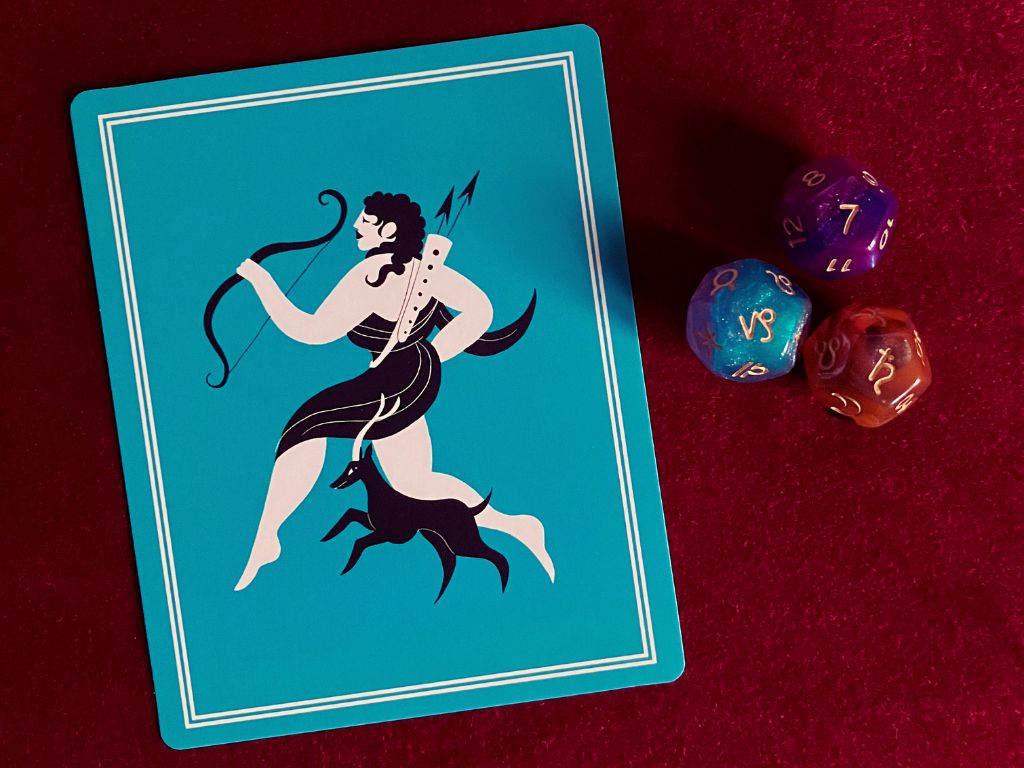
    That thought was still rattling around my head when I reached for my astrology dice.

    Saturn in Capricorn in the Seventh House.

    (Sometimes symbolism has all the subtlety of a 2×4 upside the head.)

    There it was: duty, convention, inherited expectations and obligations.

    Then I picked a card from Stephen Fry’s Mythos Oracle.

    Artemis. I smiled.

    I’ve always thought of myself as a hopeless romantic.

    Perhaps I’ve been wrong.

    Perhaps what I’ve really been hunting all these years is truth. All my writing is about romancing the Truth. Yes, capital T.

    Turning the Cards Around

    The biggest gift I took away from DeMartini’s work was the possibility of a more honest divination practice.

    For years, I’ve encouraged Tarot clients to ask thoughtful questions when they come for readings. Sometimes I forget that advice applies to me as well.

    It’s remarkably easy to use Tarot and other divination tools as mirrors that reflect whatever narrative we’re already invested in believing. I’ve done it many times. I’m fairly sure everyone who engages in divinatory practices has done it.

    From now on, I’d like to focus more on questions like these:

    • What story am I telling myself that this card quietly refuses to support?
    • Which assumption have I promoted to the status of fact without ever really questioning it?
    • What part of the picture am I conveniently leaving out?
    • If the opposite were also true, what might I be failing to see?
    • What expectation is shaping the way I’m interpreting this card?
    • Am I asking this oracle to reveal the truth, or simply to confirm what I already believe?
    • If I let go of my preferred narrative for a moment, what else becomes possible?
    • What would change if I stopped trying to be right and became genuinely curious instead?

    I’m under no illusion that this will stop me projecting onto the cards at times when I read for myself. That’s probably impossible.

    What it might do is help me notice when I’m doing it.

    And that feels like a worthwhile practice.

    After all, the cards have never lied to me.

    More often than not, I’ve simply been a little too attached to my own BS.

    purple lisa signature

  • The Chiron Return That Nearly Destroyed Me

    The Chiron Return That Nearly Destroyed Me

    On 12 January 2020, Saturn and Pluto met in Capricorn. It was also my fiftieth birthday and I was in the middle of my Chiron Return.

    At the time, I had no idea that my life was about to unravel. Looking back, however, I can see the pressure building long before the conjunction became exact. My anxiety levels had been rising for months, and every instinct I possessed was screaming that something was wrong. I couldn’t have explained exactly what I sensed, only that something immense was approaching.

    The following day, the COVID-19 narrative exploded across the media. Within two weeks, I was convinced that we were witnessing the largest psyop of modern times. Whether you agree with that assessment is ultimately beside the point. This is not an article about COVID. It is an article about what happened when I trusted my own perception and discovered that the price of doing so was exile.

    At the time, I believed I had found my tribe. I had spent years building friendships within the Tarot and Pagan communities. These were people I admired, respected, and trusted. Many considered themselves intuitive, psychic, spiritually aware, and capable of independent thought.

    Then the fault lines appeared.

    What shocked me most was not that people arrived at different conclusions from my own. What shocked me was the speed with which fear seemed to transform thoughtful people into enforcers of a narrative that could not be questioned. Questions became dangerous. Doubt became unacceptable. Nuance vanished almost overnight. Censorship and cancel culture were used to control those who dared to think for themselves.

    My own body was screaming at me not to take the vaccine. Everything in me said no. Thankfully, I listened. Thankfully, so did my husband. Had he not eventually begun seeing things the way I did, I honestly don’t know where I would have ended up.

    The social consequences arrived quickly. I was blacklisted and publicly attacked. Videos were created with the sole purpose of targeting me, and comment sections filled with accusations that bore little resemblance to reality. I remember scrolling through one thread in disbelief as complete strangers confidently explained who I was, what I believed, and what motivated me. Apparently, I was racist. Apparently, I was dangerous. I was all sorts of things that I had never been.

    The details matter less than the cumulative effect. Years of unresolved religious trauma, complex PTSD, and undiagnosed autism collided at exactly the same moment. The pressure built until my nervous system simply could not hold it any longer.

    What followed was an object lesson in what happens when religious trauma, autism, and a global panic collide.

    At the height of the meltdown, I publicly declared myself a Christian and announced that I wanted nothing more to do with the occult. I packed up my Tarot decks, boxed my books, and loaded statues, ritual tools, magical journals, esoteric texts, and spiritual treasures collected over decades into the car. Then I asked my husband to drive me to the local recycling centre, where I got rid of nearly all of it.

    At the time, I believed I was doing the right thing. Today, I see something very different. I see an AuDHD nervous system desperately trying to restore order in the middle of overwhelming chaos. I see a traumatised woman trying to find certainty in a world that suddenly felt hostile and unfamiliar. Most of all, I see someone searching for solid ground.

    Once the worst of the meltdown subsided, I found myself facing an uncomfortable truth. The evangelical Christianity of my youth no longer fit either. I had imagined that I was returning home, but there was very little there for me to return to. The certainty I was seeking did not exist, and the answers I needed could not be found inside somebody else’s belief system.

    And so began the long and often humiliating process of rebuilding. Not only did I have to figure out what I actually believed, I had to do it in full public view after having very publicly burned down the life I had spent years creating. It turns out that humble pie is every bit as unpleasant as people say.

    Recovery was neither quick nor graceful. There was no lightning-bolt moment of revelation and no dramatic return to who I had been before. Instead, I found myself slowly picking through the wreckage, examining assumptions I had never previously questioned. I had to learn how to distinguish faith from fear, discernment from paranoia, and authentic spiritual experience from groupthink. More importantly, I had to learn how to trust my own perception again.

    For a long time, I questioned everything. I questioned my judgement, my intuition, my ability to read people, and even my ability to make sense of the world. Yet that questioning eventually led me somewhere healthier than certainty ever could have. It forced me to become more honest, more curious, more willing to admit when I did not know something, and ultimately more willing to think for myself.

    Only years later did I fully appreciate the symbolism of my Chiron return. Natal Chiron sits at 2° Aries in my 11th House. Aries asks us to become ourselves, while the 11th House asks us where we belong.

    My Chiron return forced those questions together in the most brutal way imaginable.

    I lost friendships. And I lost my sense of community. I very nearly lost my business. For a time, I even lost my sense of who I was. Yet the deeper lesson had very little to do with the people who rejected me and everything to do with the parts of myself I was still willing to reject in order to belong.

    As I write this, Chiron is preparing to leave Aries and enter Taurus. Because Taurus falls in my 12th House, I suspect the next chapter will be less visible than the last one.

    Chiron’s journey through my 12th House will be more about what has been operating behind the scenes all along. The old wounds around belonging, the fear of being too different, the lingering echoes of religious conditioning, and the unconscious survival strategies that once protected me but no longer serve me all seem likely candidates for examination. I also suspect it will bring me face-to-face with a deeper question: why I spent so much of my life searching for somewhere to belong rather than recognising that I belonged to myself all along.

    If Chiron in Aries asked me to stand alone when necessary, perhaps Chiron in Taurus will ask me to become comfortable in my own skin. Perhaps it will be less about fighting for the right to exist as myself and more about fully inhabiting the person I already am.

    Time will tell.

    What I do know is that the wounds remain part of my story. Religious trauma remains part of my story. The public attacks remain part of my story. The meltdown remains part of my story. None of those experiences can be undone, nor would I want to erase them if I could. They shaped me, humbled me, and forced me to rebuild on stronger foundations.

    Most importantly, they taught me that losing a tribe is sometimes the beginning of finding out who you are because there is nobody left to tell you.

    If you’ve been through your own season of exile, I’d love to hear about it in the comments.

    Looking back, can you see a hidden gift in what you lost?

    purple lisa signature