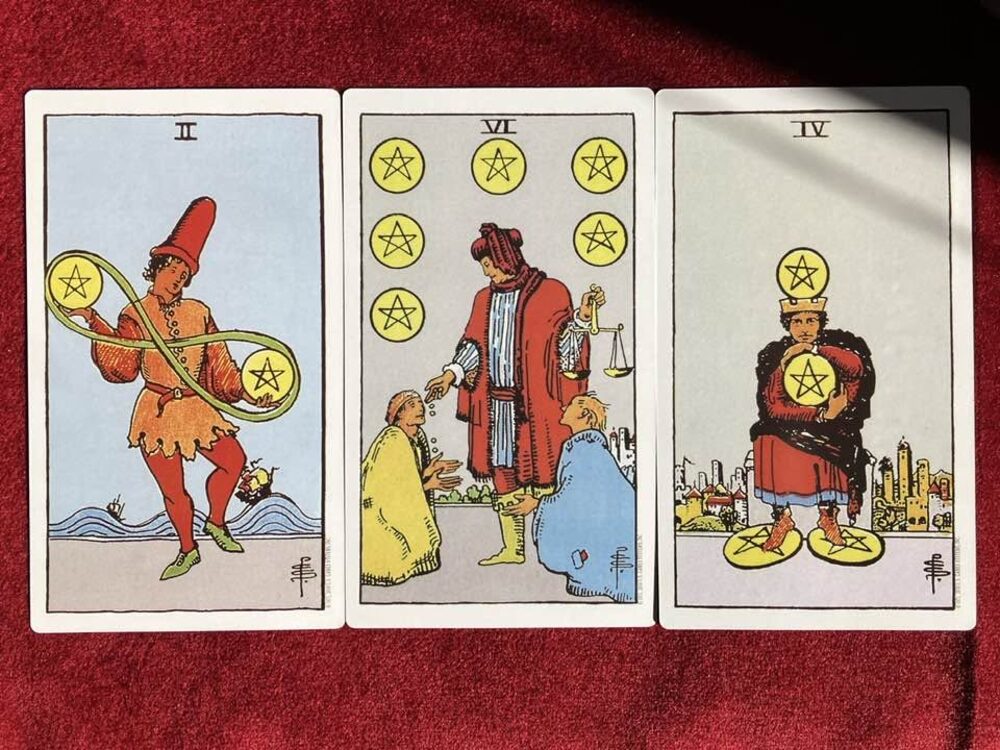
Some readings are comically literal. The three cards from the suit of Pentacles above describe almost exactly an event from this morning.
I live in a small, rural village in the North of England. Most people who live here are practical, grounded and at retirement age. You know, people who have had careers out in the real world. It’s actually a blessing that most people are older. This means fellow dog walkers, for instance, rarely ask what I do for a living. Since they no longer have to do anything for a living, they simply don’t care anymore.
However, that’s not true of everyone. Every now and again, someone asks me what I do for a living. For a moment I hesitate. I usually default to: “Self-employed, work from home.” Quietly hoping there will be no further investigation into the matter. Often it ends there. Phew!
Not so this morning. A fairly recently retired fellow dog walker took it upon himself to scrutinise my career choice. My vague reply prompted the follow-up question, “But what do you actually do.” I paused for a second, swayed on one leg like the dude in the 2 of Pentacles, and I blurted, “I’m a metaphysical writer, blogger and Tarot practitioner.”
I knew how it would land before it landed. “I don’t know anything about that. What does metaphysical mean?” When I tried to explain, he said squarely, “sounds supernatural,” and I knew he wanted to hear nothing more about it. I drew a couple of breaths, waiting for the inevitable silence to descend that demanded I ask him the same question in return. I obliged. Sigh.
What followed was a life story and a back-and-forth between the dog walker and my husband, full of The Sciences™ and, for some reason, guns and shooting. I also managed to get mansplained to by the dog walker when I, against my better knowing, tried to join in the conversation.
Essentially, the 6 of Pentacles was the man life-storying to me and my husband. And I’m sure he felt as if he was bonding and creating connection. I’m sure he doesn’t have a bad bone in his body. But fucking hell was I triggered. By the way, this isn’t the first time the 2 and 6 of Pentacles have spoken to me about exchange, isolation and belonging.
Most of the time, I’m okay with not fitting in. I’m okay because I’m not very often reminded of it. I walk my dogs, wave to other dog walkers, and sometimes talk about the weather. That even creates a superficial sense of belonging.
But then there are days like this. And I wonder what the point of even being here is.
And then I remember that belonging is not the same as blending in. Perhaps the point of being here is precisely to be the person who has to pause before answering that question. The metaphysical writer. The Tarot reader. The village eccentric in training. I may not fit naturally into conversations about guns and The Sciences™, but I’m not here to become more easily digestible.
Last autumn, Hekate interrupted my housework with clairaudience.
I wasn’t meditating. I wasn’t praying. I wasn’t performing a ritual beneath a full moon.
I was cleaning.
That probably doesn’t sound very impressive. Popular culture has conditioned us to expect spiritual experiences to arrive with dramatic special effects. If the Dark Mother wants to speak, surely there should be incense, solemn chanting, and at least one mysterious raven perched nearby.
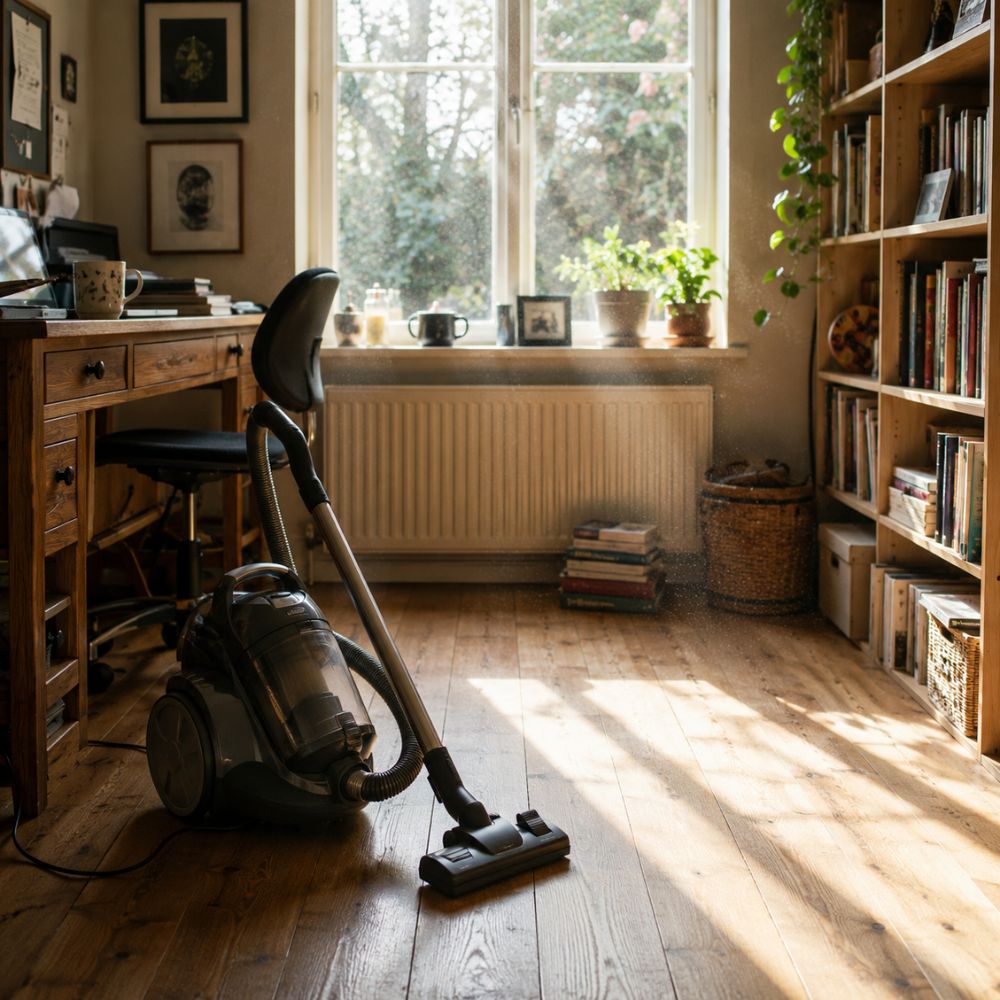
Instead, I was dusting surfaces, putting things away and moving my hoover rhythmically back and forth across my office floor.
Then, for roughly half an hour, I had what I can only describe as a god-phone.
I’ve always been intermittently clairaudient. I don’t have it on tap. I can’t summon it at will. In fact, the harder I try, the less likely it seems to happen. The experiences arrive when they arrive, often at inconvenient or unexpected moments.
This was one of those moments.
As often happens with a neurodivergent brain, I slipped into a deeply absorbed state while cleaning. Not in trance exactly. Just focused enough that the constant chatter of ordinary thought had faded into the background.
Then a voice arrived.
Not an audible voice in the room. Nothing like that.
The experience was closer to receiving complete thoughts, fully formed, carrying a distinct personality and presence that felt separate from my own internal dialogue. The answers arrived before I had properly finished forming the questions.
“Who are you?” I asked.
“Hekate.”
The reply was immediate.
What followed was one of the most unusual conversations of my life.
Every question seemed to receive an answer. Not just information, but understanding. There was a warmth to the exchange that surprised me. Wisdom without judgement. Clarity without pressure.
One of the things she told me was that I needed to learn to trust myself before we could properly work together.
That landed harder than it might sound.
At the time, I was still at the tail end of recovering from decades of religious trauma. Much of that journey involved learning to trust my own perception again after spending a lifetime outsourcing authority to other people, systems, and beliefs.
Trusting a deity is one thing.
Trusting yourself is another.
At one point, I asked a question that had been sitting quietly in the back of my mind for some time.
Are you and Santa Muerte the same being?
The answer came immediately.
“We are sisters, and she is handing you over to me now.”
That answer surprised me.
Santa Muerte had been an important presence in my spiritual life for some time. I felt extremely devoted to her. Hekate had been calling for even longer, but I had resisted her. If I’m honest, part of that resistance came from the fact that she seemed too popular. Another part came from fear. Public devotion to Hekate felt more vulnerable somehow. There is nearly as much gatekeeping around Hekate as there is around Evangelical Christianity.
Yet here she was, apparently explaining a transition that was already underway.
The strangest part is that, looking back now, she was right.
At the time, Hekate was not the central focus of my spiritual practice.
The shift happened gradually. Hekate Drakaina was born. My understanding of the crossroads deepened. My life (hello menopause) and work increasingly centred around themes of transformation, sovereignty and what I now think of as the World Soul.
The conversation wasn’t predicting the future in the fortune-telling sense.
It was describing a process already unfolding.
That experience also changed the way I think about clairaudience.
Most people expect spiritual communication to happen during ritual, meditation, or prayer. Those certainly can create the conditions for it. Yet many of the people I’ve spoken to over the years describe receiving insights while walking, driving, gardening, showering, or doing housework.
There seems to be something about repetitive activities that opens a different kind of space.
The doorway stands open for a moment.
Whether you interpret experiences like mine as communication from a deity, the subconscious mind, the higher self, or something else entirely is ultimately up to you.
I can only tell you what happened.
I was cleaning the house.
A conversation began.
The answers carried a wisdom and warmth that felt unlike my ordinary thoughts.
And nine months later, the shift she described has quietly unfolded.
The gods, if they choose to speak, don’t always wait for sacred circles and carefully planned rituals.
This year marks twenty years since I published my first blog post.
When I started blogging in 2006, Facebook was still finding its feet, Twitter didn’t exist yet, and nobody was talking about algorithms, content strategies, personal brands, or AI.
We simply wrote about our interests. Some of us spent an inordinate amount of time writing about our special interests because nobody else wanted to listen to us harp on about them. Looking back, perhaps that should have been my first clue.
Then we wandered around the blogosphere reading what everyone else had written and leaving comments.
The internet felt smaller then. More human.
Twenty years later, I find myself launching yet another website and reflecting on what blogging has given me over the past two decades.
These are some of the lessons that stand out.
1. Blogging changed my life
This sounds dramatic, but it’s true.
If I hadn’t started blogging, I would never have built the business that followed. I wouldn’t have met many of the people who became friends. I wouldn’t have discovered so much about myself.
A simple habit of writing online altered the course of my life.
2. Authenticity is not a marketing strategy
These days, authenticity is often discussed as though it were another branding technique.
People can tell the difference.
I have written thousands of posts. The posts that resonated most deeply were rarely the ones I carefully optimised. They were the ones where I was simply telling the truth or asking a question that others were curious about, too.
3. You never run out of ideas if you stay curious
All these years, people have repeatedly asked how I keep finding things to write about.
The answer is that ideas are everywhere.
Questions become posts.
Books become posts.
Conversations become posts.
Tarot readings and spread ideas become posts.
Life becomes blog posts.
Curiosity is an inexhaustible source of material.
Not worrying about whether other people will find it interesting helps, of course. It’s the writerly equivalent of dancing as if nobody is watching.
That is honestly how I’ve been writing my whole life.
Autistic much?
4. A blog can become a spiritual practice
Long before I recognised it as such, blogging became part of my spiritual path.
Writing helps me clarify what I think, what I believe, and what I am willing to question.
Many of my most important spiritual insights arrived while trying to explain something to someone else.
Then there is the light trance that sometimes settles in while I’m typing. Time disappears. The words seem to arrive more quickly than conscious thought. It feels less like constructing an argument and more like receiving one.
I’m curious whether other writers experience this too.
Whether we call it flow state, inspiration, or channelling, some of my most meaningful writing has emerged from that space.
5. The internet remembers everything
This can be comforting and horrifying in equal measure.
I’ve published things I’m proud of and things that make me cringe.
Both remain part of the record.
I’ve learned to make peace with that.
When I happen across the cringey bits, I think, “Phew. At least I didn’t turn that into a book.”
6. Starting over is not failure
I’ve started over more than once.
New websites.
New directions.
New beliefs.
New identities.
Every reinvention taught me something.
The willingness to begin again may be one of the most valuable skills I’ve learned.
7. Every successful blog is built one post at a time
It’s easy to look at an established site and imagine it appeared fully formed.
It didn’t.
Every successful blog begins with a blank page and a single post.
Then another.
And another.
Sometimes, the Tower strikes. Twice, I’ve had websites simply vanish overnight, without explanation (WordPress.com both times). Gone forever.
Yet the foundations remained. The projects that were meant to last kept growing gradually.
8. Community matters more than follower counts
One thoughtful comment is worth more than a hundred anonymous likes.
The relationships formed through blogging have often been more meaningful than any traffic statistic.
These days, thoughtful comments are like gold dust, but they are still what keep me going.
9. The comments section used to be the social network
I miss this.
Before social media took over, bloggers visited one another’s sites, left comments, and built genuine communities.
The internet felt less like a marketplace and more like a village.
Part of me would love to see that return.
10. Burnout can disguise itself as ambition
This is one I learned the hard way.
At one point, one of my websites was attracting thousands of visitors per day and generating an excellent income.
From the outside, it looked like success.
From the inside, I was exhausted.
At the time, I didn’t know I might be AuDHD. Looking back, what I called dedication may have contained a substantial amount of burnout.
Achievement is not always evidence that something is sustainable.
11. Making money from blogging is still possible
People have been declaring blogging dead for at least fifteen years.
Meanwhile, bloggers continue to build businesses.
The landscape changes. The opportunities change. The methods change.
But valuable content remains valuable.
My prediction is that genuinely personal writing will become even more valuable in the age of AI. Facts and information are becoming increasingly accessible. What remains scarce is lived experience, individual perspective, and the courage to share both honestly.
12. SEO is a tool, not a purpose
SEO helps people find your work.
It should never become the reason for creating it.
Whenever I worried more about search engines than my readers, the writing suffered.
13. Your blog grows as you grow
Every website I’ve created is a snapshot of who I was at the time.
Looking back through old posts is like opening a time capsule.
The blogs changed because I changed.
14. Writing helped me heal
Blogging has accompanied me through spiritual transformation, religious trauma, grief, joy, reinvention, and countless periods of uncertainty.
Sometimes the writing itself became part of the healing.
15. Some of my biggest breakthroughs happened in public
Not because I intended them to.
Simply because I was documenting the journey as I went.
There is something powerful about allowing people to witness growth rather than presenting a polished version after the fact.
16. Plagiarism hurts
There is no point pretending otherwise.
Seeing your work copied without permission is frustrating.
Over time, I’ve learned not to dwell on it.
The original source of the work remains with the creator.
17. Social media is rented land
This may be the most important lesson of all.
Platforms come and go.
Algorithms change.
Accounts disappear.
A self-hosted blog is still one of the few places online that genuinely belongs to you.
18. To AI or not to AI?
As Dr Angela Puca writes in an excellent essay on Substack, the question is not if we use AI, but how.
Used carelessly, AI can regurgitate information and platitudes.
Used thoughtfully, it can help us brainstorm, organise ideas, edit drafts, and explore new perspectives.
The challenge is remaining human while using increasingly powerful tools. I shared my own thoughts on how to use AI without losing my voice in this article.
19. My blog became the foundation of a business
When I published my first post, I had no business plan.
Years later, blogging became the foundation of the work I do today.
Not because I set out to build a business, but because I kept showing up and writing.
20. Twenty years later, I still love blogging
That may be the lesson that surprises me most.
The platforms changed.
The technology changed.
The internet changed.
I changed.
Yet somehow the simple act of sitting down with an idea and turning it into words still feels like magic.
Twenty years ago, I started a blog because I was curious.
Twenty years later, despite all the changes in algorithms, social media platforms, SEO updates, AI tools, successes, failures, reinventions, and false starts, the reason hasn’t changed.