Yesterday, one of my long-standing prayers was answered in a charity shop.
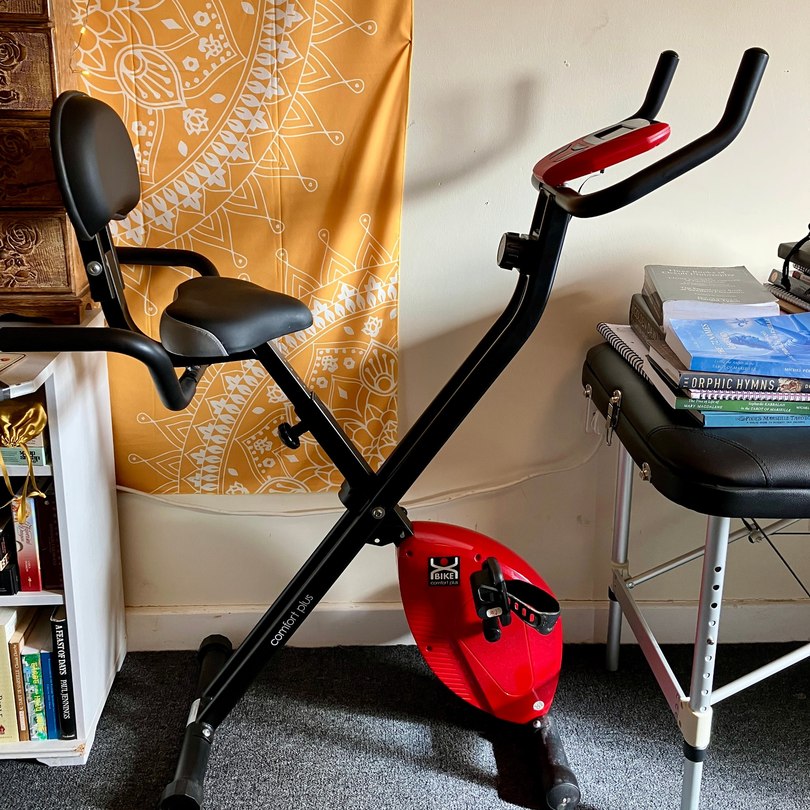
There were no choirs of angels. No shaft of celestial light broke through the ceiling. Instead, I found an affordable folding exercise bike with a supportive seat and handles in exactly the right place.
This morning, I pedalled until my heart rate rose. I was so happy that I nearly cried.
That may sound like an excessive response to an exercise bike. A year ago, I might have thought so too. But advanced arthritis in both hips has reduced my ability to walk to a fraction of what it once was. I am waiting for a total hip replacement, and even short walks have become difficult. Aerobic exercise, which used to be an ordinary part of life, had become almost impossible.
Then this little red bike appeared.
When Movement Is Part of Who You Are
I have always had a ferocious appetite for movement. I trained as a dance teacher and have a background in classical ballet. Physical expression was never merely something I did to keep fit. It was one of the primary ways I experienced myself as alive.
I had imagined ageing gracefully. I pictured myself becoming a silver swan. The present reality is rather more sorry lame duck.
Losing mobility has therefore affected far more than my body. The pain is hard, but the effect on my mental health has been one of the most difficult parts of this experience. When you are used to processing emotion, energy and stress through movement, enforced stillness can feel like being gradually sealed inside yourself.
There is also the loss of agency. I could feel my fitness deteriorating while being unable to do much about it. Walking far enough to raise my heart rate was out of the question. Most forms of aerobic exercise placed too much strain on my hips. Every week of waiting for surgery seemed to narrow my world a little further.
The bike has changed that.
The Right Bike at the Right Time
The handles behind the seat allow me to lean back into the support rather than folding forward over the handlebars. This means I do not feel so compressed through the hip joint while pedalling. It is also easy to pull out and climb onto, which matters enormously when every transfer has to be calculated.
When I am not using it, it folds neatly against the wall. It will not obstruct me when I am moving around with my walker during the first couple of weeks after the operation.
I now have the date for my preassessment, which means the hip replacement will probably take place at the end of October or in early November at the latest. Until then, I can do something. I can work within my limits to maintain, and perhaps even improve, my cardiovascular fitness instead of watching it rapidly decline.
I am not pretending that the bike is a cure. Nor do I intend to bully damaged joints through pain in the name of discipline. But it gives me a manageable form of movement that my body can currently tolerate. After months of doors closing, one has opened.
Why Exercise Matters in Magical Practice
The timing feels especially significant because I am currently working through the Golden Dawn Neophyte practices.
In Kabbalah, Magic & the Great Work of Self Transformation, Lyam Thomas Christopher makes physical exercise part of his magical curriculum from the beginning. He does not present it as an optional lifestyle accessory for the especially energetic magician. In the Neophyte grade, he calls some form of physical exercise mandatory.
His central point is simple: “A strong, balanced existence in this world is a prerequisite for a healthy one in others” (p. 69).
Christopher argues that ceremonial magic is intensely inward. It involves study, ritual, visualisation, willpower and imagination. Without an outward and embodied counterbalance, those faculties can become disproportionately developed. The student may feel spiritually powerful while becoming increasingly detached from ordinary physical reality.
Exercise brings the magician back into the World of Action. It reveals genuine limits. It asks the body to participate rather than allowing the mind to construct ever more impressive ideas about its own powers. In Christopher’s view, this also guards against ego inflation. A workout is remarkably good at puncturing grandiosity. The body will tell you exactly where you are, regardless of the grade title you have given yourself.
Physical training also turns will into something lived. Magical will is not strengthened only by vibrating divine names or holding a visualisation. It is strengthened when we keep an appropriate promise to the body, work consistently and make gradual changes in the material world.
A Grade-by-Grade Education in the Body
Christopher’s suggested forms of exercise follow the elemental grades. The Neophyte begins with the Alexander Technique, developing awareness of posture and the habitual ways we misuse the body. Zelator adds Pilates to build foundational strength, flexibility, mobility and bodily awareness.
For Theoricus, he prescribes cardiovascular exercise. His suggestions include jogging, skipping, trampolining and, rather wonderfully in my present circumstances, bicycling or spinning. He stresses starting lightly, building gradually and remaining mindful of personal limitations.
Practicus moves into resistance training and the deliberate reshaping of the body. Philosophus introduces energetic dance, which Christopher describes as a meeting of spirit and matter through movement. Finally, the Portal grade uses Chi Gung to cultivate the conscious movement of energy through the body.
The exact programme will not suit every person or every body. Some of its prescriptions are demanding, and anyone dealing with illness, disability, injury or severe arthritis must adapt exercise to their actual circumstances and medical guidance. But the deeper pattern is valuable. Magical development is not an escape from embodiment. It is a progressive education in how we inhabit, understand and work with the body.
Adaptation Is Part of the Work
Living with severe mobility restrictions has added an important qualification to Christopher’s teaching for me. Physical capacity is not a measure of spiritual worth. A person is not a lesser magician because they cannot run, dance, stand for ritual or complete a conventional workout.
The work is not to punish the body for failing to match an ideal or a syllabus. The work is to meet the body honestly and discover what is possible now.
Sometimes discipline means pushing beyond inertia. Other times it means stopping before pain becomes injury. And sometimes it means exchanging a brisk walk for a few careful minutes on a charity-shop exercise bike. Adaptation is not cheating. It is intelligence applied to circumstance.
As I engage with the Neophyte practices, I no longer have to feel that I am incapable of maintaining my physical vessel. Maintenance no longer means preserving the body of the dancer I once was. It means staying in relationship with the body I have today. It means listening, responding and giving it whatever movement it can receive.
That feels like a magical practice in its own right.
From Silver Swan to Lame Duck—and Back Again
I will admit that I got cocky. My training and lifelong love of exercise made me assume that mobility would always be mine. I thought I knew my body and could rely on it. I never imagined that I would have to plan a route around the width of a walker or assess a chair according to whether I could get out of it again.
This experience is humbling me by the minute. It is giving me far greater empathy for people who live with disabilities and chronic restrictions on movement. I am learning how much of the world quietly assumes an able body. I am also learning how exhausting it is to negotiate pain before doing the smallest ordinary thing.
This is not necessarily a lesson I would have chosen for myself. I doubt anyone would. But since I am here, I intend to learn from it.
I do not wallow in self-pity. Instead, I do what I can. I probably have my Capricorn stellium to thank for that particular strain of grit during the more oppressive trials of life.
As the saying goes—apparently not Churchill, despite what the internet insists—when you are going through hell, keep going.
For me, “keep going” currently means pedalling without travelling anywhere. Yet this morning, on a stationary bike in the corner of a room, I felt movement return to my life.
My heart beat faster. My mood lifted. The future no longer looked like an uninterrupted decline towards surgery. I could participate in my own preparation again.
That is why the bike feels like an answered prayer. It has not removed the pain or shortened the waiting list. It has given me something just as necessary: a glimmer of hope and a way to act on it.
Perhaps I should call her Hope.
She may be stationary, but she is already taking me somewhere.
Source
Christopher, Lyam Thomas. Kabbalah, Magic & the Great Work of Self Transformation. Llewellyn Publications, 2006, pp. 68–69 and Appendix B, pp. 345–352.