
I wasn’t planning to write about the Alex (formerly) Reads Tarot controversy again.
Like many people, I’d been watching it from a distance. I had no desire to add another opinion to an already overflowing internet.
Then I came across this post by Kelly-Ann Maddox.
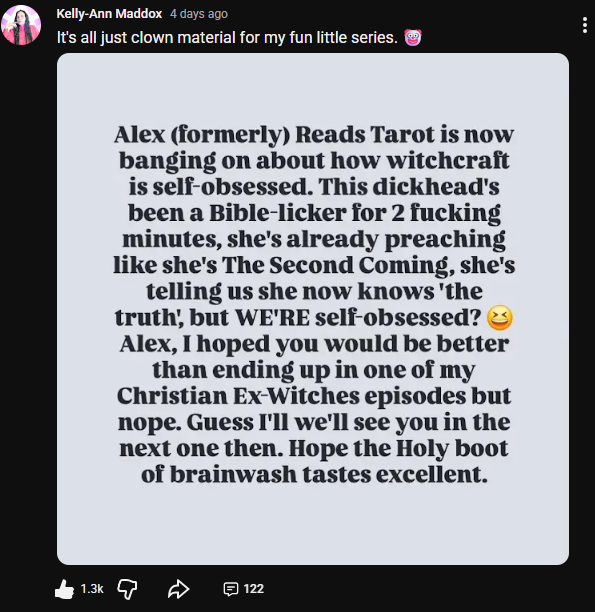
As I read her words, I wasn’t thinking about Alex.
I was thinking about Doreen Virtue.
More specifically, I was thinking about the woman I was when Doreen announced her conversion to Evangelical Christianity in 2017.
The memories came flooding back before I’d even finished reading. I suddenly realised I hadn’t made peace with that chapter of my own life as much as I’d believed.
When Doreen Virtue first announced her conversion to Evangelical Christianity, I respected her right to change her beliefs. After all, I knew from my own life that spiritual journeys can take unexpected turns. What I struggled with was what came afterwards.
Renouncing tarot soon became denouncing it. Oracle cards, angels, crystals and many of the spiritual practices she had once taught were no longer presented as simply no longer being for her. They were increasingly described as spiritually dangerous or demonic. As former students questioned her dramatic change of direction, many felt they weren’t just being disagreed with—they were being told they had been deceived, were under demonic influence, or were serving the enemy.
That changed everything.
Like many people who had benefited from Doreen’s work, I felt betrayed. Not because she’d become an Evangelical Christian, but because it seemed as though she had rewritten the story of everyone who had walked alongside her.
I reacted badly.
I wrote articles criticising Doreen. They became some of the most successful posts I’d ever published. At the time, I thought I was defending my community. Looking back, I can see that I was also feeding an outrage cycle that ultimately did none of us any good—least of all me.
At the time, those articles felt justified. They were widely shared, they sparked discussion and, if I’m honest, I enjoyed the validation. It felt good to know other people agreed with me. Every comment, every share and every spike in traffic convinced me I was on the right side of the argument.
But there was another side to that success that I couldn’t see at the time.
The more I wrote about what Doreen was doing wrong, the less attention I paid to my own spiritual life. My energy became entangled with someone else’s journey. Instead of asking where the Divine was leading me, I became preoccupied with where Doreen had gone wrong.
Looking back with nearly a decade of hindsight, I no longer believe that was healthy. In fact, I think it played no small part in my own religious trauma resurfacing. I was convinced I was resisting spiritual abuse. In reality, that level of entanglement has a habit of rebounding on us.
Which brings me back to Kelly-Ann’s post.
Reading it, I didn’t feel the urge to argue with her. Nor did I feel the urge to defend Alex.
What I felt instead was grief.
Because I recognised something painfully familiar: the heartbreak that ripples through a community when someone whose work has mattered to us changes direction so dramatically that it feels like they’ve rejected not only a practice, but the people who shared it with them.
I don’t think my biggest mistake was criticising Doreen Virtue. I still believe some of what she said after her conversion caused genuine harm, especially to people already carrying religious trauma. My mistake was believing that answering outrage with more outrage could somehow make things better.
Over the past few weeks, I’ve been immersed in Henry Cornelius Agrippa’s Three Books of Occult Philosophy. One idea keeps confronting me. Agrippa has very little patience for dialectics. He regards dialectics as one of the great traps of the fallen intellect. We become so busy proving ourselves right that we forget to seek the One who is Truth.
That has left me with an uncomfortable question.
What if the need to be right is itself part of the problem?
Looking back at 2017, I can see how easily I was drawn into it. I wasn’t seeking understanding. I was building a case. Every new statement from Doreen became another exhibit. Every article strengthened my position. Every surge in traffic convinced me I was fighting the good fight.
But where was the Good in any of it?
What troubles me is how readily we reach for the courtroom instead of the Upper Room.
We gather evidence. We assemble arguments. We decide who is orthodox, who is deceived, who belongs and who doesn’t. Then we congratulate ourselves for standing on the right side.
Yet when I read the Gospels, I see something altogether different. Yeshua challenged people—sometimes with astonishing directness—but His aim was never to win an argument. His purpose was always restoration. Even His strongest rebukes were invitations to repentance, not performances for a crowd.
I can’t help wondering how differently these conversations might unfold if more of us asked a different question.
Not, “How do I prove I’m right?”
But, “How do I respond in a way that brings restoration to this situation?”
That’s the question I wish I’d been asking in 2017.
It’s also the question I hope I’ll still be asking when the next controversy comes along.