Tag: Golden Dawn

  • A Magic Bike Named Hope: Movement as Magical Practice

    A Magic Bike Named Hope: Movement as Magical Practice

    Yesterday, one of my long-standing prayers was answered in a charity shop.

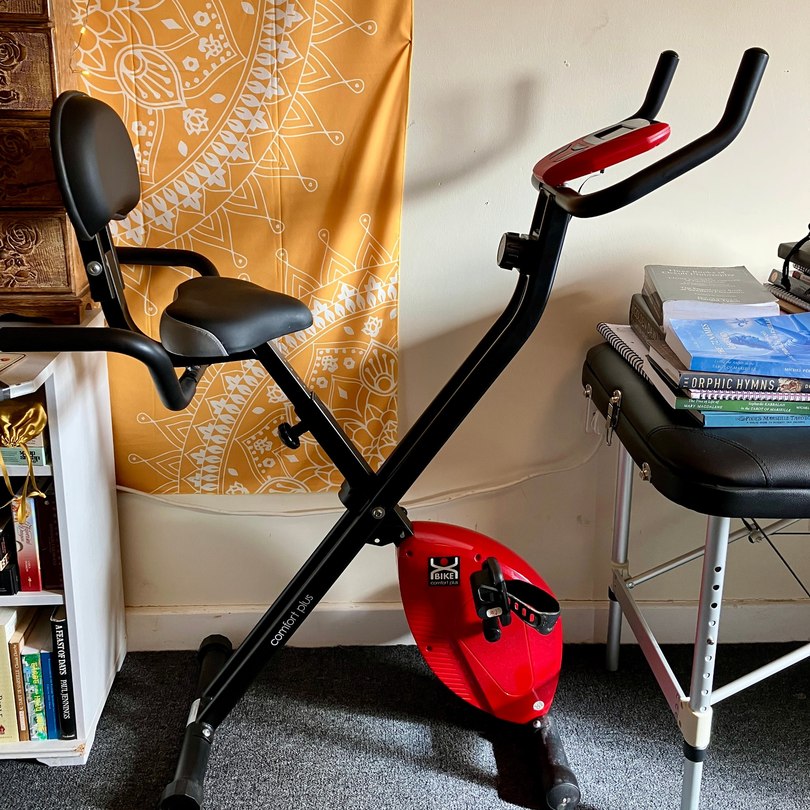
    There were no choirs of angels. No shaft of celestial light broke through the ceiling. Instead, I found an affordable folding exercise bike with a supportive seat and handles in exactly the right place.

    This morning, I pedalled until my heart rate rose. I was so happy that I nearly cried.

    That may sound like an excessive response to an exercise bike. A year ago, I might have thought so too. But advanced arthritis in both hips has reduced my ability to walk to a fraction of what it once was. I am waiting for a total hip replacement, and even short walks have become difficult. Aerobic exercise, which used to be an ordinary part of life, had become almost impossible.

    Then this little red bike appeared.

    When Movement Is Part of Who You Are

    I have always had a ferocious appetite for movement. I trained as a dance teacher and have a background in classical ballet. Physical expression was never merely something I did to keep fit. It was one of the primary ways I experienced myself as alive.

    I had imagined ageing gracefully. I pictured myself becoming a silver swan. The present reality is rather more sorry lame duck.

    Losing mobility has therefore affected far more than my body. The pain is hard, but the effect on my mental health has been one of the most difficult parts of this experience. When you are used to processing emotion, energy and stress through movement, enforced stillness can feel like being gradually sealed inside yourself.

    There is also the loss of agency. I could feel my fitness deteriorating while being unable to do much about it. Walking far enough to raise my heart rate was out of the question. Most forms of aerobic exercise placed too much strain on my hips. Every week of waiting for surgery seemed to narrow my world a little further.

    The bike has changed that.

    The Right Bike at the Right Time

    The handles behind the seat allow me to lean back into the support rather than folding forward over the handlebars. This means I do not feel so compressed through the hip joint while pedalling. It is also easy to pull out and climb onto, which matters enormously when every transfer has to be calculated.

    When I am not using it, it folds neatly against the wall. It will not obstruct me when I am moving around with my walker during the first couple of weeks after the operation.

    I now have the date for my preassessment, which means the hip replacement will probably take place at the end of October or in early November at the latest. Until then, I can do something. I can work within my limits to maintain, and perhaps even improve, my cardiovascular fitness instead of watching it rapidly decline.

    I am not pretending that the bike is a cure. Nor do I intend to bully damaged joints through pain in the name of discipline. But it gives me a manageable form of movement that my body can currently tolerate. After months of doors closing, one has opened.

    Why Exercise Matters in Magical Practice

    The timing feels especially significant because I am currently working through the Golden Dawn Neophyte practices.

    In Kabbalah, Magic & the Great Work of Self Transformation, Lyam Thomas Christopher makes physical exercise part of his magical curriculum from the beginning. He does not present it as an optional lifestyle accessory for the especially energetic magician. In the Neophyte grade, he calls some form of physical exercise mandatory.

    His central point is simple: “A strong, balanced existence in this world is a prerequisite for a healthy one in others” (p. 69).

    Christopher argues that ceremonial magic is intensely inward. It involves study, ritual, visualisation, willpower and imagination. Without an outward and embodied counterbalance, those faculties can become disproportionately developed. The student may feel spiritually powerful while becoming increasingly detached from ordinary physical reality.

    Exercise brings the magician back into the World of Action. It reveals genuine limits. It asks the body to participate rather than allowing the mind to construct ever more impressive ideas about its own powers. In Christopher’s view, this also guards against ego inflation. A workout is remarkably good at puncturing grandiosity. The body will tell you exactly where you are, regardless of the grade title you have given yourself.

    Physical training also turns will into something lived. Magical will is not strengthened only by vibrating divine names or holding a visualisation. It is strengthened when we keep an appropriate promise to the body, work consistently and make gradual changes in the material world.

    A Grade-by-Grade Education in the Body

    Christopher’s suggested forms of exercise follow the elemental grades. The Neophyte begins with the Alexander Technique, developing awareness of posture and the habitual ways we misuse the body. Zelator adds Pilates to build foundational strength, flexibility, mobility and bodily awareness.

    For Theoricus, he prescribes cardiovascular exercise. His suggestions include jogging, skipping, trampolining and, rather wonderfully in my present circumstances, bicycling or spinning. He stresses starting lightly, building gradually and remaining mindful of personal limitations.

    Practicus moves into resistance training and the deliberate reshaping of the body. Philosophus introduces energetic dance, which Christopher describes as a meeting of spirit and matter through movement. Finally, the Portal grade uses Chi Gung to cultivate the conscious movement of energy through the body.

    The exact programme will not suit every person or every body. Some of its prescriptions are demanding, and anyone dealing with illness, disability, injury or severe arthritis must adapt exercise to their actual circumstances and medical guidance. But the deeper pattern is valuable. Magical development is not an escape from embodiment. It is a progressive education in how we inhabit, understand and work with the body.

    Adaptation Is Part of the Work

    Living with severe mobility restrictions has added an important qualification to Christopher’s teaching for me. Physical capacity is not a measure of spiritual worth. A person is not a lesser magician because they cannot run, dance, stand for ritual or complete a conventional workout.

    The work is not to punish the body for failing to match an ideal or a syllabus. The work is to meet the body honestly and discover what is possible now.

    Sometimes discipline means pushing beyond inertia. Other times it means stopping before pain becomes injury. And sometimes it means exchanging a brisk walk for a few careful minutes on a charity-shop exercise bike. Adaptation is not cheating. It is intelligence applied to circumstance.

    As I engage with the Neophyte practices, I no longer have to feel that I am incapable of maintaining my physical vessel. Maintenance no longer means preserving the body of the dancer I once was. It means staying in relationship with the body I have today. It means listening, responding and giving it whatever movement it can receive.

    That feels like a magical practice in its own right.

    From Silver Swan to Lame Duck—and Back Again

    I will admit that I got cocky. My training and lifelong love of exercise made me assume that mobility would always be mine. I thought I knew my body and could rely on it. I never imagined that I would have to plan a route around the width of a walker or assess a chair according to whether I could get out of it again.

    This experience is humbling me by the minute. It is giving me far greater empathy for people who live with disabilities and chronic restrictions on movement. I am learning how much of the world quietly assumes an able body. I am also learning how exhausting it is to negotiate pain before doing the smallest ordinary thing.

    This is not necessarily a lesson I would have chosen for myself. I doubt anyone would. But since I am here, I intend to learn from it.

    I do not wallow in self-pity. Instead, I do what I can. I probably have my Capricorn stellium to thank for that particular strain of grit during the more oppressive trials of life.

    As the saying goes—apparently not Churchill, despite what the internet insists—when you are going through hell, keep going.

    For me, “keep going” currently means pedalling without travelling anywhere. Yet this morning, on a stationary bike in the corner of a room, I felt movement return to my life.

    My heart beat faster. My mood lifted. The future no longer looked like an uninterrupted decline towards surgery. I could participate in my own preparation again.

    That is why the bike feels like an answered prayer. It has not removed the pain or shortened the waiting list. It has given me something just as necessary: a glimmer of hope and a way to act on it.

    Perhaps I should call her Hope.

    She may be stationary, but she is already taking me somewhere.

    Source

    Christopher, Lyam Thomas. Kabbalah, Magic & the Great Work of Self Transformation. Llewellyn Publications, 2006, pp. 68–69 and Appendix B, pp. 345–352.
    purple lisa signature

  • What I’d Do Differently If I Started Learning Tarot Today

    What I’d Do Differently If I Started Learning Tarot Today

    I started learning Tarot long before I had properly deconstructed my religious beliefs. More precisely, I started more in-depth Tarot studies not long after I left organised religion.

    Looking back, I think that matters far more than I realised at the time.

    I had begun questioning organised Christianity and eventually left the Church around my first Saturn return. But leaving a religious institution isn’t the same thing as dismantling everything it taught you about God, yourself and the nature of reality.

    Some of those beliefs remained buried remarkably deep.

    So when I began studying Tarot, occultism and alternative spirituality in earnest, I wasn’t starting with a blank slate. I was trying to build a new spiritual worldview while parts of the old one were still running quietly in the background.

    If I started learning Tarot today, there are many things I’d do differently.

    The biggest?

    I’d give myself a tradition to learn from before trying to reinvent the wheel.

    I Wouldn’t Start by Trying to Invent My Own Spirituality

    After leaving organised religion, the freedom of the New Age was enormously appealing.

    There were no creeds to sign. No threat of hell for asking the wrong questions. No authority insisting that it possessed the only acceptable version of Truth.

    After my experiences with Evangelical Christianity, that freedom was something I needed.

    The problem was that I went from one extreme to the other.

    Instead of having a rigid framework in which everything had already been decided for me, I suddenly had virtually no framework at all.

    Tarot. Astrology. Angels. Energy healing. Eastern philosophy. Paganism. Mysticism. Channelling. Crystals. Psychology. Manifestation. Whatever resonated could be added to the spiritual soup.

    Some of it was useful. Some of it wasn’t.

    More importantly, there wasn’t always a reliable way of telling the difference.

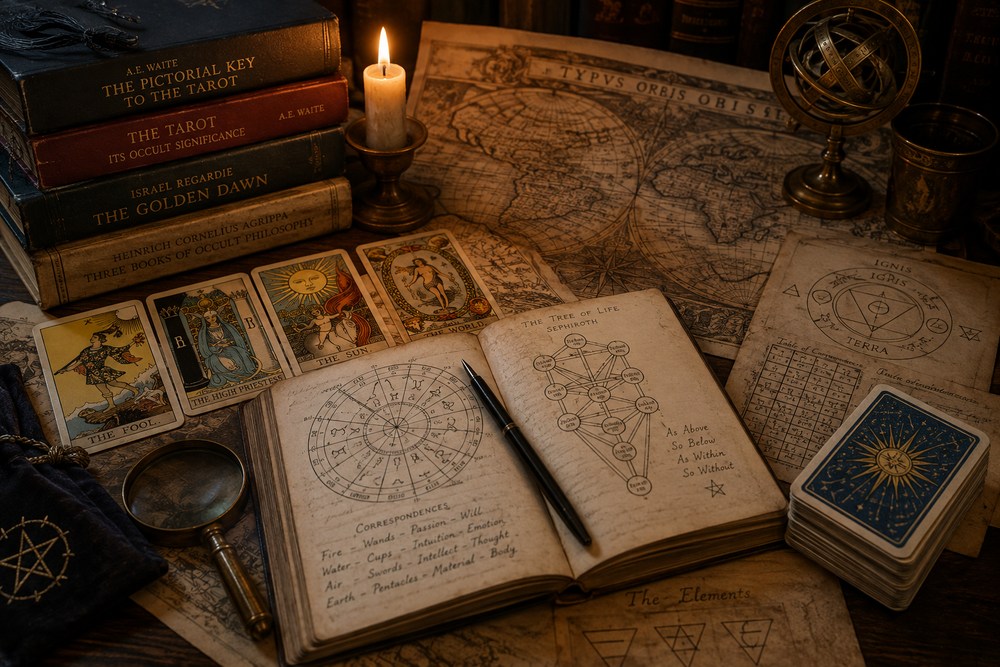
    I spent years trying to assemble my own spiritual cosmology from disconnected pieces. In retrospect, I was trying to reinvent a wheel that people such as A. E. Waite, Israel Regardie and generations of Western esotericists had already spent considerable time constructing.

    I simply didn’t realise that the wheel was available to me.

    I Wish I’d Discovered the Western Mystery Tradition Earlier

    By the Western Mystery Tradition, I mean the broad stream of Western esotericism incorporating subjects such as Hermeticism, Neoplatonism, Kabbalah, astrology, alchemy, ceremonial magic and Christian mysticism.

    These traditions don’t all teach precisely the same thing, nor should they be collapsed into one homogeneous system.

    What they provide is context.

    That is what I was missing.

    If you’re learning the Rider-Waite-Smith Tarot, for instance, you’re not dealing with 78 pictures that appeared spontaneously in 1909 and are simply waiting for your intuition to decide what they mean.

    The deck emerged from a particular esoteric environment.

    A. E. Waite and Pamela Colman Smith were both members of the Hermetic Order of the Golden Dawn. Behind the deck lies a vast network of Western symbolism involving astrology, Kabbalah, elemental correspondences, Christian mysticism and ceremonial magic.

    You don’t have to believe everything taught within those traditions.

    You don’t even have to practise magic.

    But knowing the symbolic language changes how you read the cards.

    I Would Learn Tarot’s Grammar Before Trying to Write Poetry

    This is probably the advice I most wish somebody had given me.

    Learn the grammar before trying to write poetry.

    Intuition matters enormously in Tarot. I certainly wouldn’t want to remove it from Tarot reading.

    But intuition becomes much more useful when it has something substantial to work with.

    If you understand why a particular symbol appears on a card, what its planetary correspondence means, how its element behaves, where it sits numerically within its suit and how earlier Tarot traditions treated that card, your intuition isn’t restricted.

    It has more material available to it.

    The difference is rather like learning a language.

    Eventually, you stop consciously thinking about grammar every time you speak. You simply speak.

    But that fluency didn’t arise because grammar was unnecessary. It arose because the underlying structure became internalised.

    It’s not that I didn’t study the grammar at all. I studied it in parts rather than as a whole. For instance, I quickly memorised numerological meanings and astrological correspondences, but without understanding the larger framework they belonged to.

    Tradition gives intuition something to push against, converse with and occasionally disagree with.

    I Would Study Tarot History Much Earlier

    I’d also go further back than the Golden Dawn.

    If I were beginning again today, I’d want to understand historical Tarot and the Tarot de Marseille before assuming that the Rider-Waite-Smith system simply represented what Tarot had always been.

    When you understand what came before Waite and Smith, you can begin to see what they inherited, what they altered and what those alterations reveal about the esoteric ideas behind their deck.

    You also become less likely to treat modern Tarot conventions as ancient wisdom simply because they’ve been repeated often enough.

    This is one area where access to scholarship has improved enormously since I started learning Tarot.

    I’d make use of it.

    I Was Learning an Esoteric Christian Tarot While Running Away From Christianity

    This is perhaps the greatest irony of my Tarot journey.

    I spent years trying to understand a deck created under the direction of an esoteric Christian mystic while assuming that Christianity and the occult were mutually exclusive.

    I had good reasons for making that assumption.

    The Christianity I had encountered as a teenager taught me that occult practices were dangerous and that human beings were fundamentally sinful creatures in desperate need of salvation.

    Tarot belonged firmly on the forbidden side of the fence.

    So when I eventually escaped that worldview, I naturally ran in the opposite direction.

    What I didn’t know was that Western Christianity has its own long, complicated and frequently suppressed mystical and esoteric history.

    There were other ways of understanding Christ.

    There were other ways of thinking about Scripture, creation, the soul and our relationship with the Divine.

    Had I known that when I first encountered Tarot, I wonder how different my spiritual journey might have been.

    Ironically, decades later, studying the Western Mystery Tradition helped bring me back to Christ.

    Not through fear of hell.

    Through love of Truth.

    But I Understand Why I Shied Away From the Golden Dawn

    There’s another side to this story.

    It would be easy for me to look backwards and wonder why I didn’t simply throw myself into the Western Mystery Tradition decades ago.

    The truth is that some of the people publicly representing occult traditions didn’t exactly make them look appealing.

    I had already experienced religious authority, spiritual ego and people claiming privileged access to Truth. I wasn’t particularly keen to sign up for another version of the same thing wearing a robe.

    Then there was the Golden Dawn itself.

    Here was an organisation responsible for an extraordinary synthesis of Western esoteric teachings that managed to fracture remarkably quickly amid personality clashes, competing claims to authority and some spectacular occult egos.

    I looked at that and backed away.

    In hindsight, however, I was confusing the tradition with some of its representatives.

    That’s something I would do very differently today.

    A Tradition Is Bigger Than Its Representatives

    One of the most important lessons I’ve learned is this:

    The value of a tradition is not determined by the character of everyone who has represented it.

    I’ve had to learn this lesson more than once.

    People behaving badly in the name of Christianity don’t necessarily tell me anything about Christ.

    Occultists behaving badly don’t necessarily invalidate the systems they studied.

    Human beings have an astonishing ability to bring ego, politics, status-seeking and interpersonal drama into almost anything.

    Spirituality is certainly no exception.

    If I were starting again, I still wouldn’t rush to join an occult order.

    What I’d change is my assumption that studying a tradition means submitting to the people who claim authority within it.

    It doesn’t.

    I can read Agrippa without treating Agrippa as infallible.

    I can learn from Waite without agreeing with Waite about everything.

    There is nothing stopping me from learning Golden Dawn correspondences without recreating the Golden Dawn.

    I can learn from Israel Regardie without turning him into a guru.

    The tradition gives me a body of material to engage with.

    What I do with it remains my responsibility.

    I Needed Freedom Before I Could Tell the Difference Between Structure and Control

    This is why I don’t regret my years exploring the New Age.

    I needed them.

    After experiencing authoritarian religion, I needed to discover that nobody could dictate what I was allowed to think about God.

    I needed to question and experiment.

    I needed to encounter ideas that would previously have frightened me.

    Most of all, I needed freedom.

    What I didn’t yet understand was that structure and control are not the same thing.

    A tradition can provide structure without demanding obedience.

    Historical sources can provide context without becoming Scripture.

    A teacher can point towards something without becoming an authority over my spiritual life.

    The Western Mystery Tradition could have given me a map without telling me where I was required to go.

    I Would Deconstruct Before Trying to Reconstruct

    There’s another thing I’d change if I could.

    I’d pay much more attention to the beliefs I was carrying with me into Tarot.

    Leaving a religion doesn’t automatically remove its theology from your nervous system or imagination.

    I discovered that rather dramatically.

    Years after leaving organised Christianity, unresolved religious trauma contributed to two periods when I returned to Evangelical Christianity out of fear. During the first, in 2020, I became convinced that my occult practices had been wrong and threw my entire collection of esoteric books and decks into a recycling skip.

    Yes.

    I still wince.

    Eventually, I realised that I had tried to reconstruct my spirituality without completely understanding what I was reconstructing it from.

    If I were beginning my Tarot journey today, I’d ask myself difficult questions much earlier.

    What do I actually believe?

    Which beliefs have I examined?

    Which ones am I merely reacting against?

    What am I afraid might happen if Christianity turns out to contain some truth?

    What am I afraid might happen if it doesn’t?

    Am I exploring something because I genuinely believe it, or because it is the opposite of something I was taught?

    Those questions would have saved me a great deal of flailing.

    I Wouldn’t Ask Tarot to Give Me Ultimate Truth

    This one makes me smile because Tarot is extraordinarily good at helping us explore uncertainty.

    And yet we sometimes use it in an attempt to eliminate uncertainty altogether.

    Which religion is true?

    Which spiritual path should I follow?

    Was that synchronicity a sign?

    Which deity is contacting me?

    What does the Universe want me to do?

    Tarot is such a flexible symbolic system that it can easily become incorporated into whatever worldview we’re currently constructing.

    If I started learning Tarot today, I’d be much more cautious about asking the cards to tell me what reality ultimately is. I’d use them to explore questions, notice patterns and examine possibilities, allowing space for Mystery rather than expecting the cards to provide certainty.

    But I wouldn’t expect 78 pieces of cardboard to resolve two thousand years of theological debate before breakfast.

    What I’d Actually Recommend to a Tarot Beginner Today

    If somebody asked me now about learning Tarot, I wouldn’t tell them to suppress their intuition and memorise a mountain of occult correspondences before they’re allowed to touch the cards.

    Where’s the fun in that?

    I’d encourage them to read cards from the beginning.

    But I’d study alongside the practice.

    Learn some Tarot history.

    If you’re using the Rider-Waite-Smith Tarot, learn something about Waite and Pamela Colman Smith.

    Explore the Tarot de Marseille and see what changed when the RWS appeared.

    Learn the basic elemental structure of the suits.

    Learn some astrology.

    Explore the Kabbalistic Tree of Life.

    Read about Hermeticism and the Western esoteric tradition.

    Find out where these ideas came from rather than relying entirely on modern Tarot books repeating interpretations of interpretations of interpretations.

    Then question all of it.

    Keep what proves useful.

    Challenge what doesn’t.

    And allow your personal relationship with Tarot to develop from informed engagement rather than either blind obedience or complete rootlessness.

    How This Is Changing Angelorum

    These realisations aren’t purely retrospective. They’re also changing the direction I’m taking with Angelorum.

    After nearly two decades of writing about Tarot and spirituality online, I’m increasingly interested in going back to the foundations. Rather than treating Tarot as a free-floating divination system onto which almost any spiritual idea can be grafted, I want to explore it more deeply within the Western Mystery Tradition that shaped the deck I have worked with for most of my life.

    That means paying closer attention to Tarot history, Hermeticism, astrology, Kabbalah, Neoplatonism, Renaissance magic, angelology and the esoteric Christian currents that once seemed incompatible with Tarot to me. It also means revisiting some of my older work with better sources and a much clearer understanding of the framework behind the correspondences I learned piecemeal all those years ago.

    I’m not interested in replacing one form of dogma with another. Nor am I abandoning intuition, personal experience or the freedom to question what I’ve inherited. If anything, having firmer roots gives me greater freedom to explore because I finally know what I’m agreeing with, adapting or departing from.

    Roots Without Dogma

    If I could go back and hand my younger self one thing, it wouldn’t be a better Tarot deck. As far as I’m concerned, Pixie Smith achieved perfection, as did whoever originated the Marseille Tarot.

    No. I would hand myself a map.

    For years, I thought the choice was between accepting somebody else’s spiritual truth or inventing my own from scratch.

    I no longer believe those are the only options.

    Tradition can give us roots without requiring unquestioning obedience.

    Scholarship can give us context without killing Mystery.

    Structure can support intuition without controlling it.

    And Tarot can become more interesting, not less, when we understand the centuries of philosophy, religion, magic, art and human questioning that sit behind the cards.

    Perhaps I needed to take the long way around to understand that.

    But if I started learning Tarot today?

    I’d still wander. I’d just take a map.

    purple lisa signature