Tag: Christianity

  • Ceremonial Magic and Christianity: How Magic Led Me Back to the Rosary

    Ceremonial Magic and Christianity: How Magic Led Me Back to the Rosary

    The relationship between ceremonial magic and Christianity is complicated, particularly when you’ve spent years exploring both from the inside.

    Something rather unexpected has happened lately.

    I’m losing interest in ceremonial magic.

    I realised just how true this was when I opened Facebook after a mostly sleepless night and the first thing in my feed was a meme:

    Nobody:
    Ceremonial Magicians: I’m going to make this way harder than it needs to be.

    I laughed.

    Because after spending more time praying the Rosary lately, that is increasingly how ceremonial magic feels to me.

    Not worthless and certainly not something I regret studying.

    Just… incredibly complicated.

    The irony is that ceremonial magic is partly responsible for bringing me back to the much simpler faith I’m rediscovering now.

    And today, on the Feast of Our Lady of Sorrows, that feels especially significant.

    I Needed a Practice

    For a long time, my spirituality was rich in ideas.

    Decades of study have taken me through Tarot, astrology, magic, mysticism, witchcraft, Qabalah and various esoteric traditions. Devotional practices have come and gone along the way.

    Something changed when I began taking ceremonial magic seriously, though.

    It made me realise that I needed a practice.

    There is an enormous difference between having spiritual beliefs and having a disciplined daily spiritual practice.

    A practice asks something of you. You get up and do it whether or not you feel particularly spiritual that morning. Words and gestures are repeated. Attention is trained. The whole person is deliberately oriented towards something beyond the ordinary concerns of the day.

    Eventually, the practice begins to shape the practitioner.

    Ceremonial magic taught me that.

    My exploration of Iamblichus and theurgy had already begun shifting my attention away from magical results and towards the question of what spiritual practice is ultimately meant to accomplish.

    Exploring theurgy made me realise that reading another book about spirituality wasn’t necessarily going to take me where I wanted to go.

    At some point, you have to stop reading about the path and actually walk it.

    But that discovery led to another question.

    Practice in Service of What?

    Once the need for practice became clear, another question followed naturally.

    What was that practice actually for?

    That changed everything.

    When I drilled down into what spiritual practice meant for me, it only made sense within a Christian context.

    Spiritual power for its own sake doesn’t particularly interest me. Neither does accumulating increasingly sophisticated magical techniques.

    What I wanted was transformation.

    Sanctification.

    An intimate relationship with God.

    I wanted whatever gifts and abilities I possess to become useful in relieving suffering and serving something infinitely greater than myself.

    Once I admitted that, Christianity stopped looking like merely the religion I’d left behind.

    It started looking like home.

    And home, as it turns out, already had practices.

    Then I Started Praying the Rosary

    This is where I could hear the family of Saints giggling.

    After studying elaborate systems of ceremonial ritual, there I was with a string of beads, saying prayers Christians have been repeating for centuries.

    And something clicked.

    Much of what I’d discovered I needed from ritual was already there.

    Repetition. Sacred speech. Physical gesture. Contemplative imagery. Scripture. Rhythm. Discipline. Intention. Intercession.

    There is a clear beginning and ending. The mysteries give the imagination somewhere to go, allowing us to enter sacred events contemplatively rather than merely thinking about them.

    Yet one difference matters to me more than all the others.

    There is relationship.

    Rather than manipulating an elaborate symbolic architecture in the hope of achieving a particular spiritual state, I’m praying.

    More specifically, I’m contemplating the life of Christ in the company of his Mother.

    That has changed something in me.

    Our Lady of Sorrows and the Wounded Heart

    Today is 15 September, the Feast of Our Lady of Sorrows.

    I’ve also recently begun praying the Chaplet of the Seven Sorrows, and perhaps that is part of why all of this is coming into focus now.

    Our Lady of Sorrows presents a very different model of spiritual power.

    Mary doesn’t conquer suffering.

    She remains.

    Simeon’s prophecy tells her that a sword will pierce her own soul. She flees with her child into Egypt, loses him in Jerusalem, encounters him carrying the Cross and ultimately stands at Calvary watching her Son die.

    Then she holds his body.

    There is nothing passive about this kind of presence.

    Anyone who has accompanied someone through suffering knows how much courage it can require simply to remain when there is nothing left to fix.

    And perhaps this is where my understanding of spiritual practice has changed most radically.

    The question is becoming less about what spiritual power I can acquire and more about becoming someone who doesn’t look away from suffering.

    How can the spiritual tools I’ve spent my life studying help rather than merely fascinate?

    How can my work alleviate suffering, restore hope, offer companionship or help another person recognise the presence of Divine grace in the middle of a difficult life?

    Our Lady of Sorrows gives me an answer that requires surprisingly little equipment.

    Stay.

    Love.

    Pray.

    Simplicity on the Other Side of Complexity

    I don’t think I could have arrived here by simply telling myself years ago that I ought to pray the Rosary.

    Perhaps I needed the complexity first.

    Ceremonial magic taught me through experience why ritual matters. Sacred space, intentionality, symbolism, disciplined attention and repetition stopped being abstract concepts. Most importantly, I learned the difference between occasionally doing something spiritual and maintaining a practice.

    Having learned all of that, I’ve discovered something rather wonderful.

    I might not need most of the machinery.

    Give me the Rosary, Scripture, and a candle to light for somebody who is suffering.

    Give me Tarot when I need to become quiet enough to listen.

    That may actually be enough.

    There is something wonderfully reassuring about a spiritual practice that doesn’t constantly require upgrading. Nobody is about to release Rosary 2.0 with seventeen additional correspondences and an advanced grade system.

    Tomorrow, the task will simply be to pray again.

    Then do it the following day.

    The practice remains simple while, God willing, the person practising it changes.

    What Happens to Magic?

    None of this means everything I’ve spent years studying now belongs in the bin.

    Far from it.

    Mysticism, esotericism and the Western Mystery Tradition still fascinate me. Tarot certainly isn’t going anywhere. Neither is my interest in the philosophical questions underneath magic.

    What has changed is my understanding of what I want these things to accomplish.

    Recently, I arrived at two very simple definitions:

    The purpose of theurgy is sanctification.

    The purpose of magic is to dispense Divine grace into the world.

    Those definitions have consequences.

    If lighting a candle for someone, praying a Psalm and offering the Rosary for their intention accomplishes what I’m actually trying to do, another layer of ceremonial complexity needs a reason for being there.

    Sometimes there may be one.

    Sometimes there may not.

    Increasingly, I’m comfortable with that.

    Ceremonial Magic Did Its Job

    This is why I don’t want to tell this story as I tried ceremonial magic and eventually realised Christianity was better.

    That isn’t what happened.

    In fact, I’ve written before about how studying the Western Mystery Tradition unexpectedly brought me back towards Christ. What I hadn’t yet realised was where that homecoming would lead next.

    Ceremonial magic confronted me with a question:

    What would happen if I stopped treating spirituality primarily as something to study and made it something I practised every day?

    Following that question brought me somewhere I wasn’t expecting.

    Back to Christ and Mama.

    Back to prayer.

    And, strangely enough, back to practices much older and simpler than those that prompted the journey.

    There is a tendency when our spiritual direction changes to reinterpret the previous stage as a mistake. We want a clean conversion narrative with an obvious Before and After.

    I’m increasingly suspicious of those narratives.

    Sometimes a path does exactly what it needed to do before you leave it.

    Perhaps ceremonial magic was never going to be my spiritual home.

    But it taught me that I needed one.

    Today, Our Lady of Sorrows adds something else to that lesson. Spiritual practice isn’t primarily about how much esoteric knowledge I can accumulate or how elaborate a ritual I can perform.

    At the foot of the Cross, all of that suddenly looks rather small.

    Mary simply stands there.

    She loves and suffers with.

    She remains faithful.

    Perhaps that’s why the Rosary is making so much sense to me now. Its simplicity isn’t an absence of depth. The depth comes from returning to the same mysteries until they begin changing the person who returns to them.

    Ceremonial magic taught me to practise.

    The Rosary is teaching me why.

    And sometimes the long way round really does bring us home.

    purple lisa signature

  • The Alex Reads Tarot Controversy Took Me Back to 2017

    The Alex Reads Tarot Controversy Took Me Back to 2017

    I wasn’t planning to write about the Alex (formerly) Reads Tarot controversy again.

    Like many people, I’d been watching it from a distance. I had no desire to add another opinion to an already overflowing internet.

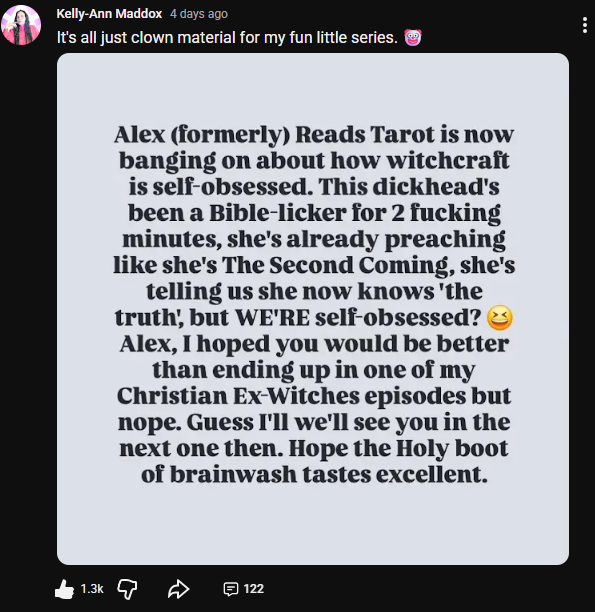
    Then I came across this post by Kelly-Ann Maddox.

    Screenshot of a social media post by Kelly-Ann Maddox discussing Alex (formerly) Reads Tarot's recent conversion to Christianity. The post strongly criticises Alex's comments about witchcraft and uses profane language to express disappointment and anger. The post received around 1,300 likes and more than 120 comments.

    As I read her words, I wasn’t thinking about Alex.

    I was thinking about Doreen Virtue.

    More specifically, I was thinking about the woman I was when Doreen announced her conversion to Evangelical Christianity in 2017.

    The memories came flooding back before I’d even finished reading. I suddenly realised I hadn’t made peace with that chapter of my own life as much as I’d believed.

    When Doreen Virtue first announced her conversion to Evangelical Christianity, I respected her right to change her beliefs. After all, I knew from my own life that spiritual journeys can take unexpected turns. What I struggled with was what came afterwards.

    Renouncing tarot soon became denouncing it. Oracle cards, angels, crystals and many of the spiritual practices she had once taught were no longer presented as simply no longer being for her. They were increasingly described as spiritually dangerous or demonic. As former students questioned her dramatic change of direction, many felt they weren’t just being disagreed with—they were being told they had been deceived, were under demonic influence, or were serving the enemy.

    That changed everything.

    Like many people who had benefited from Doreen’s work, I felt betrayed. Not because she’d become an Evangelical Christian, but because it seemed as though she had rewritten the story of everyone who had walked alongside her.

    I reacted badly.

    I wrote articles criticising Doreen. They became some of the most successful posts I’d ever published. At the time, I thought I was defending my community. Looking back, I can see that I was also feeding an outrage cycle that ultimately did none of us any good—least of all me.

    At the time, those articles felt justified. They were widely shared, they sparked discussion and, if I’m honest, I enjoyed the validation. It felt good to know other people agreed with me. Every comment, every share and every spike in traffic convinced me I was on the right side of the argument.

    But there was another side to that success that I couldn’t see at the time.

    The more I wrote about what Doreen was doing wrong, the less attention I paid to my own spiritual life. My energy became entangled with someone else’s journey. Instead of asking where the Divine was leading me, I became preoccupied with where Doreen had gone wrong.

    Looking back with nearly a decade of hindsight, I no longer believe that was healthy. In fact, I think it played no small part in my own religious trauma resurfacing. I was convinced I was resisting spiritual abuse. In reality, that level of entanglement has a habit of rebounding on us.

    Which brings me back to Kelly-Ann’s post.

    Reading it, I didn’t feel the urge to argue with her. Nor did I feel the urge to defend Alex.

    What I felt instead was grief.

    Because I recognised something painfully familiar: the heartbreak that ripples through a community when someone whose work has mattered to us changes direction so dramatically that it feels like they’ve rejected not only a practice, but the people who shared it with them.

    I don’t think my biggest mistake was criticising Doreen Virtue. I still believe some of what she said after her conversion caused genuine harm, especially to people already carrying religious trauma. My mistake was believing that answering outrage with more outrage could somehow make things better.

    Over the past few weeks, I’ve been immersed in Henry Cornelius Agrippa’s Three Books of Occult Philosophy. One idea keeps confronting me. Agrippa has very little patience for dialectics. He regards dialectics as one of the great traps of the fallen intellect. We become so busy proving ourselves right that we forget to seek the One who is Truth.

    That has left me with an uncomfortable question.

    What if the need to be right is itself part of the problem?

    Looking back at 2017, I can see how easily I was drawn into it. I wasn’t seeking understanding. I was building a case. Every new statement from Doreen became another exhibit. Every article strengthened my position. Every surge in traffic convinced me I was fighting the good fight.

    But where was the Good in any of it?

    What troubles me is how readily we reach for the courtroom instead of the Upper Room.

    We gather evidence. We assemble arguments. We decide who is orthodox, who is deceived, who belongs and who doesn’t. Then we congratulate ourselves for standing on the right side.

    Yet when I read the Gospels, I see something altogether different. Yeshua challenged people—sometimes with astonishing directness—but His aim was never to win an argument. His purpose was always restoration. Even His strongest rebukes were invitations to repentance, not performances for a crowd.

    I can’t help wondering how differently these conversations might unfold if more of us asked a different question.

    Not, “How do I prove I’m right?”

    But, “How do I respond in a way that brings restoration to this situation?”

    That’s the question I wish I’d been asking in 2017.

    It’s also the question I hope I’ll still be asking when the next controversy comes along.

    purple lisa signature

  • Alex Reads Tarot No More: A Lesson in Spiritual Grace

    Alex Reads Tarot No More: A Lesson in Spiritual Grace

    Yesterday, I learned that a popular TikTok Tarot reader with 1 M+ followers quit the world of Tarot. She used to go by ‘Alex Reads Tarot’ and was so successful that pop singer/songwriter Hayley Williams name-dropped her in one of her songs. Before yesterday, I had heard of neither.

    Alex is young enough to be my daughter, and my heart goes out to her. I watched her farewell video after stumbling across someone’s cynical take on why she quit and how that somehow, supposedly makes her a ‘grifter.’

    Watching Alex’s Farewell Video

    I didn’t see a grifter in the 10-minute TikTok video. I saw a tense, responsible young woman trying to make the best of a difficult situation. Before me was someone who felt obligated to let the world know about the internal storm of consciousness that was taking place inside her, and that led to the difficult decision to leave the successful place in the Tarot community she had worked so hard to earn.

    There were no signs of detachment from reality, and I wouldn’t want to attempt to diagnose her with religious trauma. Needless to say, for me, it brought plenty of memories of my two major religious trauma relapses.

    Watching Alex’s video also forced me to confront an uncomfortable memory about myself.

    Why I Judged Doreen Virtue

    In 2017, when Doreen Virtue announced that she had become a fundamentalist Christian and denounced Tarot, I judged her harshly. Like many others in the spiritual community, I assumed I knew what had happened. I believed she had succumbed to fear, traded freedom for dogma, and perhaps found a lucrative new audience.

    When I Walked Away from Tarot

    Then, three years later, around the time of my Chiron return, I found myself walking through a remarkably similar door.

    Not because I had suddenly become irrational. Not because I wanted to deceive anyone. And certainly not because I stopped seeking the truth.

    I was carrying unresolved religious trauma that I didn’t yet understand. When it resurfaced, it demanded to be faced. Looking back, I can see that stepping away from Tarot for a season was part of that process. At the time, however, it felt like the only faithful thing I could do.

    That experience permanently changed the way I think about other people’s spiritual journeys.

    The Spiritual Community Needs More Grace

    Today, I have no idea whether Alex’s decision will last six months, six years or a lifetime. Nor do I need to know. What I do know is that none of us has access to another person’s inner world.

    We see an announcement.

    Nor do we see the years of wrestling that came before it.

    We see a ten-minute video.

    We don’t see the sleepless nights, the private prayers, the fears, the hopes, the conversations that were never filmed, or the questions that refused to leave.

    Yet social media encourages us to fill in all those blanks. Within hours, people were confidently declaring that Alex was either genuinely saved or cynically grifting.

    Perhaps she is neither.

    Perhaps she is simply a human being responding honestly to where her conscience has led her today.

    Life Has a Way of Humbling Our Certainties

    If my own journey has taught me anything, it is that spiritual life rarely unfolds in a straight line.

    Only when I stopped judging myself for the path I had taken did something unexpected happen. The rigid either-or thinking that had trapped me for so long began to dissolve. I discovered that the deepest truths in my own life weren’t asking me to choose between one world and another. They were inviting me into a both-and spacious enough to hold Christ, Tarot, contemplation, discernment and mystery without forcing any of them into a false opposition.

    That doesn’t mean everyone will arrive at the same place I have.

    Nor should they.

    But perhaps, as a spiritual community, we could become a little slower to pronounce verdicts on one another’s journeys. The grace we withhold from others today may be the very grace we find ourselves desperately needing tomorrow.

    Life has a remarkable way of humbling our certainties.

    Mine certainly did.

    Click here for more thoughts on the ongoing Alex Reads Tarot controversy…

    purple lisa signature