Tag: Christian mysticism

  • The Alex Reads Tarot Controversy Took Me Back to 2017

    The Alex Reads Tarot Controversy Took Me Back to 2017

    I wasn’t planning to write about the Alex (formerly) Reads Tarot controversy again.

    Like many people, I’d been watching it from a distance. I had no desire to add another opinion to an already overflowing internet.

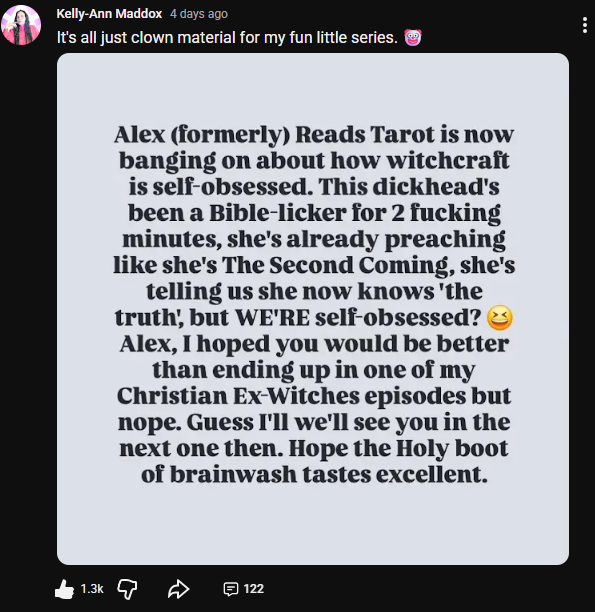
    Then I came across this post by Kelly-Ann Maddox.

    Screenshot of a social media post by Kelly-Ann Maddox discussing Alex (formerly) Reads Tarot's recent conversion to Christianity. The post strongly criticises Alex's comments about witchcraft and uses profane language to express disappointment and anger. The post received around 1,300 likes and more than 120 comments.

    As I read her words, I wasn’t thinking about Alex.

    I was thinking about Doreen Virtue.

    More specifically, I was thinking about the woman I was when Doreen announced her conversion to Evangelical Christianity in 2017.

    The memories came flooding back before I’d even finished reading. I suddenly realised I hadn’t made peace with that chapter of my own life as much as I’d believed.

    When Doreen Virtue first announced her conversion to Evangelical Christianity, I respected her right to change her beliefs. After all, I knew from my own life that spiritual journeys can take unexpected turns. What I struggled with was what came afterwards.

    Renouncing tarot soon became denouncing it. Oracle cards, angels, crystals and many of the spiritual practices she had once taught were no longer presented as simply no longer being for her. They were increasingly described as spiritually dangerous or demonic. As former students questioned her dramatic change of direction, many felt they weren’t just being disagreed with—they were being told they had been deceived, were under demonic influence, or were serving the enemy.

    That changed everything.

    Like many people who had benefited from Doreen’s work, I felt betrayed. Not because she’d become an Evangelical Christian, but because it seemed as though she had rewritten the story of everyone who had walked alongside her.

    I reacted badly.

    I wrote articles criticising Doreen. They became some of the most successful posts I’d ever published. At the time, I thought I was defending my community. Looking back, I can see that I was also feeding an outrage cycle that ultimately did none of us any good—least of all me.

    At the time, those articles felt justified. They were widely shared, they sparked discussion and, if I’m honest, I enjoyed the validation. It felt good to know other people agreed with me. Every comment, every share and every spike in traffic convinced me I was on the right side of the argument.

    But there was another side to that success that I couldn’t see at the time.

    The more I wrote about what Doreen was doing wrong, the less attention I paid to my own spiritual life. My energy became entangled with someone else’s journey. Instead of asking where the Divine was leading me, I became preoccupied with where Doreen had gone wrong.

    Looking back with nearly a decade of hindsight, I no longer believe that was healthy. In fact, I think it played no small part in my own religious trauma resurfacing. I was convinced I was resisting spiritual abuse. In reality, that level of entanglement has a habit of rebounding on us.

    Which brings me back to Kelly-Ann’s post.

    Reading it, I didn’t feel the urge to argue with her. Nor did I feel the urge to defend Alex.

    What I felt instead was grief.

    Because I recognised something painfully familiar: the heartbreak that ripples through a community when someone whose work has mattered to us changes direction so dramatically that it feels like they’ve rejected not only a practice, but the people who shared it with them.

    I don’t think my biggest mistake was criticising Doreen Virtue. I still believe some of what she said after her conversion caused genuine harm, especially to people already carrying religious trauma. My mistake was believing that answering outrage with more outrage could somehow make things better.

    Over the past few weeks, I’ve been immersed in Henry Cornelius Agrippa’s Three Books of Occult Philosophy. One idea keeps confronting me. Agrippa has very little patience for dialectics. He regards dialectics as one of the great traps of the fallen intellect. We become so busy proving ourselves right that we forget to seek the One who is Truth.

    That has left me with an uncomfortable question.

    What if the need to be right is itself part of the problem?

    Looking back at 2017, I can see how easily I was drawn into it. I wasn’t seeking understanding. I was building a case. Every new statement from Doreen became another exhibit. Every article strengthened my position. Every surge in traffic convinced me I was fighting the good fight.

    But where was the Good in any of it?

    What troubles me is how readily we reach for the courtroom instead of the Upper Room.

    We gather evidence. We assemble arguments. We decide who is orthodox, who is deceived, who belongs and who doesn’t. Then we congratulate ourselves for standing on the right side.

    Yet when I read the Gospels, I see something altogether different. Yeshua challenged people—sometimes with astonishing directness—but His aim was never to win an argument. His purpose was always restoration. Even His strongest rebukes were invitations to repentance, not performances for a crowd.

    I can’t help wondering how differently these conversations might unfold if more of us asked a different question.

    Not, “How do I prove I’m right?”

    But, “How do I respond in a way that brings restoration to this situation?”

    That’s the question I wish I’d been asking in 2017.

    It’s also the question I hope I’ll still be asking when the next controversy comes along.

    purple lisa signature

  • 3 July 2026 – Crossroads Devotion & Divination: Psalm Magic in Daily Practice

    3 July 2026 – Crossroads Devotion & Divination: Psalm Magic in Daily Practice

    Even though I no longer see the Bible as the inerrant Word of God, I adore the Psalms.

    For me, the Psalms are pure magic. They quiet the mind, open the heart and help align my thoughts with the Highest Good. They are prayers, poems, spells, songs and meditations all at once. Whether we approach them as Scripture, sacred poetry or practical mysticism, they have an extraordinary way of speaking directly to our needs.

    I usually begin with a simple prayer:

    “Show me the Psalm that will serve the Highest Good today.”

    Then I use a random number generator.

    That may sound strange, but I’ve found that when I admit I don’t know what I need, Providence usually knows better than I do.

    Once I have the number, I turn to Anna Riva’s Powers of the Psalms. Her book gives a traditional magical application for each Psalm, helping me understand the current I am about to work with. Only then do I go to my altar, light a candle, open my Bible and begin praying and meditating with the Psalm.

    This morning, the random number was 72.

    Anna Riva associates Psalm 72 with attracting prosperity and success, so I had a sense of the magical current before I even began reading and knew which colour candle to use. I chose green for abundance. It just happens to be Friday (ruled by Venus), a perfect day for attracting abundance. I couldn’t have orchestrated it better myself.

    The Psalm

    (King James Version – Public Domain)

    Psalm 72

    Give the king thy judgments, O God, and thy righteousness unto the king’s son.

    2 He shall judge thy people with righteousness, and thy poor with judgment.

    3 The mountains shall bring peace to the people, and the little hills, by righteousness.

    4 He shall judge the poor of the people, he shall save the children of the needy, and shall break in pieces the oppressor.

    5 They shall fear thee as long as the sun and moon endure, throughout all generations.

    6 He shall come down like rain upon the mown grass: as showers that water the earth.

    7 In his days shall the righteous flourish; and abundance of peace so long as the moon endureth.

    8 He shall have dominion also from sea to sea, and from the river unto the ends of the earth.

    9 They that dwell in the wilderness shall bow before him; and his enemies shall lick the dust.

    10 The kings of Tarshish and of the isles shall bring presents: the kings of Sheba and Seba shall offer gifts.

    11 Yea, all kings shall fall down before him: all nations shall serve him.

    12 For he shall deliver the needy when he crieth; the poor also, and him that hath no helper.

    13 He shall spare the poor and needy, and shall save the souls of the needy.

    14 He shall redeem their soul from deceit and violence: and precious shall their blood be in his sight.

    15 And he shall live, and to him shall be given of the gold of Sheba: prayer also shall be made for him continually; and daily shall he be praised.

    16 There shall be an handful of corn in the earth upon the top of the mountains; the fruit thereof shall shake like Lebanon: and they of the city shall flourish like grass of the earth.

    17 His name shall endure for ever: his name shall be continued as long as the sun: and men shall be blessed in him: all nations shall call him blessed.

    18 Blessed be the Lord God, the God of Israel, who only doeth wondrous things.

    19 And blessed be his glorious name for ever: and let the whole earth be filled with his glory; Amen, and Amen.

    20 The prayers of David the son of Jesse are ended.

    The Temple at Lagina

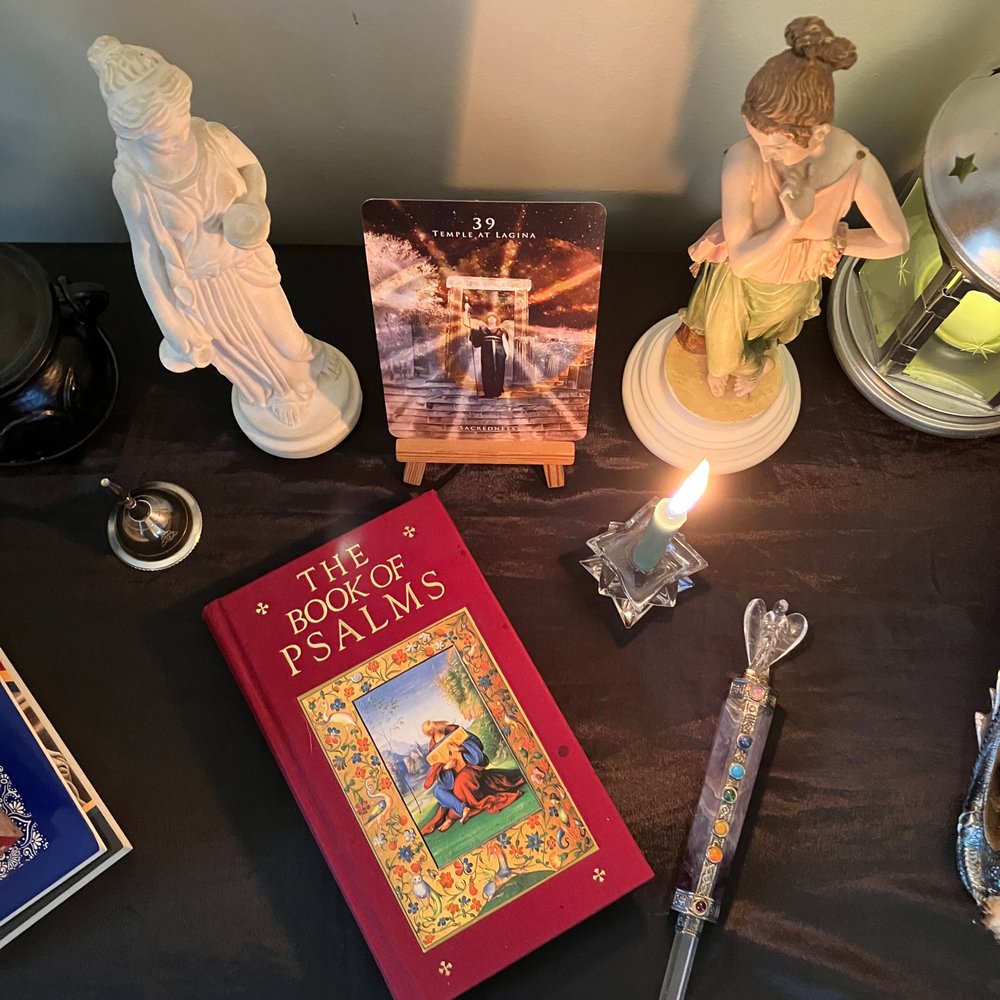
    After reading the Psalm, I pulled a card from the Oracle of the Hekatean Path.

    The Temple at Lagina – Sacredness.

    I smiled as soon as I saw it because the synchronicity couldn’t have been clearer.

    The card reminded me that before we can effectively serve the Divine, we must learn to care for the temple through which we serve.

    Our own bodies.

    That has been a recurring lesson for me recently.

    With a hip replacement on the horizon, improving my diet, prioritising sleep and building strength are no longer just health goals. They have become part of my spiritual practice.

    Sometimes we imagine devotion as something dramatic or mystical.

    More often, it looks remarkably ordinary.

    Preparing nourishing food.

    Going to bed on time.

    Taking medication when needed.

    Doing the physiotherapy exercises we’d rather avoid.

    Accepting help.

    Keeping promises to ourselves.

    These seemingly mundane acts become sacred when we offer them consciously as part of our service to God.

    The Temple at Lagina reminded me that holiness doesn’t begin somewhere “out there.”

    It begins here.

    In the body.

    Why Psalm 72?

    Many people know Psalm 72 as a royal Psalm celebrating righteous kingship.

    I was introduced to it through Ariel Gatoga’s teaching on Psalm magic, where he presents it as a Psalm for prosperity and Divine provision.

    His interpretation goes far beyond simply attracting money.

    Instead, he invites us to recognise prosperity as our natural inheritance as children of the Divine.

    That perspective resonates deeply with me.

    Financial provision certainly matters, but so do health, opportunities, supportive friendships, wisdom, courage and the practical resources we need to fulfil our calling.

    Psalm 72 speaks repeatedly about justice, protection, peace and abundance.

    It reminds us that Divine provision doesn’t always arrive in the form we expect.

    Sometimes it comes as healing.

    Other times, as unexpected guidance.

    And sometimes it arrives as the inner strength to keep going until the outer world catches up.

    How I Work with Psalm Magic

    My practice is simple, but if you would like to dive deeper into the history of Psalm Magic and different approaches, you can learn more in my article about Psalm Magic on angelorum.co.

    I begin by reading the entire Psalm aloud without interruption.

    Then I return to it slowly, verse by verse, allowing particular words or images to stand out.

    Rather than analysing every line intellectually, I ask:

    “What is this saying to my soul today?”

    The symbols begin to speak.

    A mountain becomes an elevated state of consciousness.

    Rain becomes Divine blessing.

    The oppressor becomes the fearful ego that insists there will never be enough.

    The needy become the parts of myself still operating from old narratives of scarcity.

    Each reading is slightly different because I am slightly different each day.

    A Royal Inheritance

    One of Ariel Gatoga’s most powerful teachings is the idea of adopting what he calls a Royal Identity.

    Instead of approaching God as a beggar, we approach as beloved children.

    That image echoes something deeply Christian.

    We are invited to receive grace rather than earn it.

    Prayer becomes less about convincing God to bless us and more about opening ourselves to blessings already prepared.

    When Psalm 72 speaks of “the king’s son,” I hear an invitation to remember who we really are beneath all the stories of fear, lack and limitation.

    Children of the King do not need to manipulate life into providing for them.

    They learn to trust.

    The Method I Learned

    The approach I use comes from Ariel Gatoga’s teachings on Psalm Magic.

    In summary, the practice involves:

    • Reading the Psalm aloud in one sitting.
    • Returning to it verse by verse to uncover symbolic meaning.
    • Allowing limiting beliefs to come into awareness without judgement.
    • Replacing thoughts of lack with the consciousness of Divine inheritance.
    • Returning to the Psalm daily until a deep sense of peace and certainty naturally arises.

    I have found this to be a surprisingly gentle practice.

    Rather than trying to force manifestation, it gradually changes the way I see both myself and the world around me.

    As my inner landscape shifts, life seems to respond in kind.

    Trusting the Process

    I don’t know which Psalm the random number generator will choose tomorrow.

    That’s part of what makes the practice so beautiful.

    Each morning begins with a simple act of surrender.

    “Not my will, but Thy will be done.”

    Sometimes the greatest act of faith isn’t knowing which prayer to choose.

    It’s trusting that, when we genuinely ask for guidance, the right words have a way of finding us.

    purple lisa signature

  • 1 July 2026 – Crossroads Devotion & Divination: Asking Yeshua

    1 July 2026 – Crossroads Devotion & Divination: Asking Yeshua

    The Question I Had Been Avoiding

    During my morning quiet time, I pulled Aconite (Death) from the Oracle of the Hekatean Path. Meditating on the message, I realised I was standing at a crossroads where something indeed had to die.

    For months now, I’ve been immersed in exploring what I have come to think of as my Christo-Hekatean path. My days have been filled with the Gospel of Philip, Jewish mysticism, Greek philosophy and modern writers such as Seren Bertrand and Sarah Iles-Johnston. Every new connection has sent me down another fascinating rabbit hole, and I’ve loved every minute of it.

    Yet, despite all that study, one thought landed with uncomfortable clarity this morning.

    I’d been asking everyone except Yeshua.

    So I asked him.

    I told him, as honestly as I knew how, that if this wasn’t a path he would walk with me, I would choose Hekate.

    I don’t mean that as a rejection of Christ. Quite the opposite: it was my way of acknowledging that I can no longer deny the reality of what has happened through my relationship with Hekate. If following Christ required me to pretend that those experiences were false, then I wouldn’t do it.

    I wanted the answer from him, not from another book or another expert.

    What the Tarot Reflected

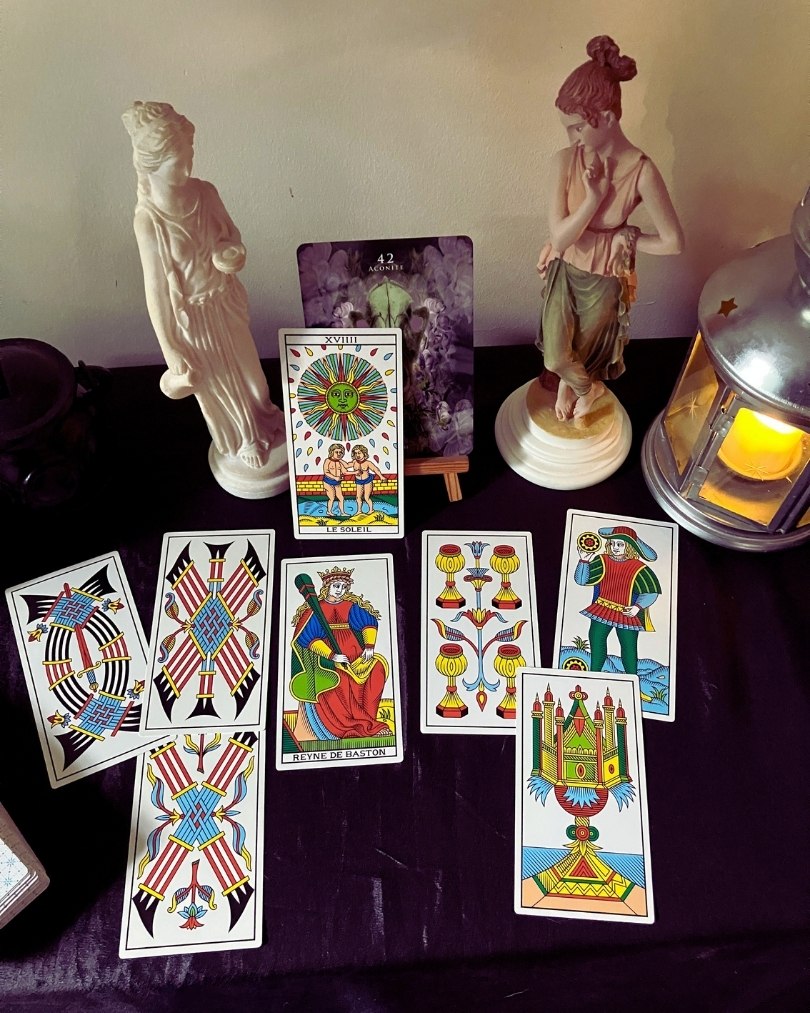
    Only after praying did I lay out the Tarot de Marseille.

    altar image of reading with the hekatean path oracle and tarot de marseille

    The 9 of Swords captured the mental agony of trying to get everything exactly right. Crossing it was the 10 of Batons, which felt like carrying far more than any one person could reasonably bear. It wasn’t simply my own uncertainty. It was centuries of theology, historical debate and the constant pressure to make sure every insight could be justified by someone else’s authority. It was the oppressive weight of feeling divided against myself.

    The Queen of Batons appeared as the action card. She has represented Mary Magdalene for me for many years, so seeing her there made me smile. She doesn’t argue for her authority or apologise for it. She simply lives it.

    The quint was Le Soleil.

    For me, the Sun is Christ.

    I smiled again.

    That was my answer.

    The near future cards were the 4 of Cups, the Page of Coins and the Ace of Cups. Rather than seeing four cups, I suddenly imagined the Page discovering four fountains from which to draw wisdom as he continues his journey. I’m still sitting with that image and suspect it has more to reveal over time.

    What Aconite Was Really Asking to Die

    Only afterwards did I understand why the day’s oracle card had been Aconite – Death.

    The thing being asked to die wasn’t my love of study or my fascination with history. It was something much older.

    Growing up, my father taught me that my will didn’t matter.

    If I wanted to know what mattered, someone else had to tell me.

    That pattern followed me into adulthood more faithfully than I realised.

    Whenever something important happened spiritually, my instinct wasn’t to ask whether it rang true in prayer. It was to ask whether I could find an ancient source to validate it. If not an ancient source, then perhaps a respected scholar. If not a scholar, then at least someone who wasn’t a blogger but who had published a book.

    The Resurrection

    Looking back, I can see that I wasn’t really searching for theology.

    I was searching for permission.

    Permission to trust my own encounters with the Divine.

    This morning, I stopped treating prayer as the beginning of the conversation and started treating it as the place where the conversation could end.

    For me, that changed everything.

    It’s not about the need to find the correct belief. That need kept me trapped in the 9 of Swords space. It’s about becoming whole, and this is where the Ace of Cups leads me.

    Want to know what happened when I asked Mary Magdalene the same question? Read Mary Magdalene: Midwife of Souls on the Christo-Hekatean Path

    purple lisa signature