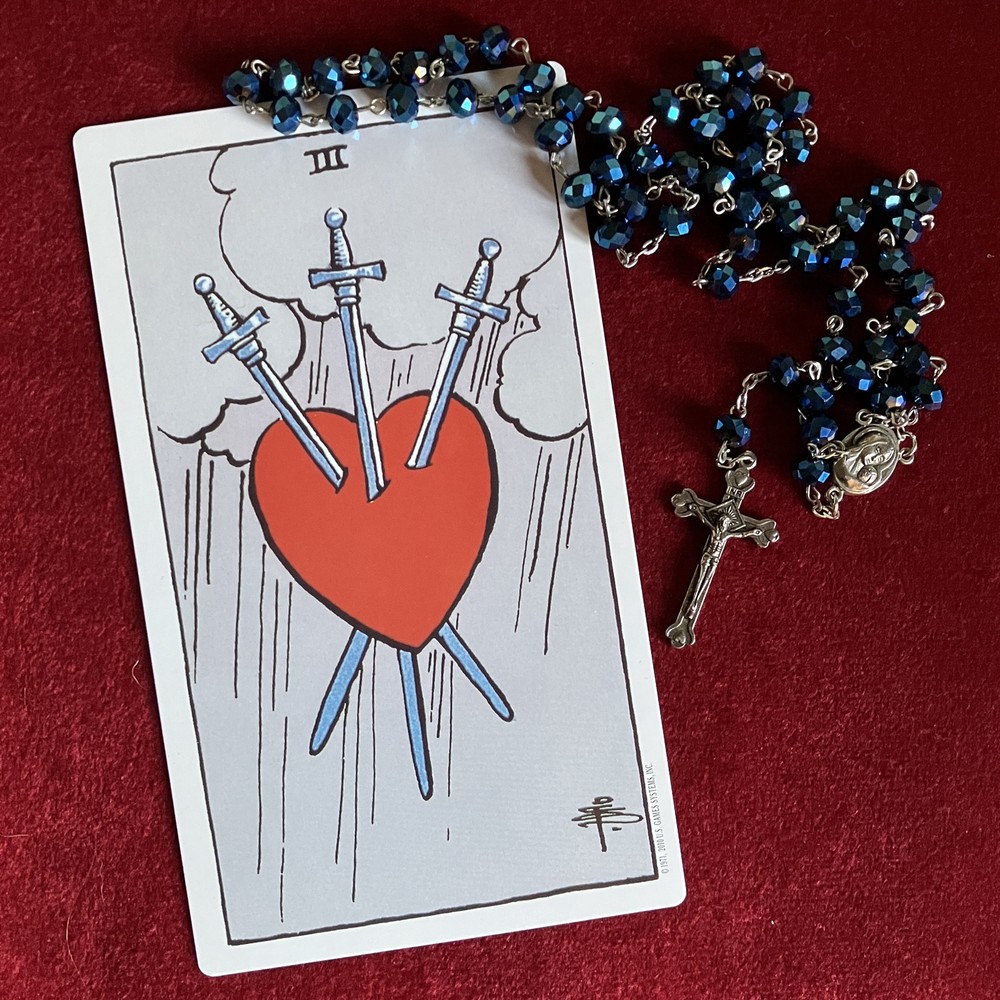
Category: Spirituality

Personal reflections on prayer, contemplation and the search for wisdom. These posts explore my Christo-Hekatean path, religious trauma recovery, sacred symbolism and the ways spiritual practice continues to shape my life.

  • What I’d Do Differently If I Started Learning Tarot Today

    What I’d Do Differently If I Started Learning Tarot Today

    I started learning Tarot long before I had properly deconstructed my religious beliefs. More precisely, I started more in-depth Tarot studies not long after I left organised religion.

    Looking back, I think that matters far more than I realised at the time.

    I had begun questioning organised Christianity and eventually left the Church around my first Saturn return. But leaving a religious institution isn’t the same thing as dismantling everything it taught you about God, yourself and the nature of reality.

    Some of those beliefs remained buried remarkably deep.

    Change to:

    So when I began studying Tarot, occultism and alternative spirituality in earnest, I wasn’t starting with a blank slate. I was trying to build a new spiritual worldview while parts of the old one were still running quietly in the background.

    If I started learning Tarot today, there are many things I’d do differently.

    The biggest?

    I’d give myself a tradition to learn from before trying to reinvent the wheel.

    I Wouldn’t Start by Trying to Invent My Own Spirituality

    After leaving organised religion, the freedom of the New Age was enormously appealing.

    There were no creeds to sign. No threat of hell for asking the wrong questions. No authority insisting that it possessed the only acceptable version of Truth.

    After my experiences with Evangelical Christianity, that freedom was something I needed.

    The problem was that I went from one extreme to the other.

    Instead of having a rigid framework in which everything had already been decided for me, I suddenly had virtually no framework at all.

    Tarot. Astrology. Angels. Energy healing. Eastern philosophy. Paganism. Mysticism. Channelling. Crystals. Psychology. Manifestation. Whatever resonated could be added to the spiritual soup.

    Some of it was useful. Some of it wasn’t.

    More importantly, there wasn’t always a reliable way of telling the difference.

    I spent years trying to assemble my own spiritual cosmology from disconnected pieces. In retrospect, I was trying to reinvent a wheel that people such as A. E. Waite, Israel Regardie and generations of Western esotericists had already spent considerable time constructing.

    I simply didn’t realise that the wheel was available to me.

    I Wish I’d Discovered the Western Mystery Tradition Earlier

    By the Western Mystery Tradition, I mean the broad stream of Western esotericism incorporating subjects such as Hermeticism, Neoplatonism, Kabbalah, astrology, alchemy, ceremonial magic and Christian mysticism.

    These traditions don’t all teach precisely the same thing, nor should they be collapsed into one homogeneous system.

    What they provide is context.

    That is what I was missing.

    If you’re learning the Rider-Waite-Smith Tarot, for instance, you’re not dealing with 78 pictures that appeared spontaneously in 1909 and are simply waiting for your intuition to decide what they mean.

    The deck emerged from a particular esoteric environment.

    A. E. Waite and Pamela Colman Smith were both members of the Hermetic Order of the Golden Dawn. Behind the deck lies a vast network of Western symbolism involving astrology, Kabbalah, elemental correspondences, Christian mysticism and ceremonial magic.

    You don’t have to believe everything taught within those traditions.

    You don’t even have to practise magic.

    But knowing the symbolic language changes how you read the cards.

    I Would Learn Tarot’s Grammar Before Trying to Write Poetry

    This is probably the advice I most wish somebody had given me.

    Learn the grammar before trying to write poetry.

    Intuition matters enormously in Tarot. I certainly wouldn’t want to remove it from Tarot reading.

    But intuition becomes much more useful when it has something substantial to work with.

    If you understand why a particular symbol appears on a card, what its planetary correspondence means, how its element behaves, where it sits numerically within its suit and how earlier Tarot traditions treated that card, your intuition isn’t restricted.

    It has more material available to it.

    The difference is rather like learning a language.

    Eventually, you stop consciously thinking about grammar every time you speak. You simply speak.

    But that fluency didn’t arise because grammar was unnecessary. It arose because the underlying structure became internalised.

    It’s not that I didn’t study the grammar at all. I studied it in parts rather than as a whole. For instance, I quickly memorised numerological meanings and astrological correspondences, but without understanding the larger framework they belonged to.

    Tradition gives intuition something to push against, converse with and occasionally disagree with.

    I Would Study Tarot History Much Earlier

    I’d also go further back than the Golden Dawn.

    If I were beginning again today, I’d want to understand historical Tarot and the Tarot de Marseille before assuming that the Rider-Waite-Smith system simply represented what Tarot had always been.

    When you understand what came before Waite and Smith, you can begin to see what they inherited, what they altered and what those alterations reveal about the esoteric ideas behind their deck.

    You also become less likely to treat modern Tarot conventions as ancient wisdom simply because they’ve been repeated often enough.

    This is one area where access to scholarship has improved enormously since I started learning Tarot.

    I’d make use of it.

    I Was Learning an Esoteric Christian Tarot While Running Away From Christianity

    This is perhaps the greatest irony of my Tarot journey.

    I spent years trying to understand a deck created under the direction of an esoteric Christian mystic while assuming that Christianity and the occult were mutually exclusive.

    I had good reasons for making that assumption.

    The Christianity I had encountered as a teenager taught me that occult practices were dangerous and that human beings were fundamentally sinful creatures in desperate need of salvation.

    Tarot belonged firmly on the forbidden side of the fence.

    So when I eventually escaped that worldview, I naturally ran in the opposite direction.

    What I didn’t know was that Western Christianity has its own long, complicated and frequently suppressed mystical and esoteric history.

    There were other ways of understanding Christ.

    There were other ways of thinking about Scripture, creation, the soul and our relationship with the Divine.

    Had I known that when I first encountered Tarot, I wonder how different my spiritual journey might have been.

    Ironically, decades later, studying the Western Mystery Tradition helped bring me back to Christ.

    Not through fear of hell.

    Through love of Truth.

    But I Understand Why I Shied Away From the Golden Dawn

    There’s another side to this story.

    It would be easy for me to look backwards and wonder why I didn’t simply throw myself into the Western Mystery Tradition decades ago.

    The truth is that some of the people publicly representing occult traditions didn’t exactly make them look appealing.

    I had already experienced religious authority, spiritual ego and people claiming privileged access to Truth. I wasn’t particularly keen to sign up for another version of the same thing wearing a robe.

    Then there was the Golden Dawn itself.

    Here was an organisation responsible for an extraordinary synthesis of Western esoteric teachings that managed to fracture remarkably quickly amid personality clashes, competing claims to authority and some spectacular occult egos.

    I looked at that and backed away.

    In hindsight, however, I was confusing the tradition with some of its representatives.

    That’s something I would do very differently today.

    A Tradition Is Bigger Than Its Representatives

    One of the most important lessons I’ve learned is this:

    The value of a tradition is not determined by the character of everyone who has represented it.

    I’ve had to learn this lesson more than once.

    People behaving badly in the name of Christianity don’t necessarily tell me anything about Christ.

    Occultists behaving badly don’t necessarily invalidate the systems they studied.

    Human beings have an astonishing ability to bring ego, politics, status-seeking and interpersonal drama into almost anything.

    Spirituality is certainly no exception.

    If I were starting again, I still wouldn’t rush to join an occult order.

    What I’d change is my assumption that studying a tradition means submitting to the people who claim authority within it.

    It doesn’t.

    I can read Agrippa without treating Agrippa as infallible.

    I can learn from Waite without agreeing with Waite about everything.

    There is nothing stopping me from learning Golden Dawn correspondences without recreating the Golden Dawn.

    I can learn from Israel Regardie without turning him into a guru.

    The tradition gives me a body of material to engage with.

    What I do with it remains my responsibility.

    I Needed Freedom Before I Could Tell the Difference Between Structure and Control

    This is why I don’t regret my years exploring the New Age.

    I needed them.

    After experiencing authoritarian religion, I needed to discover that nobody could dictate what I was allowed to think about God.

    I needed to question and experiment.

    I needed to encounter ideas that would previously have frightened me.

    Most of all, I needed freedom.

    What I didn’t yet understand was that structure and control are not the same thing.

    A tradition can provide structure without demanding obedience.

    Historical sources can provide context without becoming Scripture.

    A teacher can point towards something without becoming an authority over my spiritual life.

    The Western Mystery Tradition could have given me a map without telling me where I was required to go.

    I Would Deconstruct Before Trying to Reconstruct

    There’s another thing I’d change if I could.

    I’d pay much more attention to the beliefs I was carrying with me into Tarot.

    Leaving a religion doesn’t automatically remove its theology from your nervous system or imagination.

    I discovered that rather dramatically.

    Years after leaving organised Christianity, unresolved religious trauma contributed to two periods when I returned to Evangelical Christianity out of fear. During the first, in 2020, I became convinced that my occult practices had been wrong and threw my entire collection of esoteric books and decks into a recycling skip.

    Yes.

    I still wince.

    Eventually, I realised that I had tried to reconstruct my spirituality without completely understanding what I was reconstructing it from.

    If I were beginning my Tarot journey today, I’d ask myself difficult questions much earlier.

    What do I actually believe?

    Which beliefs have I examined?

    Which ones am I merely reacting against?

    What am I afraid might happen if Christianity turns out to contain some truth?

    What am I afraid might happen if it doesn’t?

    Am I exploring something because I genuinely believe it, or because it is the opposite of something I was taught?

    Those questions would have saved me a great deal of flailing.

    I Wouldn’t Ask Tarot to Give Me Ultimate Truth

    This one makes me smile because Tarot is extraordinarily good at helping us explore uncertainty.

    And yet we sometimes use it in an attempt to eliminate uncertainty altogether.

    Which religion is true?

    Which spiritual path should I follow?

    Was that synchronicity a sign?

    Which deity is contacting me?

    What does the Universe want me to do?

    Tarot is such a flexible symbolic system that it can easily become incorporated into whatever worldview we’re currently constructing.

    If I started learning Tarot today, I’d be much more cautious about asking the cards to tell me what reality ultimately is. I’d use them to explore questions, notice patterns and examine possibilities, allowing space for Mystery rather than expecting the cards to provide certainty.

    But I wouldn’t expect 78 pieces of cardboard to resolve two thousand years of theological debate before breakfast.

    What I’d Actually Recommend to a Tarot Beginner Today

    If somebody asked me now about learning Tarot, I wouldn’t tell them to suppress their intuition and memorise a mountain of occult correspondences before they’re allowed to touch the cards.

    Where’s the fun in that?

    I’d encourage them to read cards from the beginning.

    But I’d study alongside the practice.

    Learn some Tarot history.

    If you’re using the Rider-Waite-Smith Tarot, learn something about Waite and Pamela Colman Smith.

    Explore the Tarot de Marseille and see what changed when the RWS appeared.

    Learn the basic elemental structure of the suits.

    Learn some astrology.

    Explore the Kabbalistic Tree of Life.

    Read about Hermeticism and the Western esoteric tradition.

    Find out where these ideas came from rather than relying entirely on modern Tarot books repeating interpretations of interpretations of interpretations.

    Then question all of it.

    Keep what proves useful.

    Challenge what doesn’t.

    And allow your personal relationship with Tarot to develop from informed engagement rather than either blind obedience or complete rootlessness.

    How This Is Changing Angelorum

    These realisations aren’t purely retrospective. They’re also changing the direction I’m taking with Angelorum.

    After nearly two decades of writing about Tarot and spirituality online, I’m increasingly interested in going back to the foundations. Rather than treating Tarot as a free-floating divination system onto which almost any spiritual idea can be grafted, I want to explore it more deeply within the Western Mystery Tradition that shaped the deck I have worked with for most of my life.

    That means paying closer attention to Tarot history, Hermeticism, astrology, Kabbalah, Neoplatonism, Renaissance magic, angelology and the esoteric Christian currents that once seemed incompatible with Tarot to me. It also means revisiting some of my older work with better sources and a much clearer understanding of the framework behind the correspondences I learned piecemeal all those years ago.

    I’m not interested in replacing one form of dogma with another. Nor am I abandoning intuition, personal experience or the freedom to question what I’ve inherited. If anything, having firmer roots gives me greater freedom to explore because I finally know what I’m agreeing with, adapting or departing from.

    Roots Without Dogma

    If I could go back and hand my younger self one thing, it wouldn’t be a better Tarot deck. As far as I’m concerned, Pixie Smith achieved perfection, as did whoever originated the Marseille Tarot.

    No. I would hand myself a map.

    For years, I thought the choice was between accepting somebody else’s spiritual truth or inventing my own from scratch.

    I no longer believe those are the only options.

    Tradition can give us roots without requiring unquestioning obedience.

    Scholarship can give us context without killing Mystery.

    Structure can support intuition without controlling it.

    And Tarot can become more interesting, not less, when we understand the centuries of philosophy, religion, magic, art and human questioning that sit behind the cards.

    Perhaps I needed to take the long way around to understand that.

    But if I started learning Tarot today?

    I’d still wander. I’d just take a map.

    purple lisa signature

  • When the Gates Are Barred: How to Move Forward in Life

    When the Gates Are Barred: How to Move Forward in Life

    Two days ago, the orthopaedic surgeon confirmed that my left hip needs replacing as soon as possible. He also told me my right hip will almost certainly need replacing in time.

    Recently, I began lifting weights to strengthen my upper body ahead of surgery. Unfortunately, I soon realised that my right shoulder is arthritic too. Some days it’s manageable. Other days, the pain shoots down my arm and reminds me that it has limits of its own.

    This morning, I lit a pink candle for sisterhood and prayed.

    Not for healing.

    Not for certainty.

    Just for a way forward.

    The Monastery I Still Miss

    A few years ago, I wrote about a past life memory that has accompanied me since I was a teenager.

    Whether it was an actual past life, a symbolic vision, or something else entirely, honestly, it doesn’t matter to me. The imprint is real, and it has shaped my life in ways I have never been able to ignore.

    The memory is of being a Carmelite prioress during the French Revolution. Over the years, fragments of that life have surfaced in dreams, meditation and an inexplicable sense of homesickness whenever I hear the Salve Regina sung in Latin.

    When I wrote about it in 2023, I believed I was primarily healing the fear of persecution.

    Looking back now, I wonder if I was only scratching the surface.

    Perhaps what I’ve really been grieving all these years is the loss of a way of life.

    Not because monastic life was perfect, but because it offered something I have struggled to find ever since: shared purpose, daily rhythm, prayer, meaningful work and a community devoted to something greater than themselves.

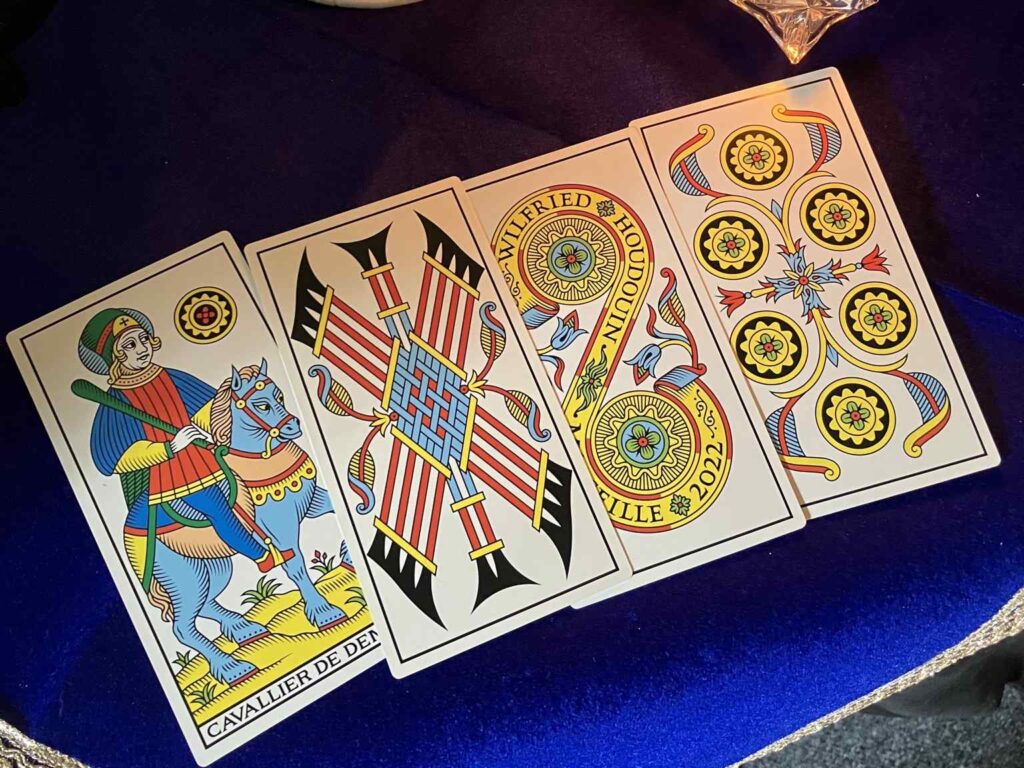
    four tarot cards from the millennium edition marseille tarot on a blue velvet cloth

    Four Cards

    After praying, I drew four Tarot cards.

    Not with any particular spread.

    Just a conversation with God.

    Knight of Coins

    I asked what I had learned in that lifetime.

    I’ve always associated this knight with the Fixed Earth sign Taurus. What I saw wasn’t simply diligence or perseverance. I saw vocation.

    Knowing who you are.

    Knowing what your day is for.

    Belonging.

    Ten of Wands

    This card broke me.

    In the Tarot de Marseille, the crossed wands create something that resembles a barred gate.

    I couldn’t stop looking at it.

    The message felt simple.

    You can’t go back.

    The gates are barred.

    Things have moved on.

    The form your vocation once took is no longer available.

    That realisation carried a grief I hadn’t expected.

    Two of Coins

    Then the conversation changed.

    The Two of Coins isn’t enclosed.

    It moves.

    Exchanges.

    Circulates.

    Perhaps the invitation isn’t to recreate the cloister but to carry its spirit into ordinary life.

    To step beyond the walls.

    To engage with the world instead of retreating from it.

    That feels far more daunting than disappearing behind monastery walls ever did.

    Six of Coins

    The final card answered the prayer I had begun with.

    Sisterhood.

    Not followers.

    Sisterhood.

    Women carrying one another’s burdens and praying together.

    My Body is Asking a Question

    I don’t know exactly what the connection is between emotional pain and osteoarthritis. Bodies are complicated, and I have no desire to oversimplify either medicine or spirituality.

    But I couldn’t help noticing the symbolism.

    My hips, the joints that carry us forward, have reached the point where one needs replacing, and the other will likely follow. Then, just as I began building upper body strength in preparation for surgery, my right shoulder reminded me that it too has limits.

    Whether that’s coincidence or something more, I honestly don’t know.

    What I do know is that my body is forcing me to ask questions I’ve spent years avoiding.

    Questions about how I move through life and what I’m carrying.

    Questions about why I’ve always believed I had to carry it alone.

    My Mother

    As I sat with these thoughts, I found myself thinking about my mother.

    She left my abusive father when I was very young.

    She carried wounds from her own childhood that were never given the chance to heal properly.

    I remember her saying more than once that she wished she could join a convent.

    A couple of years before dementia took hold, she told me she was eternally twelve.

    Not long afterwards, her life began unravelling in ways none of us could stop. She eventually became homeless before the police found her and reunited her with my sister in Sweden. By the time I visited her in the care home two weeks before she died, she no longer knew who I was.

    Looking back, I don’t think she ever found a place where she truly belonged.

    Perhaps that’s why her longing for the convent has stayed with me all these years.

    And maybe I’ve been looking for the same thing.

    God-Substitutes

    Looking back over my own life, I can also see another pattern.

    I’ve been wondering whether some of the relationships I invested so much hope in were really attempts to recreate a sense of sanctuary. I don’t mean that the feelings weren’t genuine. They were. But looking back, I can see that I was sometimes asking another human being to become a God-substitute: to provide the sense of safety, certainty, belonging and homecoming that I couldn’t find within myself.

    That’s far too heavy a burden for anyone to carry. No relationship can bear the weight of becoming someone else’s monastery.

    That’s why those relationships could never carry what I was asking of them. Not because the people themselves were lacking, but because I was asking them to fill a space that only God could fill.

    A Different Way Forward

    One of the hardest things I’ve had to admit this morning is that I can’t keep doing everything on my own.

    Perhaps that’s the deepest lesson hidden in these four cards.

    The story doesn’t end with the barred gate.

    It moves from the burden of the Ten of Wands to the exchange of the Two of Coins and finally to the generosity of the Six of Coins.

    From carrying everything alone…

    to a fair exchange.

    When I lit that pink candle this morning, I asked God to show me a way forward.

    I expected another solitary path.

    Instead, I was shown people.

    Whether I’m ready for that is another question.

    I’ve spent so much of my life believing I had to carry everything alone that accepting help feels strangely unfamiliar.

    Perhaps that’s where the real work begins.

    I wish I could tell you that drawing those four cards resolved everything.

    It didn’t.

    Old fears don’t disappear in a single morning. Neither do old patterns.

    But something shifted.

    Instead of trying to force the gates open, I found myself wondering what might happen if I simply turned around.

    purple lisa signature

  • Iamblichus: How Reading On the Mysteries Led Me to a Spiritual Homecoming

    Iamblichus: How Reading On the Mysteries Led Me to a Spiritual Homecoming

    I wasn’t expecting to cry while reading Iamblichus. What began as an exploration of theurgy became something far more personal—a recognition that I’d been walking towards this moment for years without fully realising it.

    Mercury is retrograde, and it was retrograde when I was born. Over the years, I’ve noticed a pattern. While many people associate Mercury retrograde with communication mishaps and travel delays, my deepest spiritual insights often seem to arrive during these periods. They invite me to revisit old questions, rediscover forgotten wisdom and notice the threads that have quietly been weaving through my life all along.

    This year, another pattern revealed itself. My reading of On the Mysteries by Iamblichus has coincided with the Three Weeks (Bein HaMetzarim), the traditional Jewish period of introspection leading to Tisha B’Av. I don’t assume that every symbolic convergence carries cosmic significance, but occasionally two streams seem to flow together in a way that feels deeply meaningful.

    Mercury retrograde invites reflection, revision and return. The Three Weeks call us to self-examination and metanoia. Together, they have created the perfect inner landscape for asking deeper questions than I’ve perhaps ever asked before.

    Looking back, I can’t think of a more fitting season for what has been unfolding within me. Rather than feeling delayed or blocked, I feel invited to listen more carefully than ever before. This Cancer season is taking me into deep remembering and a spiritual homecoming that has, perhaps, been waiting for me all along.

    As I worked my way through The Epistle of Porphyry to Anebo, something unexpected happened. I found myself reading the very same questions I have been pondering for decades.

    Question after question, I found myself thinking, Yes… exactly. That’s what I’ve been trying to understand.

    Porphyry asks about ritual, divine beings, astrology, fate, free will, prayer and the relationship between the soul and the gods. He questions whether theurgy can genuinely unite us with the divine or whether philosophy alone is sufficient. They’re the very questions I’ve been carrying, in one form or another, for as long as I can remember.

    I hadn’t even reached Iamblichus’ answers before I realised something else.

    I have so much more to learn.

    That wasn’t a discouraging realisation. Quite the opposite. It felt strangely liberating. Instead of pretending I understood more than I did, I found myself doing something I hadn’t planned. I lit incense as an offering to Hermes and read the Twenty-Eighth Orphic Hymn, asking simply for help in becoming a better student.

    Not a master.

    A student.

    Ever since my first Saturn return, I’ve been travelling back and forth between esoteric and mystical Christianity, exoteric religion, the New Age and witchcraft. Each tradition held part of what I was searching for, but none felt like home in quite the way I hoped. They all offered gifts, yet something always remained unresolved.

    Even the recent decision to lay aside the magical name Tanit and embrace Tamar now feels like part of the same process. At the time, it was an act of discernment about name meanings. In hindsight, I can see it wasn’t simply about changing a name. It was about allowing an old identity to fall away so that something more authentic could emerge.

    Reading Iamblichus, I realised that what I’ve been searching for wasn’t another system.

    It was a way.

    Looking back, I can see that the desire has always been the same. Whether I was replacing the elemental Watchtowers with the Archangels, exploring mystical Christianity, studying angelic magic, practising Psalm magic or searching through ancient texts, the goal was never power for its own sake. The goal for me was always to use ritual to be closer to God-Source and the gods.

    I wasn’t looking for a path that rejects ritual in favour of pure contemplation, nor one that mistakes elaborate ceremony for spiritual depth. I’d been searching for a path where the body, the heart and the soul all participate. Where prayer and contemplation are inseparable from symbolic action. Where correspondences aren’t tools for controlling the divine but invitations to participate more fully in divine reality. And with all my heart, I wanted to love both God-Source and the gods as they revealed themselves to me.

    If I had to describe it today, I’d probably say it’s Mary Magdalene meets Iamblichus.

    Or perhaps, Iamblichus read through the heart of someone whose deepest longing has always been love rather than power.

    Because if this journey has taught me anything so far, it’s that the goal has always been communion.

    Communion with the Divine through prayer, contemplation, study and ritual. A way of allowing both body and soul to participate in grace.

    And perhaps that’s why I found myself in tears more than once this Cancer season.

    Not because I’d finally found all the answers, but because I finally remembered the right questions.

    Every step, every prayer, every ritual, every season of wandering had been leading me towards the same Light.

    Christ, the Light on the Way.

    Hekate, the Light in the Shadows.

    purple lisa signature
  • 7/7 Portal Musings: Psalm 77, The Chariot & Synchronicity

    7/7 Portal Musings: Psalm 77, The Chariot & Synchronicity

    Portal schmortal. I must admit, I sometimes wonder if these numerology portals are just New Age nonsense. That said, I have paid attention to some of them when intuition nudged me to, especially the triple portals where the day, month and year all carry the same number.

    I decided to dig around in memory for when the 7th of July was a triple portal. That would have been in 2023. My memory isn’t great, so I looked through my blog posts over on angelorum from July 2023. It was a busy month of blogging, apparently, and about half the posts no longer resonate.

    While I found nothing on the day itself, I did find a 777 portal tarot spread from the 5th of July. If you resonate strongly with number portals, you might wish to take this spread for a spin today.

    7/7 Psalm Magic

    I also decided to look up Psalm 77. According to Anna Riva, in Powers of the Psalms, this is a psalm to use against despondency and lack of faith.

    That kind of synchronicity speaks to me far more than the idea of a numerology portal. In July 2023, I was still in the throes of religious trauma recovery, trying to write my way through it. Hence, the copious amount of blog posts that month. This was and still is my neurodivergent way of coping with any form of trauma.

    Looking back, I can see that the real issue wasn’t a lack of faith in God so much as a lack of faith in myself. I hadn’t yet learned to trust my own discernment.

    The Chariot

    Perhaps that’s why The Chariot came to mind this morning. As the seventh Major Arcanum, and traditionally linked with Cancer, it speaks of harnessing opposing forces and moving forward with intention. The Chariot doesn’t succeed through brute force but through inner alignment. When our will and our deeper purpose pull in the same direction, life begins to move again.

    For so long, childhood abuse, abandonment and trauma left my will feeling broken. Without knowing and trusting our own will, we easily fall prey to doubts and despondency.

    A Reading About Despondency

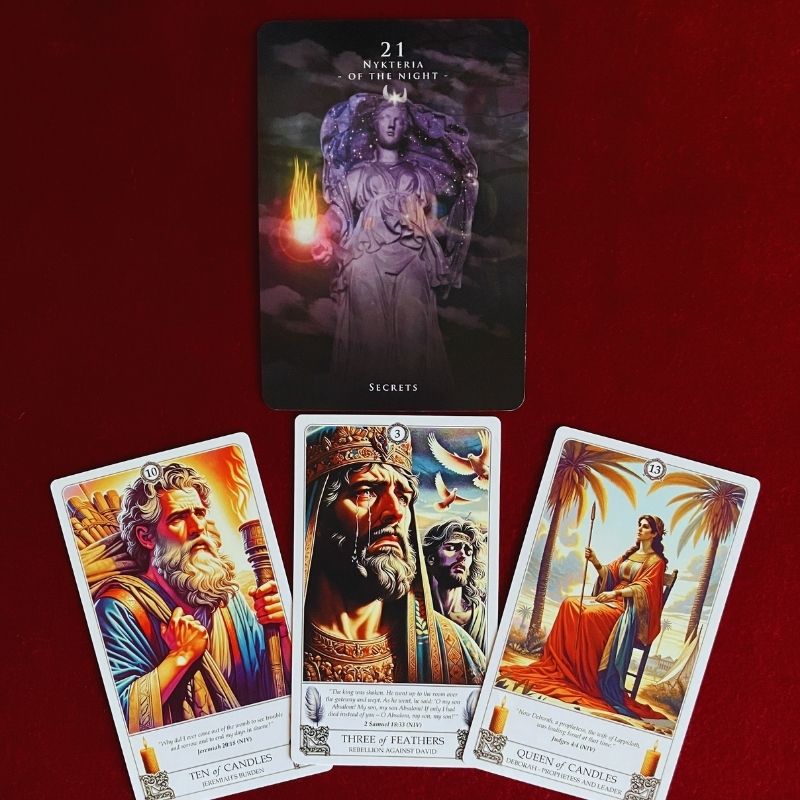
    Yesterday, I spoke to someone near and dear to me. They were feeling very despondent, so this morning I lit a candle and read the Psalm over their situation. I also pulled some cards for them. I love how clearly the Oracle of the Hekatean Path and the Biblical Tarot spoke to the situation.

    Tarot and oracle reading for 7/7 featuring Nykteria of the Night from the Oracle of the Hekatean Path above the Ten of Candles, Three of Feathers and Queen of Candles from the Biblical Tarot on a deep red cloth.

    The 10 of Wands (here called Candles) testify to the state of feeling at the end of one’s tether and simply not knowing if one has the strength to carry on. The 3 of Swords (here called Feathers) shows that there is a real need to shed some tears. Tears can remove blockages and relieve tension so that we can breathe again.

    The final card, the Queen of Wands/Candles, is how I see this person. They are much more resourceful than they think they are, and so very beautiful, artistic and charismatic. Yesterday, I found myself reminding them how very loved they are, and it boggled my mind that someone so stunningly beautiful would ever need such a reminder. Yet that’s what despondency does. It blinds us to our own light.

    But it also showed me that they will bounce back very soon, and that filled me with hope. It also reminded me of all the times I bounced back from the pit of despair.

    Whether or not 7/7 is really a “portal” almost feels beside the point now. This morning became a doorway for me, not because of numerology, but because it invited me to look back and notice how much has changed. Three years ago, Psalm 77 would have described my own heart. Today, it became a prayer for someone else. That’s the kind of synchronicity I trust. Not one that tells me what to believe, but one that quietly reveals how far I’ve come.

    purple lisa signature

  • The Day Hekate Interrupted My Housework: A Clairaudience Experience

    The Day Hekate Interrupted My Housework: A Clairaudience Experience

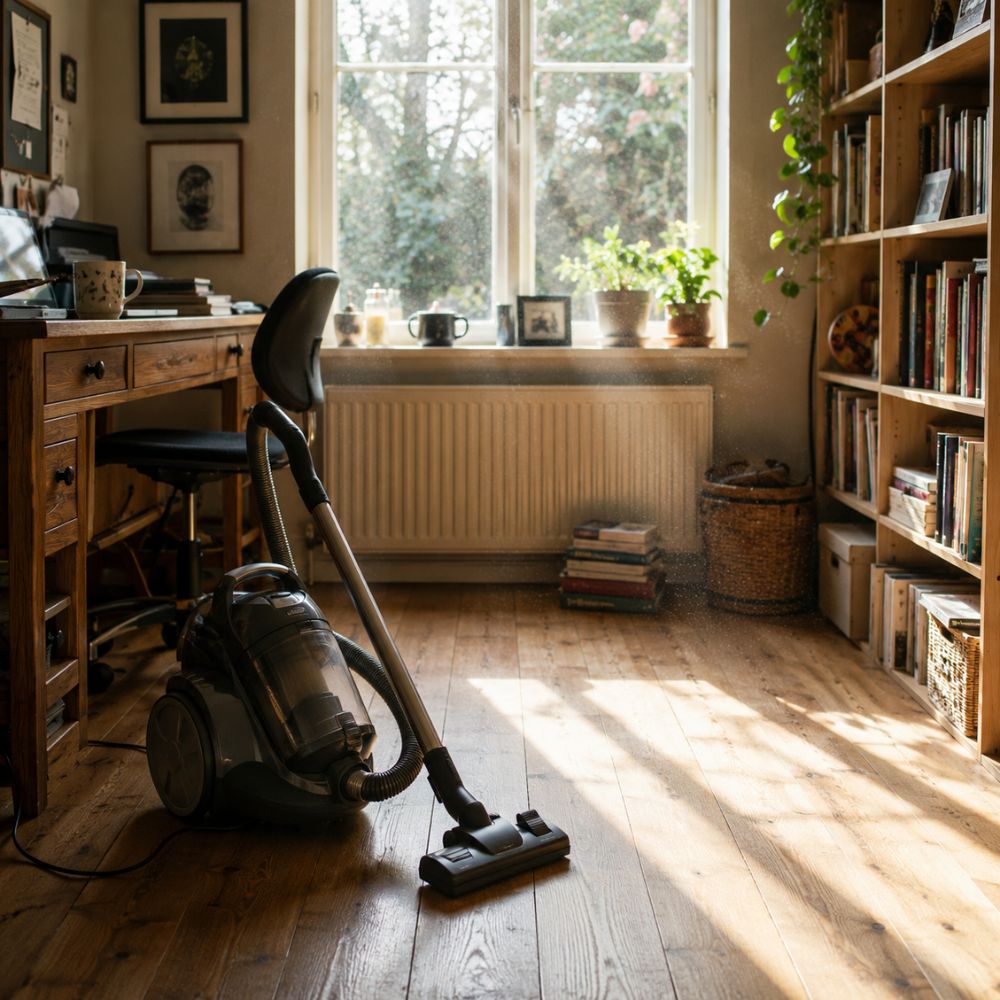
    Sunlit home office with a vacuum cleaner paused on a wooden floor, surrounded by bookshelves, plants, and a writing desk. Warm morning light streams through the window, illuminating floating dust motes and creating a calm, contemplative atmosphere that reflects the ordinary setting of an unexpected spiritual experience.

    Last autumn, Hekate interrupted my housework with clairaudience.

    I wasn’t meditating. I wasn’t praying. I wasn’t performing a ritual beneath a full moon.

    I was cleaning.

    That probably doesn’t sound very impressive. Popular culture has conditioned us to expect spiritual experiences to arrive with dramatic special effects. If the Dark Mother wants to speak, surely there should be incense, solemn chanting, and at least one mysterious raven perched nearby.

    Instead, I was dusting surfaces, putting things away and moving my hoover rhythmically back and forth across my office floor.

    Then, for roughly half an hour, I had what I can only describe as a god-phone.

    I’ve always been intermittently clairaudient. I don’t have it on tap. I can’t summon it at will. In fact, the harder I try, the less likely it seems to happen. The experiences arrive when they arrive, often at inconvenient or unexpected moments.

    This was one of those moments.

    As often happens with a neurodivergent brain, I slipped into a deeply absorbed state while cleaning. Not in trance exactly. Just focused enough that the constant chatter of ordinary thought had faded into the background.

    Then a voice arrived.

    Not an audible voice in the room. Nothing like that.

    The experience was closer to receiving complete thoughts, fully formed, carrying a distinct personality and presence that felt separate from my own internal dialogue. The answers arrived before I had properly finished forming the questions.

    “Who are you?” I asked.

    “Hekate.”

    The reply was immediate.

    What followed was one of the most unusual conversations of my life.

    Every question seemed to receive an answer. Not just information, but understanding. There was a warmth to the exchange that surprised me. Wisdom without judgement. Clarity without pressure.

    One of the things she told me was that I needed to learn to trust myself before we could properly work together.

    That landed harder than it might sound.

    At the time, I was still at the tail end of recovering from decades of religious trauma. Much of that journey involved learning to trust my own perception again after spending a lifetime outsourcing authority to other people, systems, and beliefs.

    Trusting a deity is one thing.

    Trusting yourself is another.

    At one point, I asked a question that had been sitting quietly in the back of my mind for some time.

    Are you and Santa Muerte the same being?

    The answer came immediately.

    “We are sisters, and she is handing you over to me now.”

    That answer surprised me.

    Santa Muerte had been an important presence in my spiritual life for some time. I felt extremely devoted to her. Hekate had been calling for even longer, but I had resisted her. If I’m honest, part of that resistance came from the fact that she seemed too popular. Another part came from fear. Public devotion to Hekate felt more vulnerable somehow. There is nearly as much gatekeeping around Hekate as there is around Evangelical Christianity.

    Yet here she was, apparently explaining a transition that was already underway.

    The strangest part is that, looking back now, she was right.

    At the time, Hekate was not the central focus of my spiritual practice.

    Today, she is.

    The shift happened gradually. Hekate Drakaina was born. My understanding of the crossroads deepened. My life (hello menopause) and work increasingly centred around themes of transformation, sovereignty and what I now think of as the World Soul.

    The conversation wasn’t predicting the future in the fortune-telling sense.

    It was describing a process already unfolding.

    That experience also changed the way I think about clairaudience.

    Most people expect spiritual communication to happen during ritual, meditation, or prayer. Those certainly can create the conditions for it. Yet many of the people I’ve spoken to over the years describe receiving insights while walking, driving, gardening, showering, or doing housework.

    There seems to be something about repetitive activities that opens a different kind of space.

    The doorway stands open for a moment.

    Whether you interpret experiences like mine as communication from a deity, the subconscious mind, the higher self, or something else entirely is ultimately up to you.

    I can only tell you what happened.

    I was cleaning the house.

    A conversation began.

    The answers carried a wisdom and warmth that felt unlike my ordinary thoughts.

    And nine months later, the shift she described has quietly unfolded.

    The gods, if they choose to speak, don’t always wait for sacred circles and carefully planned rituals.

    Sometimes they interrupt your housework.

    purple lisa signature