
A few days ago, I prayed to Physis.
I had been thinking increasingly about embodiment and the role of the physical body in spiritual practice, particularly through my study of Iamblichus and theurgy. The more I read, the less interested I became in any spirituality that treats the body as something we must overcome in order to reach the Divine. I wanted to understand what it means to encounter the sacred through matter, through nature and through the body itself.
So I turned to the Orphic Hymn to Physis.
I knew, intellectually at least, that the Physis of the ancient world was not the sanitised Mother Nature of modern spirituality. In the Chaldean and later Neoplatonic tradition, Physis could be understood as the nature-facing manifestation of Hekate-Psyche, the cosmic World Soul. She is the generative power of Nature in its totality: creation and destruction, growth and decay, life and death.
When I first encountered Physis, she immediately reminded me of Santa Muerte.
Not because I believe they are the same being, but because both confront me with something modern spirituality often prefers to look away from. Nature does not only give birth. She devours. Bodies grow, flourish, age, break down and die. The same force that pushes the first green shoots through the soil eventually reclaims everything that lives.
There was something about Physis that felt utterly unsentimental in the same way Santa Muerte does. Neither allows me to pretend that death is somehow separate from life.
Apparently, knowing that intellectually is not the same thing as knowing it in your bones.
Within the next couple of days, severe pain and rapidly diminishing mobility brought me into an encounter with my own physical vulnerability that frightened me more than I care to admit. At its worst, I wasn’t contemplating embodiment or thinking profound thoughts about theurgy.
I was terrified.
And somewhere in the middle of that terror, I began to understand what it might mean to see the face of Physis.
When I Called Out to Jesus
By then, this was no longer an interesting philosophical exploration of embodiment.
My world had become very small, very quickly.
I am already waiting for a hip replacement because of severe osteoarthritis in my left hip. But suddenly my right hip had become excruciatingly painful too. The pain was deep in my groin and at times felt like a knife. Walking became increasingly difficult. Finding a position in bed where I could rest comfortably became impossible.
One night the pain became so severe that I called NHS 111. That led to an urgent care appointment in the middle of the night.
My husband drove me to hospital while I sat there wondering what on earth was happening inside my body. There was concern that there might be a hairline fracture or some other new problem with my hip. I was given morphine for the pain and told to see my GP the following morning and arrange another X-ray.
So that’s what I did.
The next day I saw my GP and was sent for an urgent X-ray. Then came the waiting.
Waiting for somebody to take the images. Waiting to find out what they showed. Wondering how I was supposed to move around safely when both hips now hurt. Waiting while my imagination supplied all the possibilities that nobody could yet rule out.
Meanwhile, my physical world continued shrinking.
Walking the dogs had already become impossible. Getting around the house was becoming an ordeal. At one point, the prospect of getting from my bed to the bathroom frightened me, even though it is only a few steps away.
I had gone from thinking about the body philosophically to discovering just how much of my sense of freedom had always depended upon a body that could carry me where I wanted to go.
And that frightened me more than I knew how to handle.
The following morning, I reached rock bottom.
I was in pain again and overwhelmed by fear. I didn’t feel brave or wise. And I certainly didn’t feel like somebody who had spent years studying Tarot, spirituality and the Western Mystery Tradition.
I felt helpless.
And I cried out:
“Jesus Kristus!”
Not Jesus Christ. Jesus Kristus, in Swedish, despite even dreaming in English after living in the UK since 2002.
I’ve thought a lot about why Jesus Kristus was who I cried for in my deepest agony.
There was no theology involved in the moment itself. I didn’t consciously choose which deity, angel or divine power would be most appropriate to invoke. There was no ritual and no carefully constructed prayer.
I simply called out to the face of God I trusted most completely.
Jesus as Saviour.
And afterwards I began to understand why.
For me, Jesus represents unconditional love, healing and forgiveness. He is the one I trust never to turn away somebody who comes to him sincerely. It doesn’t matter how frightened, confused or imperfect they are. They don’t have to make themselves presentable first.
I keep thinking about the thief crucified beside him.
The man had absolutely nothing left with which to prove himself. It was too late for this thief to turn his life around. He couldn’t perform good works or demonstrate his spiritual worthiness. He was dying. All he could do was turn towards Jesus and ask to be remembered.
And Jesus received him.
There is something about that story that cuts straight through spiritual performance.
I’ve become increasingly aware of my own tendency to perform in spiritual spaces online. I can see it easily enough when other people do it: the beautiful surroundings, immaculate altars, glossy self-portraits and carefully curated lives of people who appear to have their spiritual shit completely together.
I’m sick of competing with it.
More importantly, I’m sick of the part of myself that believes I have to compete with it.
Perhaps this is one reason the Jesus of the Gospels has become so important to me again. There is a realness about him that I find enormously attractive. Jesus doesn’t lick the boots of the powerful. He doesn’t appear particularly impressed by status at all. In fact, some of his harshest words are directed towards religious authorities who use outward righteousness and position to elevate themselves above everybody else.
His attention repeatedly goes in the opposite direction.
Towards the sick. The poor. The frightened. The grieving. The socially unacceptable. The morally compromised. The person making a scene. The person whose body is bleeding, diseased or failing.
Jesus touches people others consider untouchable.
He sees through reputation, appearance and social standing to the human being underneath.
He treats people as embodied souls of equal value.
That matters enormously to me.
As an AuDHD person, I know what it is to monitor myself, adapt myself and present versions of myself that work in a particular social environment. Spiritual spaces aren’t immune to that dynamic. Sometimes they simply provide more elaborate costumes.
But there was no costume left when I cried Jesus Kristus.
I wasn’t a Tarot reader or blogger. I wasn’t a student of Agrippa and Iamblichus. Gone were all signs of attainment.
I was a frightened woman in a hurting body who wanted her God.
And perhaps that was part of seeing the face of Physis too.
She stripped the abstraction out of embodiment.
My body wasn’t an interesting component in a theurgical cosmology anymore. It was the body in which I was trapped in the middle of the night when I couldn’t make the pain stop. It was the body being driven to urgent care. The body needing morphine. It was being X-rayed. It was waiting for somebody else to tell it what was happening inside it.
And underneath all of that fear was something even more frightening that I hadn’t yet named.
Mortality.
The Cards Told the Same Story
This morning, feeling considerably better and finally able to look back on the events of the past few days with some perspective, I reached for my cards.
I wanted to hear from the divine powers that had become so intimately woven into the experience. I wasn’t looking for predictions; I just wanted to understand what had happened.
First, I asked for a message from Physis, as an aspect of Hekate.
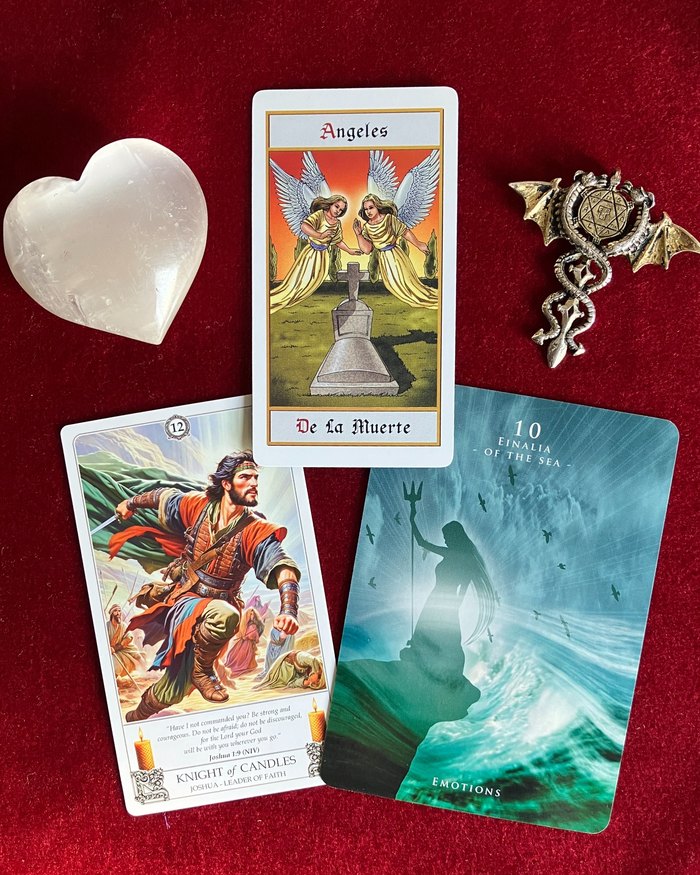
From the Oracle of the Hekatean Path, I pulled Einalia.
I actually laughed when I saw it.
Einalia means “of the sea” and represents Hekate in her sea-facing, deeply elemental aspect. For me, she also speaks beautifully to Hekate-Physis: consciousness encountering the vast, uncontrollable forces of embodied Nature.
More importantly, this wasn’t the first time Einalia had appeared.
I had pulled the same card on the day I prayed to Physis.
At the time, I understood it primarily as a message about embodiment. Now I saw another layer entirely.
The sea doesn’t simply represent the body. It mirrors what happened to me emotionally when I was forced to confront the reality of having one.
I was overwhelmed.
There is an enormous difference between accepting intellectually that we are embodied, mortal creatures and suddenly experiencing the vulnerability of that condition. Two days ago, and again yesterday morning, I felt as though I had been swept out to sea.
My usual sense of control disappeared.
Perhaps this is what it means, psychologically and spiritually, to look upon the face of Physis.
Nature is beautiful, but she is not safe. She creates bodies knowing that every one of them will eventually fail. She gives life and takes it back again. We can romanticise her while our bodies are working well enough to allow us that luxury. It becomes considerably harder when Nature begins expressing herself through pain, limitation and deterioration in our own flesh.
Then I asked Christ for a message.
I pulled the Knight of Candles — Joshua, Leader of Faith, from the Biblical Tarot.
The message printed directly on the card could hardly have been more appropriate:
“Be strong and courageous.”
Courage.
That stopped me.
Because courage was precisely what I had discovered I didn’t have.
When I was frightened enough, all my ideas about being strong collapsed. I couldn’t reason myself into courage. Nor could I summon some heroic spiritual version of myself capable of serenely accepting whatever was happening.
I called for help.
Jesus Kristus.
And perhaps that is another thing I had misunderstood about courage.
Courage doesn’t necessarily mean being unafraid. Sometimes courage is admitting that you are terrified and reaching for the hand you trust to hold yours anyway.
The Knight of Candles didn’t feel like Christ chastising me for my fear.
It felt like an answer to it.
And then I reached for the Tarot de los Angeles.
The card I pulled was Angels of Death.
Of course it bloody was.
By that point, the reading could hardly have been more explicit if the cards had assembled themselves into a PowerPoint presentation.
Because Death was what had been standing behind the entire experience.
I wasn’t dying. But for perhaps the first time in a very long time, I felt mortal.
There is a difference.
The more limited my body became, the closer Death felt.
Every physical freedom I temporarily lost seemed to remove another layer of insulation between me and the knowledge that this body is finite. I couldn’t simply decide to walk farther or decide not to hurt. I couldn’t make my joints work through force of will. Heck, I couldn’t even find a comfortable position in my own bed.
My body had limits.
And if it had limits here, it had an ultimate limit too.
Death.
Suddenly the three cards in front of me looked less like separate messages and more like a map of what I had just lived through.
Einalia: the overwhelming encounter with embodied Nature.
The Knight of Candles: the call to courage, and my discovery that when my own courage failed, I reached instinctively for Christ.
The Angels of Death: the truth hiding underneath my terror.
I had prayed to Physis because I wanted to understand embodiment more deeply.
I don’t think I realised quite what I was asking.
The answer didn’t arrive as an intellectual insight about the role of matter in theurgy.
It arrived through my own flesh.
And when my body frightened me enough to strip away everything I thought I knew about myself, I found myself face to face with two things I could no longer intellectualise:
my mortality and my God.
Nothing to Do with It
Today I feel much better. The fear has receded enough for me to see what happened without being swallowed by it.
And strangely, what I feel most of all is gratitude.
Not gratitude for the pain. I won’t romanticise that. Pain hurts, disability limits us and fear can reduce the whole universe to the few feet immediately surrounding our bodies.
I’m grateful for what became visible when everything else fell away.
For a few hours, I saw my own soul without the presentation layer.
There was no spiritual persona to maintain. No need to appear knowledgeable, courageous or enlightened. No beautiful ritual setting or carefully chosen words.
There was simply a frightened human being confronting the reality of her own physis.
And underneath all those layers, I discovered that I still trusted Love.
When I could no longer perform strength, I called for Jesus.
That knowledge feels precious to me.
I don’t feel any need to turn what happened into a new spiritual identity or to announce that I have somehow become more authentic. That would be far too easy. Even vulnerability can become another performance if we start arranging it carefully enough for other people to admire.
I want something simpler than that now.
I want to allow whatever is real to emerge in its own time.
Perhaps that is another gift of Physis. Nature doesn’t perform authenticity. A tree doesn’t try to look convincingly tree-like. The sea doesn’t worry whether anybody understands what it is doing. Bodies don’t maintain spiritual personas either. They hunger, hurt, heal, age, need rest and eventually return to the same Nature from which they came.
For now, I am content simply to have seen something that I cannot unsee.
I prayed to Physis.
And then I saw her face.

Leave a Reply